Politics & Government
Royersford-Spring City Bridge To Close for Approximately Eight Weeks
A public meeting was held Monday to discuss the upcoming closure of the Royersford-Spring City Bridge.



PennDOT and local business owners and residents met at Royersford Borough Hall to discuss the upcoming closure of the Royersford-Spring City Bridge, which was revealed to occur on July 18. The bridge would remain closed for about eight weeks, depending on weather conditions.
"Unfortunately there’s no easy way to do this work," TranSystems designer Michael Cuddy said. "To do work of this scope requires a full shutdown of the bridge. Using all of the accelerated methods we have at our fingertips, we’re looking at a shutdown of about eight weeks. That will involved the contractors crews working 24-7, around the clock in order to accomplish the work around that timeframe."
The project was originally set to be complete by fall of 2011 with only night and weekend closures; however, given the circumstances of new findings of problems in the bridge, crews had to alter the program in order to keep the traveling public safe.
Find out what's happening in Limerick-Royersford-Spring Cityfor free with the latest updates from Patch.
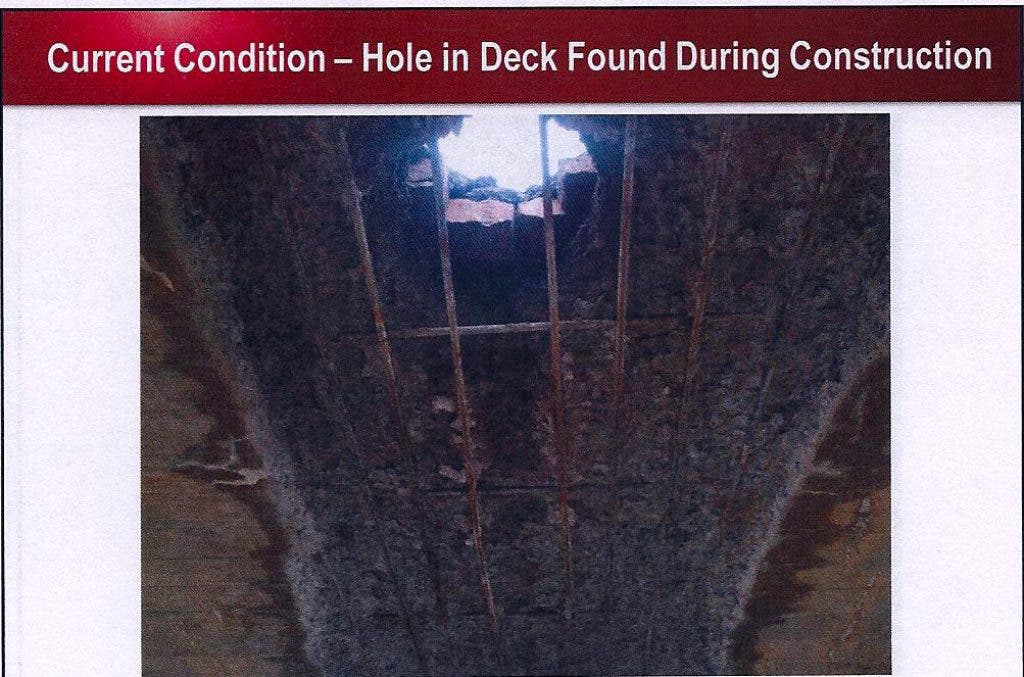
"When we got out there, the bridge was in much worse condition than when we actually thought we were going to find when we got out here," said Steve Laws, assistant construction engineer of PennDOT District 6-0.
In the original plan, existing bituminous wearing course and underlying brick pavers would be removed, original slab would be repaired to provide a quarter-inch deep scarification, latex modified concrete wearing surface of one and a quarter-inch thickness would be installed to the deck; concrete repairs would be done to the arch ribs, spandrel columns and substructure; and support beam retrofit would be done to the floor beams.
Find out what's happening in Limerick-Royersford-Spring Cityfor free with the latest updates from Patch.
In the new plan, much of the same work would be done, along with a power washing of the original slab, the construction of an eight-inch reinforced deck using high performance concrete placed on top of the original slab, and construction of new parapets with pedestrian railings on top.
Much of the work that has to be done has to do with the distress in the wearing surface, causing problems underneath the bridge. Many of the things needing to be done today were performed in an emergency shutdown that lasted a total of six weeks in 2005.
When asked why the problem wasn't fixed in 2005, Cuddy referred back to the emergency shutdown.
“We work within a restrained financial program," Cuddy said. "Part of the difference is the shutdown in 2005 was a complete emergency. One day the hole appeared. There was no time to mobilize the necessary engineering or the contractors to do a repair like this at that time.”
The contractors have already come through and made a saw cut in areas of sound concrete, chipped away all the bad concrete, placed additional reinforcement and then will eventually come through and place repair concrete. All of these repairs were made to the arch's ribs.
"In keeping with our theme of getting in quickly, getting out and then staying out – not having to come back – we’re using the current waterproofing details that comply with PennDOT standards," said Cuddy. "We’re taking all of the steps that we can to make sure we don’t have water infiltration."
PennDOT assured the approximately 50 people in attendance at the Monday meeting that the work would be done as quickly as possible to avoid the loss of business and the interference with the 2011-2012 school year. Townspeople expressed concerns with the validity of those statements, saying the schools hadn't been contacted about this and that in today's economy, businesses may not come out alive.
A member of the school district's transportation department was in attendance and had a lengthy conversation with Laws in regards to the bridge closure to work hand-in-hand. The school district will contact parents with any updates to transportation patterns.
The posted detour would be through Schuylkill Road to route 724 and out to 422 back into Royersford, which is about 15 miles in length. Townspeople also asked about the safety of the children on local detours that aren't posted, such as Phoenixville and the Linfield truss. Officials said they would explore options of changing traffic light timing and ensuring the safety of the children.
During the construction, officials stated that the walkways would also be closed, much to the chagrin of the public. However, once the bridge is done, the walkways will have railings according to regulation and the bridge will have a 25-year lifespan. It will also have no more restrictions and will be able to carry the full legal load, once again.
There are no plans of a tax refund in place for businesses that lose potential revenue and it will be impossible to do one-lane, alternating closures of the bridge, due to safety concerns of ingress/egress of people's driveways, along with the railroad at the end of the bridge.
"That was one of the first options we looked at when we knew this would cause a problem," said Cuddy. "A large part of the reason ties in with the railroad crossing, numerous driveways that go in and out and an average daily traffic volume of 17,000 vehicles a day. There is no safe way we can provide a one-way alternating traffic scenario."
Officials said the project would cost about $18-20 million if the bridge were to be completely replaced. The current project is costing approximately $2.5 million, according to a Tuesday press release. Business owners were guaranteed that once detour signs are posted, a sign would be posted below saying that the businesses along the strip are still open. They were also instructed that they could post their own signs around town with no issues.
Get more local news delivered straight to your inbox. Sign up for free Patch newsletters and alerts.