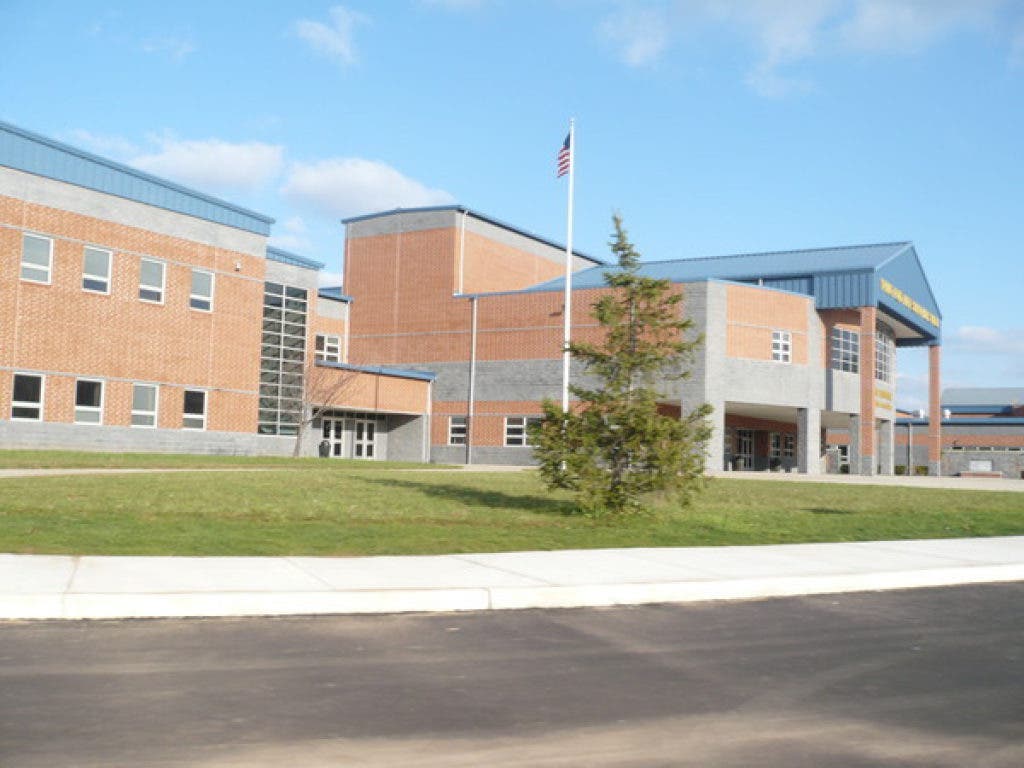
The Area School District board of education discussed what to do with $9.03 million in funds from the at Monday night's meeting. The discussion went on for about two hours.
The conclusion of the talks revealed that the board was preliminarily deciding to spend $3.6 million on capital projects and defeasing the remaining $5.4 million to an escrow account. The money in escrow must sit untouched until 2017.
According to the administration, including Superintendent David Goodin and Business Manager Tim Anspach, the administration is losing 16 cents on every dollar, or $908,000 if the entire amount sits in escrow. Therefore, the more the board uses on capital projects (which is the only allowable use), the less it loses in the long haul.
Find out what's happening in Limerick-Royersford-Spring Cityfor free with the latest updates from Patch.
With the remaining $5.4 million in escrow, the board will be able to save between $300,000 and $400,000 per year over the next five years in debt service. This means that amount would decrease the budget annually until 2017.
Board member Mark Dehnert disagreed entirely with using any money on capital projects. It was Dehnert's understanding that all of the money should go back into escrow so that the budget could be decreased by $600,000 annually until 2017.
Find out what's happening in Limerick-Royersford-Spring Cityfor free with the latest updates from Patch.
Goodin and various board members disagreed with Dehnert's position, saying that the list of repairs and capital projects the board has come up with are things that the district "will, should and could spend money on anyway."
The board took the money out for the high school construction project at over four-percent interest; however, the contractor overestimated the amount needed to fund the project and the board was "burdened" with leftover funds. It was placed into escrow.
The board will only gain back one percent on the money if it sits in escrow, hence the board's overall position to use some of the money, which would have to come out of the general fund. Dehnert was still against the board's desires, voting "no" on every item on the list.
"Some of these things don't have to be done," he said. "When you don't have money, you choose not to do some things. We're facing many difficult budget years. Some of these things are luxary items."
New board President Tom DiBello told Dehnert that his opinion is only one opinion and that the board has been facing difficult budget years since 2009/10.
The board then voted, virtually one-by-one on 48 different capital project items that were listed by various members of the administration. Of the 48, the board decided to pursue 43 of them, calculating to $3,627,439 in capital projects.
Of the agreed projects, one in particular was discussed in length, which was the installation of a wireless network in all schools. DiBello and Ciresi questioned why this wasn't done when the high school was constructed. After the meeting, former board President John Grispon, who no longer serves the board, explained why.
"We used a theory called 'Just in Time,'" he said. "Which means you install the technology when you need it. It usually ends up being cheaper."
The board agreed to deny a few controversial issues, including the installation of a new standalone Fitness/Health Center for male and female students/athletes, which would include bathrooms, and the installation of turf fields. Both issues were noted by Athletic Director Mickey McDaniel as needs for not only the athletic department, but also the student body.
McDaniel said that a field consultant came out a few years ago and made these recommendations for the grass fields to become turf, since it's nearly impossible to grow grass on those fields anymore due to overuse. It was also noted that the drainage on those fields is poor and that it would take $500,000 every year to rebuild the grass fields as is.
"Some physical education classes cannot go out on those fields for weeks at a time because the fields are so wet [and unsafe]," McDaniel said. "The students at the Eighth Grade and Ninth Grade Centers are still, at this point in the school year, using the turf field."
Solicitor Marc Davis also mentioned that adding both the turf field and the fitness center could help resolve any Title IX issues that may arise. McDaniel added that there is more student participation and growth than ever at the schools, and athletics is not the only department needing the new fitness/health center. He explained that the current facilities only allow for about 50 students to use that center at a time, which makes it overcrowded and a liability concern.
Members of the board still shot both items down. Former board member Rick Schroeder approached the board in the public comment section of the meeting about these items.
"I have a lot of good friends and acquaintances up here," he said. "But let me tell you: this last two hours was an abomination of how this process was gone through. I question: Do we have an athletic committee, property committee, curriculum committee, technology committee anymore? Every one of these expenditures should have fallen into consideration at the committee level. And the committee level should have brought it to the board for consideration in coordination with the finance committee as to where these expenditures should fall.
"Every one of these things, were probably discussed in the course of the year or past few years, but in their entirety, $3.6 million was just approved as far as this last resolution or agenda item. The agenda calls to move forward with bids as quickly as feasible. There's some things in here that really haven't been studied. There's one that was a no to and that's the Health and Fitness Center. To me, that made the most sense at a capital reserve level, because it affected the most students within the curriculum. It was obviously a project that fell within the general obligation. And it was just kind of glassed over.
"You have seven periods a day, with 50 students in that facility per period, which gives you a total of accommodating 1,500 students at its maximum capability per week! That doesn't cover your entire student body in this building going forward with larger class sizes. These things should be looked at from a curriculum standpoint. Not only that, from a physical education standpoint, you're rejecting a turf field. Well, an expanded Health and Fitness Center can make up for physical education classes that they can spend in that kind of facility in worse outside conditions.
"So, I'm hoping some of my friends here can look at this stuff and bring it up again at the next meeting to discuss in their totality and individually."
The board has called for a meeting to take place on Dec. 12 at 6 p.m. to finalize the bond defeasement. Patch will have the coverage.
Other items shot down included:
- A system upgrade to the Avaya Phone System, which has reached the end of support. Board members were skeptical in being trapped in a contract with current provider, as well as spending as much as $550,000 on the upgrade with little information to back it.
- Asbestos Removal at the old district office. Board President Tom DiBello added he did not see a return on the investment if the $45,000 was spent on doing this. It was noted by administrators that the removal is mandated by the state, but it was still voted down.
- New lighting, totaling $60,500 at the Ninth Grade Center's tennis courts.
The following items were approved:
- Softball fields: Lighting, grandstands, a press box, a scoreboard and fencing (junior varsity field only) for Title IX compliance.
- Addition of new water fountains at all schools' cafeterias per a state-mandated law.
- Flat roof replacement at , which is out of warranty and leaking.
- Core network equipment upgrade to support the implementation of high density wireless network at all schools.
- Safety issues: Upgrade and 3 Phase Generator for Backup of MDF RM at the high school, parking repaving, replacement of the subflooring and tile in the third floor hallway between Room 324 and Room 326 at the , replacement of one salt truck due to wear and salt damage at the Maintenance Office.
- One new transportation van with handicapped wheel chair lift to be used throughout the district for community-based instruction/field trips/athletics.
- Replacement of LED lights in the gyms and cafeterias of all district schools. It was noted that LED lights would pay for themselves within four to five years.
- ATC/DDC - HVAC for energy savings.
- Band/music equipment, replacement of obsolete equipment for the Golden Ram Marching Band.
- Replacement of Chiller #2 at the high school, which is out of its lifespan - for energy savings.
- Chiller Replacement at because it is out of warranty.
- AC Split system for Studio and Control Rooms at the high school for energy savings.
- Upgrade the fire alarm system at Spring City Elementary School for safety reasons.
- Window replacement due to age and availability at Spring City Elementary School for safety reasons.
- Replacement of cafeteria equipment district wide, which will last 15-20 years.
- Replacement of recently-removed playground equipment for code issues at .
- Relamping of lighting due to age (paying for half the cost. American Legion pays for the other half through partnership formed with them) for energy savings at the stadium and high school.
- Upgrade the card reader system district wide for safety.
- Television studio lighting for energy savings and upgrade at the high school.
- A high jump pit and pole vault pit cover and mat, which both needed replacement in 2011.
- Reconfiguring the lobby and main office areas so all entrants must go through the main office at Brooke Elementary School, which is the only building that does not have this feature.
- A stage storage building for props due to lack of storage for the drama program at the high school.
- Upgrades to the underground exterior wiring at the high school and for safety and age reasons.
- Surveillance system installation to include 10 cameras and a video recorder at the and .
- Wiring from the studio to gym/auditorium at the high school to enhance the educational program.
- Replacement of competition wrestling mats.
- Replacement of remedial gym mats for health and physical education classes as well as athletics.
- A walking path along the road entrance to the Intermediate and Middle Schools for safety.
- Repair of the walking path at Brooke Elementary School.
- Moving lights for the stage at the high school for safety.
- Replacement of old bathroom floor tile at Oaks Elementary School.
- A batting cage at the Ninth Grade Center like the one at the high school, which will no longer interfere with physical education activities during the day.
- A runner's gate to secure the stadium and students after school hours and to not permit trainers/classes to conduct business on Spring-Ford property without permission (ie. kicking schools, etc).
- Driveway lighting along the lower driveway at Brooke Elementary School for safety.
- Parking expansion at Royersford Elementary for more parking and safer conditions.
Get more local news delivered straight to your inbox. Sign up for free Patch newsletters and alerts.