Arts & Entertainment
Where Art Plays Its Part: Volume II: Musician Ted The Fiddler
All for the love of fiddling.
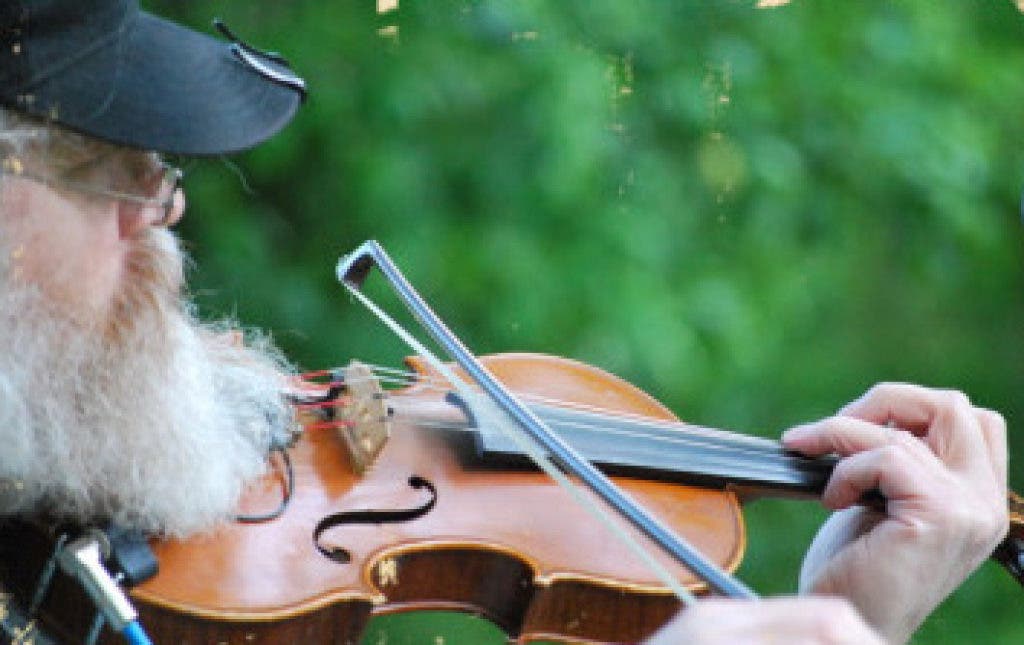


Charmed by whims of sound and song early on in his childhood, Ted The Fiddler has performed all around the country but kept the heart of his music in Spring City for decades.
Ted watched The Glen Campbell Goodtime Hour in the late 1960s and discovered musician John Hartford, soon trying to play guitar and banjo like him.
Seeing a family band known as the Earl Scruggs Revue on PBS while at a friend’s house piqued his auditory interest, too.
Find out what's happening in Limerick-Royersford-Spring Cityfor free with the latest updates from Patch.
“It was one of the first bluegrass style bands with drums,” Ted said. “It broke a lot of ground, and it made a lot of bluegrass fans angry because of the drums, but I was immediately drawn to it because I grew up on rock and roll, Motown, and psychedelic rock.”
When he discovered Vassar Clements behind the violin played in fiddle-form, he quickly learned to appreciate that fiddlers were few and far between. Ted’s own affection for string-spent labors began to blossom around 1971.
Find out what's happening in Limerick-Royersford-Spring Cityfor free with the latest updates from Patch.
From the beginning, he gravitated to acoustic music with rock and roll beats.
“There’s something about acoustic music as opposed to electric music that’s more primal and in tune with the way we are inside our humanness and our bodies,” he said. “People who like acoustic music are more connected to the natural flow of nature and the earth.”
Today, he describes his music as a style of American close to bluegrass. He’s involved with the Phoenixville-based Manatees, who have been around since 1985. A few of his projects are trios known as Stumble Down The Mountain Boys and of course, Ted The Fiddler.
Throughout his lifetime, he’s performed in Texas, New Jersey, Delaware, New York, Maryland, Rhode Island, Massachusetts, Vermont, Virginia, West Virginia, Tennessee, Missouri and Canada. He’s also traveled to play in the Japanese cities of Tokyo and Chiba.
“I toured up and down the East Coast with a Celtic singer for a couple of years, and I toured by myself playing at festivals,” he said.
Most notably on the local level, he’s playing the night of Nov. 12 at in Spring City.
He estimated that he’s written at least 30 of his own songs throughout the years and that he’s performed thousands, joining in 50 or 60 bands either as one-time stints, just briefly or for decades.
“You play music from your soul, like a recording of an emotion,” he reflected. “When you play a song, each time, it gives you the same feeling, if you play it well. The composer of a song was trying to capture something, and that’s often a feeling. Since I often think of a song as a recording of an emotion, when I play the fiddle, it’s very basic—very much a part of me.”
With such a strong penchant for his craft, Ted sometimes helps to produce music and manage bands.
He also does private film showings for parties, as he teaches a course on film appreciation through the Chester County Night School, focusing on the silent era to today.
Up until this past April, he served as the technical director for the Colonial Theatre for 14 years. Now, he’s zeroing in on his music yet again.
In what sets Ted apart from others out there in his field of sound, he explained that plainly, he chooses to play a melody.
“I don’t play wild crazy lines on the fiddle,” he said. “A lot of fiddle players try to show off and show you what they can do. I don’t do that. I just play the songs.”
“In the end, that’s what people want to hear, the music,” he said, looking back on advice he heard 40 years ago at the Philadelphia Folk Festival in Upper Salford Township.
“Son, nobody wants to hear how great you are—they just want to hear the tune,” he said, quoting words thrown his way by Carl Martin of Martin, Bogan and Armstrong of Chicago, one of the last African-American string bands in the U.S.
“If somebody works at a factory or at their job all day long and wants to go out and have a good time, they’ll come out and hear me play,” Ted said, calling himself television of the old days. “My purpose in life is to entertain people and help them get through life, making it a little happier so they can go back and do the jobs that need to be done.”