Arts & Entertainment
Where Art Plays Its Part: Volume III: Formal Poet George Reitnour
George Reitnour offers some worthy introspection on the value of poetry.
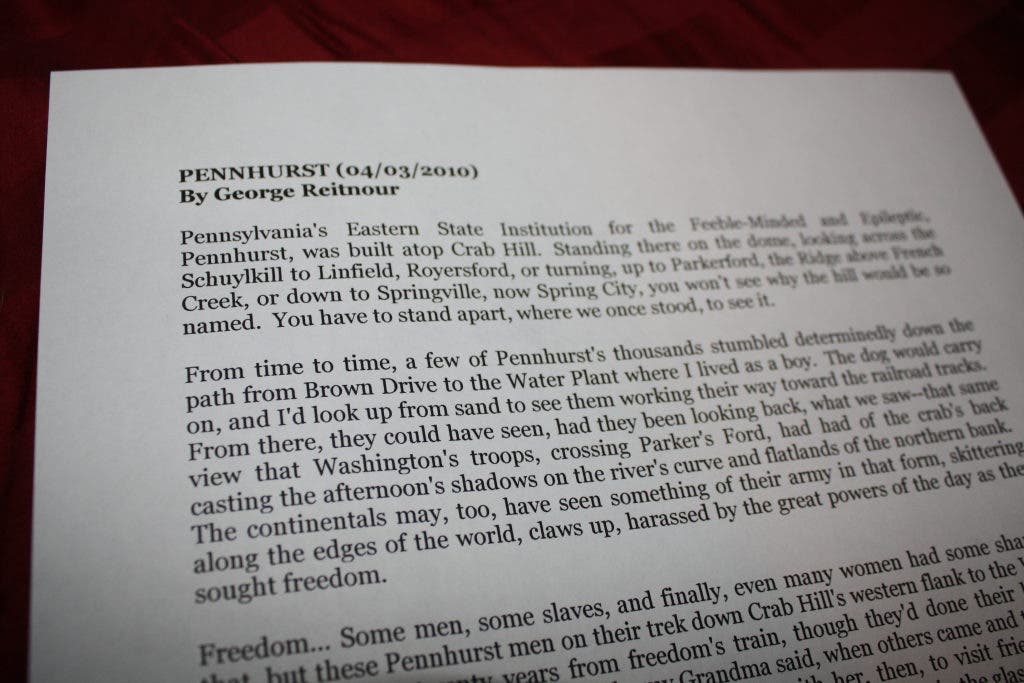


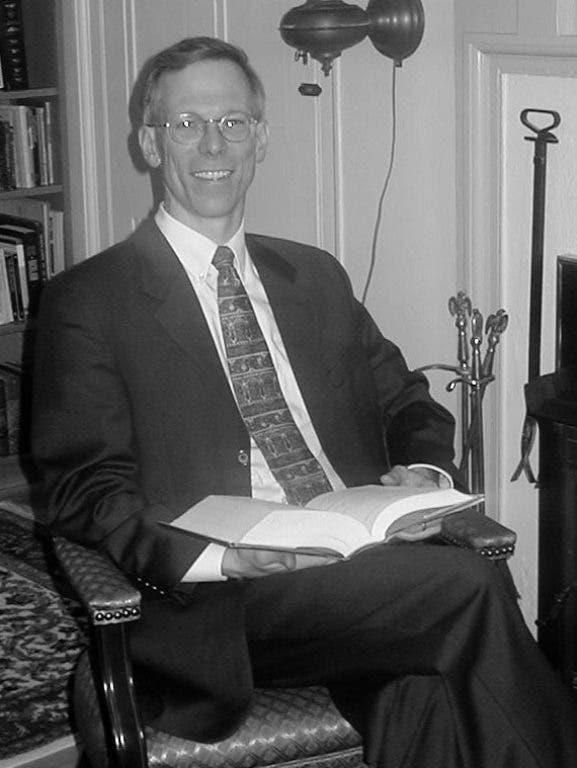

For George Reitnour, the first poems from within him joined the world on paper on Nov. 26, 1975.
Reitnour lived in Spring City until around 1990, but still had a law office there until 2000. He works as a trust officer for National Penn Investors Trust Company in Wyomissing, Berks County and still serves as the moderator of the on Sundays.
Within his different roles over the years, one of the strongest to keep hold of him, pulling at his heart and the writer in him, is that of poet.
Find out what's happening in Limerick-Royersford-Spring Cityfor free with the latest updates from Patch.
As a child, he attended the in Pottstown where in fifth and sixth grade, he and his classmates were required to memorize and recite poems. At the , he studied poetry very introspectively, focusing mostly on the classics.
“I traveled to Japan as an Exchange student with the Spring City Lions Club,” Reitnour said about after he graduated from the Hill School. “When I was there, I kept a diary, and it started to move toward poetry; I began thinking in its terms.”
Find out what's happening in Limerick-Royersford-Spring Cityfor free with the latest updates from Patch.
A few months later, the weekly dedicated writing of poems stirred into Reitnour’s life, with the first as a recollection poem he’s edited quite a bit since then.
“I’m an obsessive rewriter and am editing the poems all the time,” Reitnour said, adding that he’s kept all of his notebooks and is almost up to 50 of them. “I’ve averaged about a poem a day since the time I started writing, so there are well over 10,000 poems.”
He concentrates primarily on formal poetry, often penning haikus, sonnets, villanelles and sestinas. Most of his poems are around 14 lines long, filling up about half of a page.
While a lot of those producing poems today practice a more free form, Reitnour has always been enamored with the substantial mental and emotional challenges of writing formal poetry.
“If you can just write it and say it outright, you don't have to rethink it or be as creative, whereas if you're forced by form, to think more deeply about the poem and the subject, it can help you to be creative if you are not disciplined enough to be creative on your own,” Reitnour said. “A poet who writes in freeform and is very disciplined should in theory be able to produce a poem as well-thought-out as a poem by a poet who is writing in form.
“But for some of us, having form compels us to think where we might be a little lazier than that and to use our imaginations more because sometimes what you want to say just doesn't work.”
To Reitnour, one of the most rewarding aspects of pursuing poetry is the very sound of it.
“It’s the intensity of it. I’m enamored with the sounds and the words—playing with words,” Reitnour said. “I love hearing the sound of it as it’s being read. I have an emotional attachment to poetry because of those attributes.”
The majority of his poems are themed around nature, but in many of them, he manages to ensure that they are boisterous, in the end, given his affection for plosives—consonants with loud, often popping sounds made when they’re vocalized.
“I like the plosives. The consonants each have an effect. I'm very conscious of their effects when I'm writing,” said Reitnour. “Consonants are something very human; most animals don't have them, for instance. You don't hear sheep, dogs or donkeys using consonants. They use vowels, whereas consonants have to do with telling the human story.”
A great example of his penchant for plosives and alliteration is in his 1978 poem titled “Pennsylvania Line,” in which one part reads: “Canal-house child chinned on the third-floor windowsill / Back crooked, brown belly-flesh pressed on plaster / Praying those pinned rails should yield their master.”
Reitnour has had his poetry published in a literary magazine called the Legal Studies Forum, which features poems only by attorneys.
He’s read his poems at , Alvernia University, the community libraries in Phoenixville and West Chester, alongside Kimberton poets and at the Steel City Coffeehouse.
“It brings attention to some things that are in neglect,” Reitnour said in hindsight, about the sometimes unseen necessity of poetry and other forms of art in life, integral to communities. “It helps you to stay alive.”