Schools
Exchange Club Swaps Volunteerism for Gratitude
Western Lehigh organization needs more members to keep going strong.


Generally, when the Exchange Club of Western Lehigh's name surfaces in the news the subject is the organization's holiday basketball tournament at Emmaus High School or the clay shoot fund-raisers.
Sounds like all fun and games, doesn't it?
And club member Jim Lichtenwalner would agree in part, except these games are a means to an end. There is plenty of work that goes into these fund-raisers, but the money raised primarily goes toward the prevention of child abuse and preserving and promoting patriotism.
Find out what's happening in Lower Macungiefor free with the latest updates from Patch.
The Exchange Club is a chapter of a national organization. It primarily is composed of members who live within the East Penn and Parkland school districts, although a few members live outside those boundaries.
Lichtenwalner, a past president and Lower Macungie Township resident, says there is plenty of camaraderie in the club with meetings for planning and socializing. But membership has slipped to about 15, meaning there are fewer to share experiences ... and the work.
Find out what's happening in Lower Macungiefor free with the latest updates from Patch.
"For a club our size, when the national club looks at us, we're at a point where we're considered a distressed club, yet we are an active club compared to many," Lichtenwalner says. "We could accomplish so much more if we could double our membership."
The Exchange Club was started in 1911 in Dayton, Ohio, with the philosophy that people coming together to share and implement ideas can do much more than individuals trying to go it alone, Lichtenwalner says. Interestingly, the club was founded as its focus the intention to convince Americans that flight was safe.
Allentown eventually formed a club, and that group was large enough to form a spin-off organization in 1971 in West Allentown, recounts Lichtenwalner. Continuing with strong numbers, an East Penn club was chartered in 1976.
The Allentown club had about 100 members in 1973, but dwindling membership led to its demise, Lichtenwalner says. Meanwhile, numbers fell for the other two local chapters, which in 1981 merged to form the Western Lehigh group of today.
He says he's not discouraged by the few numbers, but wants to spread the word to try to boost the roster. The club continues to do important work, he says, coming up with good ideas, but without the number of bodies to achieve all of them.
Several factors have led to a downturn, he says. Chief among them are the bad economy and the proliferation of the two-member working household. With both married partners with jobs, there often are fewer hours to join civic clubs or volunteer. And with the recession, some are taking second jobs or working longer hours to keep the position they have.
The economy also has hurt fund-raising. Not only are individuals less likely to dig in their pockets, but sponsorships of the basketball tournament program, for example, are down because businesses have tightened their advertising expenses. It's just more challenging to raise money in this climate, he says.
The club has two monthly dinner meetings at Pickles Steakhouse in Upper Milford Township. Although members occasionally hold other fundraisers, the two primary ones are the holiday basketball tournament and the clay shoot.
The 29th-annual tournament was held over the Christmas break and won by the host Emmaus Hornets. Funds are raised from admissions and advertising from a souvenir booklet, Lichtenwalner says.
Attendance has fallen in recent years and, as noted, business sponsorship is more challenging than ever, yet the event raised about $3,000 a year ago.
The other large fund-raiser has been the clay shoot, which has been held for three years at Lehigh Valley Sporting Clays near Ironton. This event, held in September, works much as a golf tournament in which teams compete by shooting at 19 stations.
In keeping with the national club's mission to help prevent child abuse, the local club provided funds to train staff to interact with families at risk. Lichtenwalner says the club initiated the program that today is administered by organizations such as Project Child of the Lehigh Valley and Turning Point of the Lehigh Valley. The club continues its financial support to these groups today.
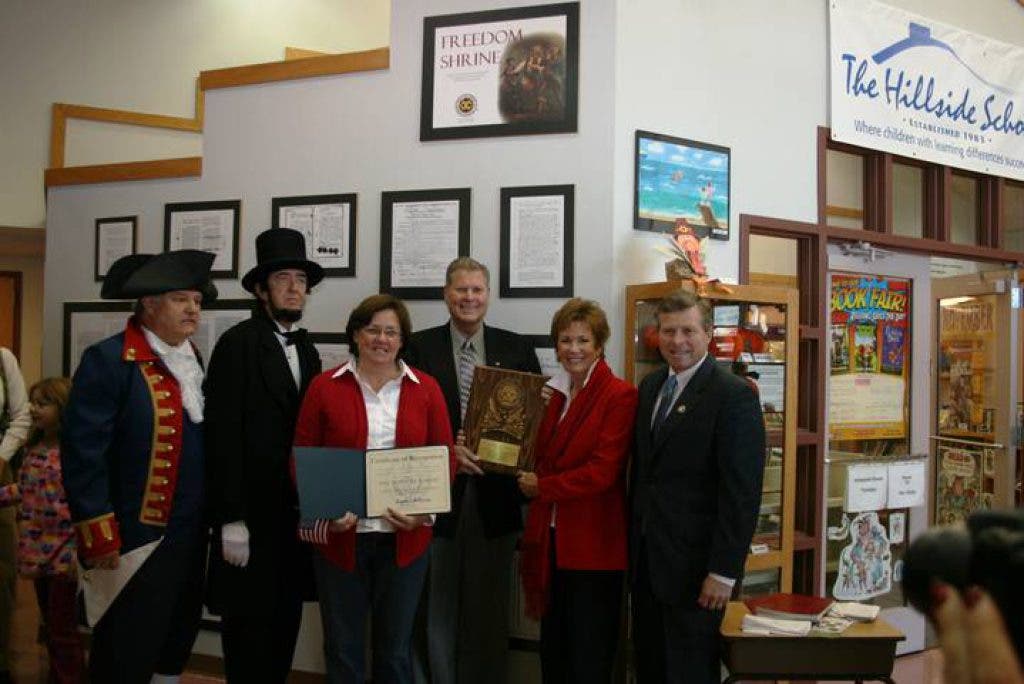
The other largest club program deals with Americanism, Lichtenwalner says. The club has purchased several Freedom Shrines for area schools, most recently the Hillside School in Lower Macungie Township last year. In this case, 30 documents that were instrumental to the freedoms American enjoy were reproduced, enlarged and mounted on 8-by-30-foot interior walls.
These documents, such as the Magna Carta, are used in conjunction with workbooks to teach democratic principles. The club also enlisted the help of some costumed actors to reinforce the lesson to the Hillside students.
"That really put it together to make it entertaining and informative," Lichtenwalner says.
And, the club also offers one scholarship each for Emmaus and Parkland students who excel in providing community service. It also supports the high school basketball summer program.
Lichtenwalner is recently retired from PPL after 39 years as an engineer and project manager. He has extra time now, but has been involved in the club since 1973.
He became involved in service clubs in high school.
"It's just something I think is important," he says. "A good motto to follow is that at the end of your life if you gave at least one more ounce than you took, you did pretty well."
Asked for a top memory or feeling of accomplishment, Lichtenwalner points to a program in which the club organized assistance for a needy family to receive a lavish holiday dinner.
"It was amazing to see the looks on their faces," he recalls. "People usually look the other way in cases like these, but because we were in the home and got a close-up view, it was different. That was touching."
He also points to the experiences offered by child-abuse prevention trainers.
"It kind of opens your eyes," he says. "I think those are the two biggest things ... that give us motivation to keep going."
And so Lichtenwalner and his 14 colleagues continue to gather, despite knowing they fight an uphill battle with dwindling group numbers and community need.
"You might not be able to cure hunger, but maybe you can put a smile on a kid's face," he says in summary. "That's probably the driving force."