Politics & Government
Main Street Macungie to get More Restrictive to Truckers
New signs will note further limitations on trailer size and try to clarify need for rigs to use alternate route.
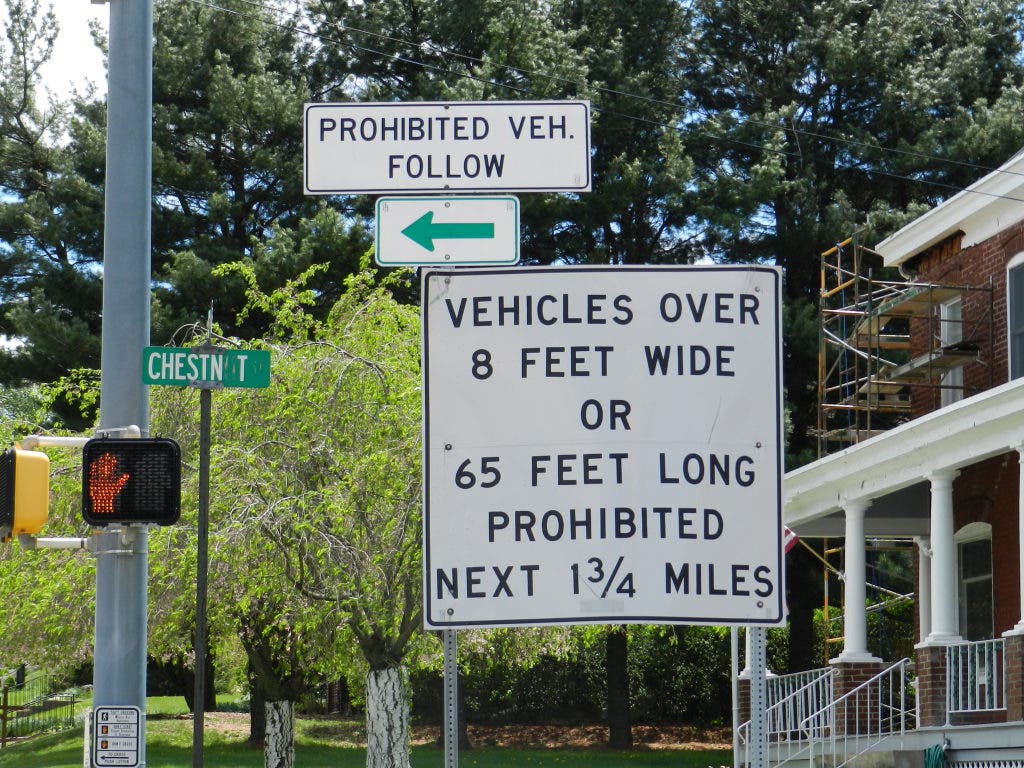


Police Chief Ed Harry has heard a lot of stories from truckers during his five years in Macungie.
They were lost. The didn't see the sign. They saw the sign, but the alternate route is not how they were told to go. They saw the sign, but an alternate route would put them over their allotted trip mileage.
"I get all kinds of excuses," he says.
Find out what's happening in Lower Macungiefor free with the latest updates from Patch.
And then there are the straight-forward responses: "Yeah, I know. My company pays the bill. Just give me the citation." He's heard a bunch of these, too.
Since he got here, Harry has been the protector of the hill on Main Street, writing an estimated 4,500 citations to truckers violating regulations restricting length and width of trucks that may use the hill from Buckeye Road in the borough to Countryside Restaurant in Upper Milford Township.
Find out what's happening in Lower Macungiefor free with the latest updates from Patch.
Pass the area near Fairview Cemetery on a weekday and you are likely to see Harry with a truck pulled over at some point. The cruiser lights will be flashing and he'll be looking up at a trucker in a cab. The only question in his mind is which excuse will be offered.
But the essence of his answer remains pretty much the same: "There really is no excuse," he says.
The restriction is placed on the road by the state Department of Transportation for safety reasons, based on the number of accidents, the grade, the sharp turns and the width of the road, Harry says. It's similar to reasons why an intersection gets a traffic light or not.
He has no statistics to back it up, but offers, "It has to help, safety-wise."
Truckers should be aware of these restrictions through maps or computer programs developed for electronic devices such as GPSes, he says. They should map out a trip in advance; it's all part of the job. And if they don't, they should at least see the large signs noting the restrictions.
"If I'm driving in Ohio, I'm responsible for the laws of that state," he says. "The same is true here."
All this comes to light again because it recently was announced at a Borough Council meeting that new signs -- and new regulations -- will be put in place within a month, Harry says.
Macungie Mayor Rick Hoffman asked PennDOT to review the restrictions, but it took more than a year for the agency to come to Macungie to take a look, Hoffman says.
"When they finally came out to look at the signs, they were deemed "outdated and misleading."
"They're not what truckers are used to seeing," Hoffman says.
There are several problems with pulling over large trucks in the middle of Main Street, he says, including the fact that while a truck is stopped, drivers coming out of side streets who are trying to turn on to Main can't see around them.
PennDOT recommendations were as follows:
* Simplify the wording on the large black and white signs to read: "Prohibited trailers over 45 feet."
* Add signs that designate the alternative roads as a trucker's route. The thinking is that this is a more standard way of notifying truckers of a restriction and might avoid confusion, Harry says he was told.
Significant in the changes is the size restriction. The existing regulation says trucks more than 65 feet long (including the cab and trailer) or 8 feet wide must take the alternate route. The new law says any vehicle more than 45 feet long cannot use that portion of Main Street. There never has been a weight restriction on the section -- nor will there be now -- except noting those that must reduce gear.
"It will actually be more restrictive," Harry says, even though he didn't believe that was the borough's intention in asking for the review.
Harry says the big problem is the length of vehicles. The only "bend" or give is where the tractor and trailer meet. Since a long trailer can't bend, it tends to hang over the edge of the road or middle on the sharp curves, creating a hazard.
History of the restrictions
Harry believes the restrictions date to the 1990s when neighbors complained of accidents along the hill, particularly in the area of the "S" turns in Upper Milford. Today, an assortment of signs attempt to lessen the number of accidents. He believes these measures help, but adds enforcement is necessary.
Besides the truck size restrictions, yellow arrow signs warn of curves. Others warn it is a reduced-gear zone. The speed limit for trucks is 20 mph for those 21,000 pounds and above.
Harry says there is a lore that follows the restrictions. One particularly serious accident involved a decapitation, he says. Even if true, the story goes that it involved a car not a truck, but he says caution must be maintained by all.
He says he was told when he took the job that the size restriction enforcement had been lax. He has made it a priority ever since.
He estimates that he might stop four or five trucks a day on average, with an estimated 14 as a high. He also said he had eight stopped at once on one day, just motioning each succeeding truck to pull over and told the drivers he would get to them.
That's $385.50 in fines and costs at a shot, he says, without even having to look it up. He's been through it enough to know.
Asked whether there is incentive to use the enforcement as a major source of revenue, Harry defends the actions.
"The borough has nothing to do with this restriction," he says. "It's a PennDOT restriction.
"Does it bring in revenue? Yes, it does," he continues. "But that is not our motivation. It's not a function of the Police Department to make money."
Will it help?
In the end, Harry doesn't believe the old signs have been the problem. Based on excuses he has heard, he believes many truckers didn't want to lose the time or their companies didn't want them driving the extra miles. So, he believes the citations will continue.
If you're curious, here's the breakdown of the difference in the two routes. Instead of remaining on Route 100 from Buckeye Road to the top of the hill where it meets Route 29 at Countryside Restaurant, truckers are taken onto Buckeye Road to Route 29 at the Trivet Restaurant. They turn right and continue up Route 29 to where it meets Route 100 at Countryside.
In a survey taken simply by driving the speed limit for both routes, the alternate route adds 1.4 miles and 2 minutes to the trip.
Harry admits there are likely to be a few mistakes made early on by truck drivers who met the previous restrictions but now will be prohibited under the new regulation, such as those who make local deliveries. He says there is likely to be a grace period for those instances.
However, there will be no such period for those whose sizes always were restricted, since those rules have been in effect for years.
Harry also explains a criticism he has heard of allowing a trucker, once cited, to continue on his way and completing the Main Street stretch without being required to turn around and take the alternate route.
Particularly in the instance in which a truck has completed the "S" turns of Upper Milford and entered the borough, Harry sees no point in turning them around and requiring them to take Route 29 and Buckeye Road after a citation is issued.
"What's more of a hazard at this point?" he asks.
He says that many residents support the restrictions to promote safety. He also is aware that others may perceive the frequent stops as being unnecessary. To that he offers the many cases in which truckers just tell him to give them the citation and their company will pay the bill. They weren't going to follow the regulations and don't care.
Hoffman says the new signs will make Main Street safer. After they're installed, if truckers still don't notice them or still choose to ignore them, they'll still be punished.
"But it should make Route 100 safer," Hoffman says, "Not as many trucks will have to pay the fine and there won't be as many trucks to block drivers' view. It's a win-win situation."
To those who believe some truckers might be caught in an innocent mistake, Harry allows the possibility that that may occasionally happen, but says they should know the restrictions through maps and GPSes.
And, he sees through the "innocent protests," too.
"The story sounds good, but it's a little obvious when I've cited the same trucker for the same offense before," he says.
He'll say it again: "There really is no excuse."