Neighbor News
Banana Wars Exhibit at DELCO Museum
Gen. S.D. Butler Detachment Moves Its Banana Wars Exhibit to Delco Historical Society Museum in Chester
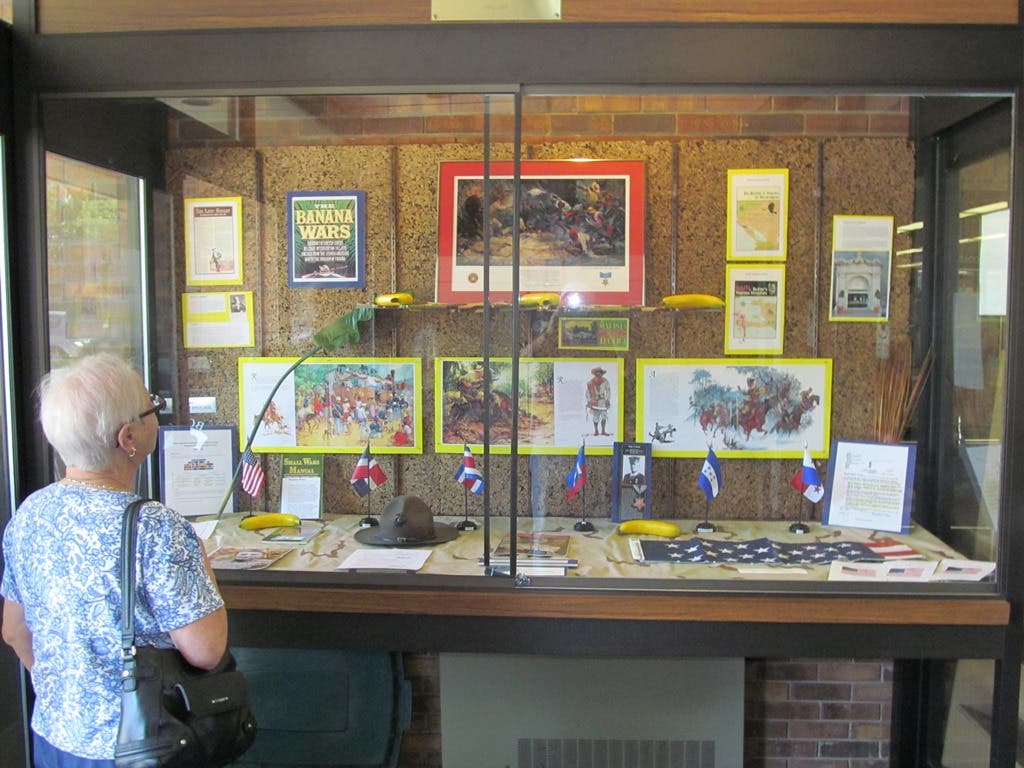
The General Smedley D. Butler Detachment of the Marine Corps League, headquartered in Newtown Square, will set up its Banana Wars exhibit this Friday, March 13, at the Delaware County Historical Society Museum and Research Library, 408 Avenue of the States, Chester. It includes a signed watercolor print by Col. Charles Waterhouse and copies of other Waterhouse prints. It also includes a photo of General Butler’s ribbons, including those earned during the Banana Wars. It was during the Banana Wars that General Butler earned his two Medals of Honor, his first at Vera Cruz, Mexico in 1914 and his second in Haiti in 1915. Photos, posters, newspaper articles, historic documents, uniforms, and small arms used during that period will be on display. The exhibit will then be moved to the Springfield Township library where it will remain on display through July. Additionally, the Newtown Square Historical Society has offered to place the exhibit in its museum for the month of August. One of the founders of the Newtown Square Historical Society was Stan Short, former Chief of Police of Newtown Township and a member of the General Smedley D. Butler Detachment. The Newtown Square Historical Society Museum will be open for 4 Saturdays during August.
The exhibit will be on display until May 28. The hours and days the Museum is open are: Wednesday and Friday, 9 am to 4 pm, Thursday, 1 pm to 6:30 pm, Saturday, 9 am to 2pm. There is a small admission fee.
Find out what's happening in Marple Newtownfor free with the latest updates from Patch.
The Banana Wars
Wikipedia (www.Wikipedia.org) describes the Banana Wars were a series of occupations, police actions, and interventions involving the United States in Central America and the Caribbean between the Spanish American War (1898) and the inception of the Good Neighbor Policy (1934). The military interventions were most often carried out by the United States Marine Corps. The Marines were involved so often that they developed a manual, “The Strategy and Tactics of Small Wars”, in 1921. On occasion, the Navy provided gunfire support and Army troops were also used.
Find out what's happening in Marple Newtownfor free with the latest updates from Patch.
The objective of the Banana Wars was to protect the United States interests in Central America. Reason for these conflicts was varied but largely economic in nature. They were called “Banana Wars”, a term that arose from the connections between these interventions and the preservation of American business interests in the region.
With the Treaty of Paris, which ended the Spanish American War, Spain ceded control of Cuba, Puerto Rico, and the Philippines to the United States. Thereafter, the United States conducted military interventions in Panama, Honduras, Nicaragua, Mexico, Haiti and the Dominican Republic. The series of conflicts only ended with the withdrawal of troops from Haiti in 1934 under Franklin D. Roosevelt’s Good Neighbor Policy. The Banana Wars lasted from the presidential terms of Teddy Roosevelt to that of Franklin Roosevelt.
Most prominently, the United Fruit Company had significant financial stakes in the production of bananas, tobacco, sugar cane and various other products throughout the Caribbean, Central and northern South America.
Interventions:
Cuba and Puerto Rico, 1898
Panama, 1846, 1856, and 1903
Nicaragua, almost continually occupied by The United States from 1912-1933
Cuba, Occupied by the United States from 1898-1902 and again from 1906-1909, 1912, and 1917-1922. It was governed by the terms of the Platt Amendment through 1934.
Haiti, Occupied by the U.S. from 1915-1934
Dominican Republic, action in 1903, 1904, and 1914. Occupied by the U.S. from 1916-1924.
Honduras, where the United Fruit Company and Standard Fruit Company dominated the country’s key banana export sector and associated land holdings and railways, saw insertion of American troops in 1903, 1907, 1911, 1912, 1919, 1924 and 1926... Writer O. Henry coined the term “Banana Republic” in 1904 to describe Honduras.
Mexico, 1914, this incursion at Vera Cruz was an exercise to cut off the supplies of German munitions to the government leader Victoriano Huerta, whom President Woodrow Wilson refused to recognize.
���Ք�H���