Health & Fitness
Newtown 1860 Census: Day Two
1860 census: William B. Flounders, the census taker, continues to go house to house in Newtown Township on Friday July 20, 1860. Who does he meet along the way? Free blacks and mill workers.

(Continued from last week...)
On Friday, July 20th, Flounders met his first person of color in the township, 12 year old Eliza J. Jackson, a mulatto born in Virginia and living on the Rhoads farm. Out of a total population of 841 people in Newtown, 16 were colored males, and 19 were colored females.
The colored population was largely born in Pennsylvania, the men all farm laborers, while none of the women were listed with any occupation, and so probably kept house. All of the children were attending the local schools.
Find out what's happening in Marple Newtownfor free with the latest updates from Patch.
Six of the 13 adults reported that they could not read or write. Newtown was settled by Quakers, still had a large Quaker presence in 1860, and they were fervently anti-slavery, and so the free black population may have found Newtown to be a tolerant community.
Flounders covered 30 houses in the area north of the Turnpike and east of Newtown Street Road that Friday, mostly farmers with households of children and live-in farm laborers and female domestic help. By the end of the day, he had made his way to the industrial center of the township, the textile mills along Darby Creek and the small houses lining Paper Mill road west of the creek housing the various workers in these mills.
Find out what's happening in Marple Newtownfor free with the latest updates from Patch.
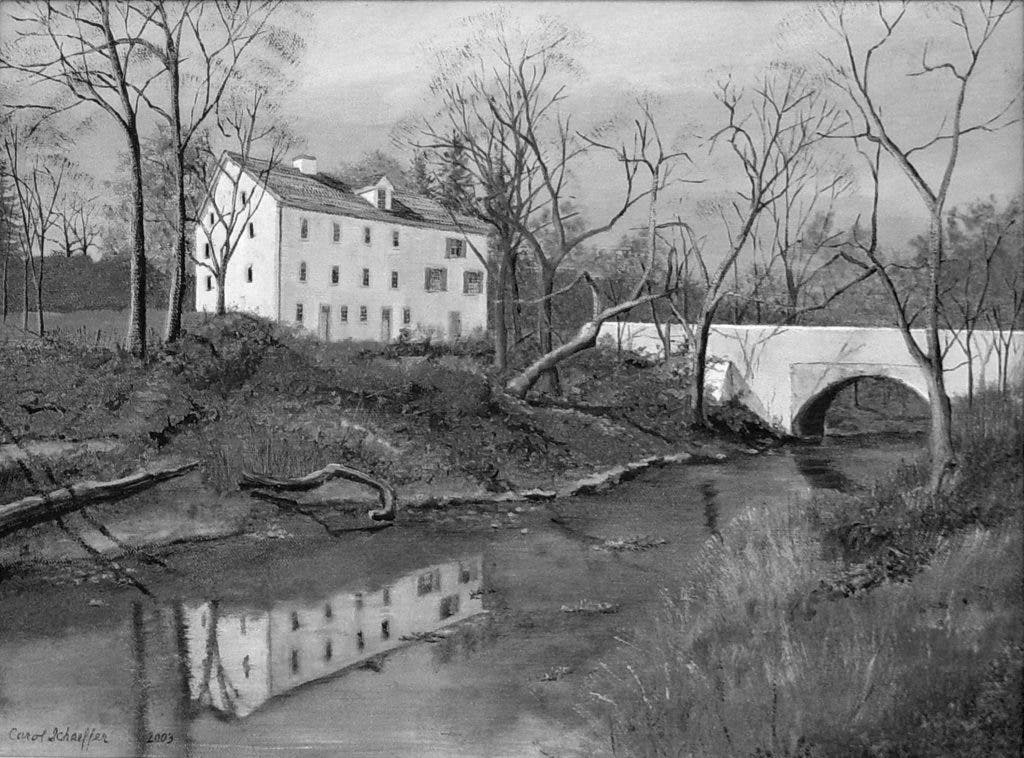
The old Crosley Mill, initially built in 1828, was then known as the I. & R.S. Griffith Woolen Factory. John Griffith had moved his family of seven up from Loudon County, Virginia within the last two years to run the factory. The factory produced woolen products – clothing and blankets – made of wool procured from the sheep kept by area farmers. The Griffith factory had 670 spindles, and ran on both water power and a 15 horsepower steam engine. The factory employed 24 males and 14 females as weavers, spinners, carders, beamers, twisters, dyers, and cloth finishers.
Teamsters with horse-drawn wagons and carts would haul the raw materials to the factory and then take the finished products to market. A half mile south of the Griffith factory was the Cedar Hill Factory, a cotton mill that annually used about 38,000 pounds of cotton brought from the South by boat and rail, and then hauled to the factory by horse and wagon. The coming war would be good business for clothing and blanket manufacturers who turned out the uniforms and blankets for men in the army and navy, and that thought may have been disturbing to John Griffith, who had roots in Virginia.
However, on February 22, 1861, the Griffith factory was destroyed by fire, and was not rebuilt, putting that whole community out of work. Fire struck the Cedar Hill cotton factory in the same year, and with the supply of raw cotton cut off by the war, that factory went out of business as well, leaving all of the mill workers unemployed. Griffith moved his large family to Indiana, and others left as well. By the 1870 census, the population of Newtown had declined by about 100 people.
(To be continued...)