Health & Fitness
Understanding Aperture
What is aperture, and why is it important in photography? The answers to your questions.

Aperture is defined as the size opening of a lens diaphragm, and is calibrated by what some people call f-stops, f-values or f-numbers.
The lens opening, when taking a picture, is extremely important. The aperture regulates the amount of light that passes through to a DSLR camera's sensor when you take a picture.
Apertures can vary, depending on the camera. It can be fixed, like in point-and-shoot cameras, which pick the aperture for you. Or the aperture can be adjustable, like in a lens on a DSLR camera.
Find out what's happening in Nazarethfor free with the latest updates from Patch.
For this blog post, I'm going to write specifically about the adjustable type.
Have you ever noticed those little numbers engraved on the end of your lens barrel? Each of those numbers represent how long or short the lens opens and how much light is allowed through. So for each time you change the f-stop -- up or down -- it doubles or halves the size of the opening in your lens.
One thing that confused me when I was learning f-stops was that a larger aperture (bigger opening, which means more light) is given a smaller number, and a smaller aperture (smaller opening, which means less light) is given a larger number.
Find out what's happening in Nazarethfor free with the latest updates from Patch.
This can be a little confusing at first, but you will eventually get the hang of it. For awhile, I kept a note written in my cell phone. When I would be out shooting, I would refer to the note when I got mixed up.
When setting your aperture, there a few things to keep in mind, but mainly, DOF or depth of field. If you look at a picture, say of a landscape, and most of the picture is in focus, that is what you would call a large depth of field.
Or, say you have a picture of wild flowers. One flower is the main focus and is sharp, crisp and clear, but the rest of the flowers are fuzzy looking or blur into the background. This is what you would call a shallow depth of field.
I've included two examples.
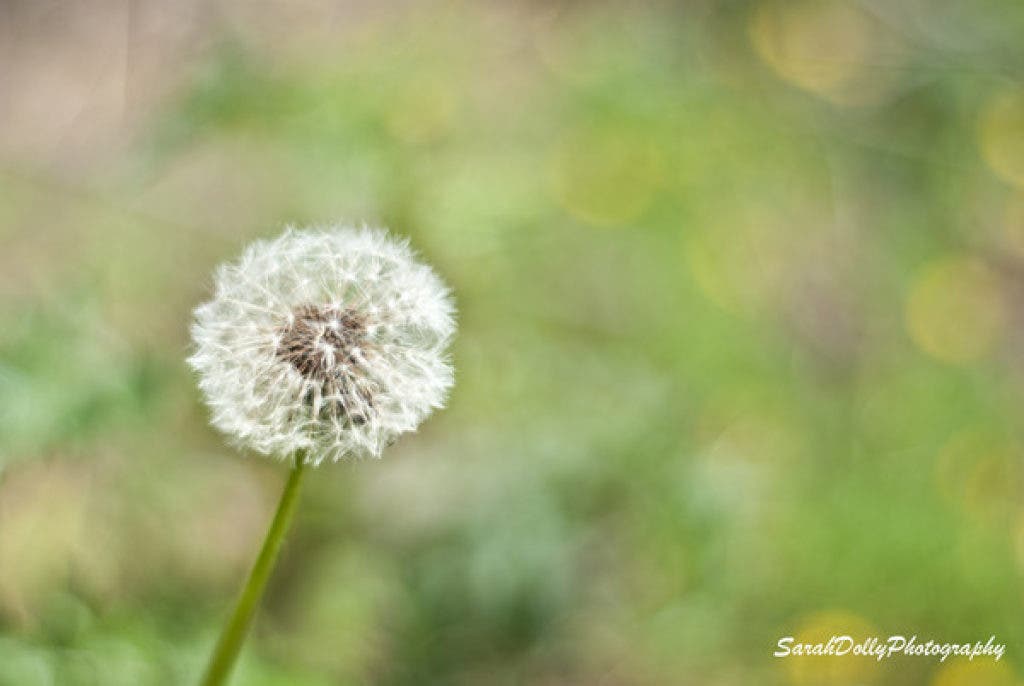
The first example is a picture of a dandelion that was shot at f/6.3. The dandelion is in focus, the background is blurred. This is not as appealing to the eye because it makes it difficult to tell exactly where the focal point is.
The second picture was taken at f/1.8, and there is no question what the focal point is. The dandelion is nice and crisp, and the background is fuzzed out really nice.
You need to experiment in order to discover what best suits your style of photography.
So, always remember: small numbers mean a small depth of field, large numbers mean a large depth of field. The best way to understand and remember this is to practice. Take the same picture multiple times, but change your f-stop slowly. You'll start to see how each f-stop affects your picture.
If you think your pictures aren't great, don't get discouraged. Like anything you learn, it takes patience and practice. You will get better.