Community Corner
A Look Inside An Endangered Species Birth At Elmwood Zoo
"Cat partnerships are tricky," zookeepers said. Months of challenges precipitated the birth, heralded as a major conservation victory.


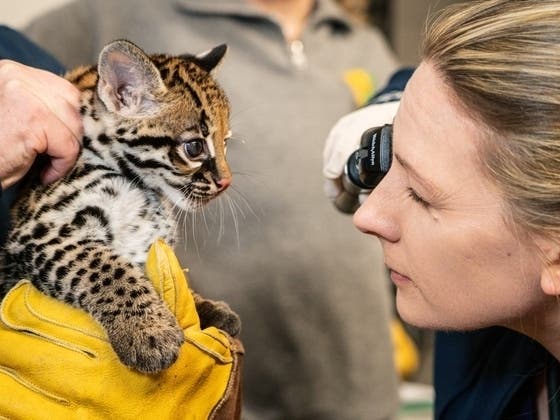
NORRISTOWN, PA — The birth of a female baby ocelot at Elmwood Park Zoo is being widely heralded as a major victory in the protection of an endangered species.
But the birth of the yet-unnamed baby ocelot on Feb. 1 was precipitated by years of planning and months of efforts by zookeepers and conservationists alongside the zoo's ocelots, Rio and Mateo.
The breeding was led by Elmwood's animal keepers Janine Farmer and Carlee Redmon. Ocelots are critically endangered in the United States, with only a small handful of individuals left in west Texas, according to the Nature Conservancy. While their numbers are stronger in central and South America, they face significant habitat loss and disruption and low genetic diversity.
Find out what's happening in Norristownfor free with the latest updates from Patch.
While Rio and Mateo had bonded last summer, they experienced a significant cooling down in their relations last fall, and attempts by the zoo to facilitate a kitten seemed frustrated.
"Cat partnerships are tricky, and their interests naturally wax and wane in cycles that are not easy to predict," Farmer and Redmon said. "It’s up to us to watch their behaviors carefully and give them what they need to set them up for success."
Find out what's happening in Norristownfor free with the latest updates from Patch.
However, to the surprise of caretakers, Rio began showing signs of pregnancy in the beginning of January. The signs were subtle, but enough for zookeepers to investigate further.
Rio had undergone training for years so that she could learn to undergo examinations in the case that she became pregnant. She does not like being touched and the idea of ultrasounds would have proved quite difficult. With that knowledge in hand, zookeepers chose to go with x-rays, which were less invasive.
Rio had been trained to put herself in what is called a "squeeze crate," where the x-rays are captured and she is rewarded once she's out. The x-rays confirmed the pregnancy.
Zookeepers then began a several-week period of carefully monitoring Rio. It was difficult to know exactly how far along she was in her pregnancy, and experts told the zoo that she could give birth within the week. Her weight was carefully monitored, as was her food and water intake, and zookeepers watched carefully for any other changes in behavior and diet.
The zoo also received a significant grant from an ocelot recovery program called Ocelot SAFE, including a "den box" customized to Rio with a camera. The grant also provided for baby-proofing modifications to her sleeping area.
"We turned Rio’s living area into a real 'maternal suite' in two days," Farmer and Redmon said. Curtains, sound machines, the works. Once she gave birth, we needed to be 'ghosts” in the building. Her comfort, especially as a first-time mother, was our priority."
About a month passed from the time the pregnancy was first discovered to when Rio went into labor. Her caretakers watched every day through January, waiting for the big moment. But as Farmer and Redmon put it, "Rio has always been a cat who has done what she wants when she wants."
When she did finally go into labor at about 8 a.m. on Monday, it was in breach, meaning the kitten was coming tail instead of headfirst. Regardless, Rio somehow only took about 15 minutes to successfully deliver her kitten. Farmer and Redmon were stunned.
"This is particularly impressive because it’s not uncommon at all for breach births to require surgical intervention, and we did not have any prior knowledge of this successfully being done in ocelots," they said.
Ocelots can sometimes abandon their young if they feel unsafe, so extra efforts were taken to keep both Rio and the kitten calm and comfortable in the first few days following the birth. The zoo did not make the announcement of the kitten's birth until she was nearly two months old.
The fact that Rio is a female is immensely helpful to conservationists, who need more females to balance and grow the ocelot population.
The name of the kitten will be determined in the coming days, the zoo added.
The ocelots live in the Trail of the Jaguar exhibit at Elmwood, adjacent to the barn. While Rio and the baby will be slowly reintroduced to public spaces in the coming weeks and months as the kitten gets old enough to climb, they're also likely to be out of sight for some time, too.
"The mother she gets full and final say of where she and her kitten go," Farmer and Redmon added.
Get more local news delivered straight to your inbox. Sign up for free Patch newsletters and alerts.