Travel
New Translation Devices Being Used At Philly International Airport
A TSA officer or a traveler can speak into the device, which will translate the message into the selected language audibly and visually.


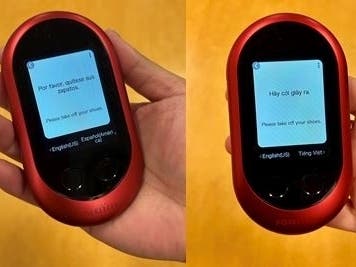
PHILADELPHIA — Transportation Security Administration officers are testing the use of new hand-held language translation-interpretation devices at the Philadelphia International Airport.
The new devices hope to support a more positive security checkpoint experience for individuals who are limited English proficient, international travelers, and individuals who are deaf or hard of hearing or who are blind or have low vision.
The goal of this pilot is to allow Transportation Security Administration (TSA) to evaluate the viability of these devices by assessing the ease and effectiveness of use and its impact on checkpoint operations.
Find out what's happening in Philadelphiafor free with the latest updates from Patch.
"We hope that this will turn out to be a valuable tool for our officers to provide guidance to passengers who might not speak English," Gerardo Spero, TSA’s Federal Security Director for Philadelphia International Airport, said. "For example, it will help us to explain in the language that the traveler understands, that we may need to open a carry-on bag for a search."
The devices are smaller than a mobile phone and contains a library of 83 languages.
Find out what's happening in Philadelphiafor free with the latest updates from Patch.
A TSA officer or a traveler can speak into the device, which will translate the message into the selected language. The devices then audibly repeat the message into the chosen language for the traveler. The same message will also appear on the screen for travelers to read if they are deaf or hard of hearing.
TSA is using five of these devices at checkpoints in Philadelphia’s international terminals A-East and A-West, and also at its busiest checkpoints in terminals B and DE. Since the rechargeable units work via Wi-Fi or data connection, they can easily be moved to any checkpoint lane where they are needed because they do not need to be tethered to an electrical outlet.
In the short time that the units have been in use, TSA has seen the benefits of the units as well as a few challenges, such as the use of colloquialisms. For example, the term "pat-down" does not translate accurately into all languages and instead TSA officers may need to use different words to explain that a pat-down needs to take place.
TSA can pre-program common advisements that TSA officers use in typical checkpoint conversations. The device can keep up to 10,000 translations that are "favorites" and commonly used. Software updates can be downloaded to add languages and words to the vocabulary library. Some foreign languages have specific dialects and other nuances. For example, the units distinguish four types of Spanish--that spoken in Spain, Argentina, Columbia or the United States.
Checkpoints can be noisy places and as a result, TSA officials have learned that enunciating words into the device is important. For example, the unit may mistakenly translate the words "your coat" into "you’re a coat." It is this type of information that TSA is gathering to help determine how to work around the ambient noise issues of a checkpoint.
Get more local news delivered straight to your inbox. Sign up for free Patch newsletters and alerts.