Politics & Government
Rep. Gerber: Government is Failing
At a town hall event in Whitemarsh, Mike Gerber (D-148) shared his exasperation with pensions, natural gas, the budget, and Grover Norquist.
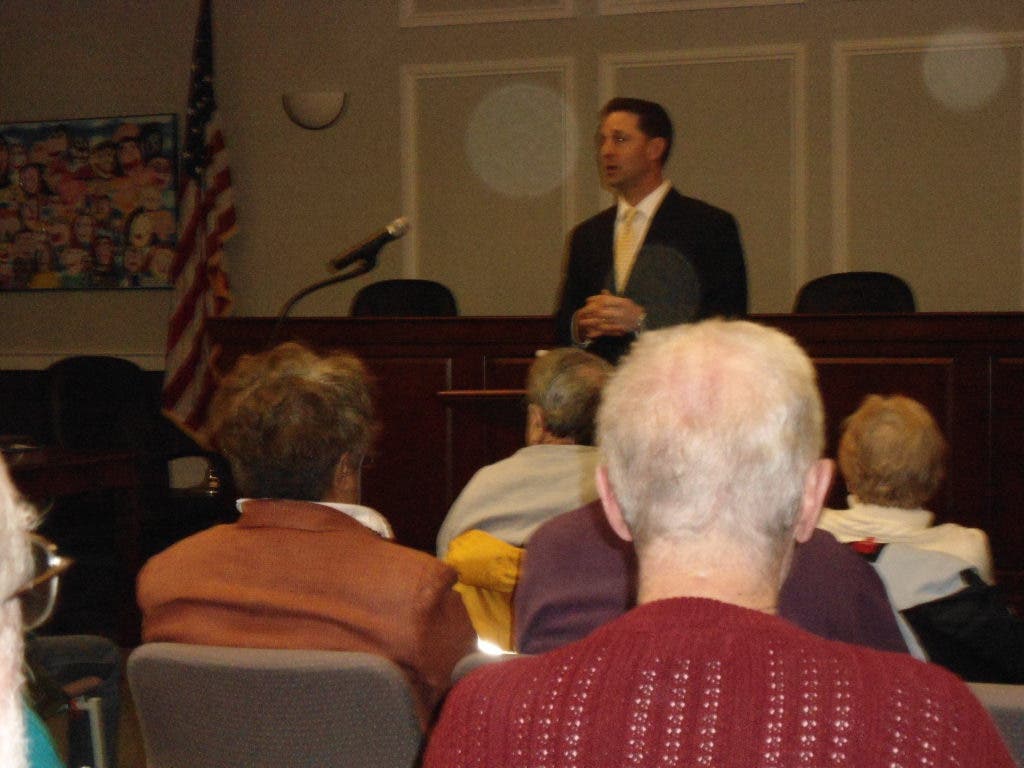


Mike Gerber says he considers himself an optimist. These days he doesn't sound like one.
Wednesday night at a town hall meeting at Whitemarsh Township's municipal building, the 148th District Democrat outlined his mounting frustrations with recent legislative outcomes in the state capitol—many of which are underpinned, he suggested, by a refusal on the part of Republican lawmakers to consider proposals that would raise revenue.
"History will show we are one of the most irresponsible generations this country has ever seen," he told a room of about 60 in response to a question about balancing the budget amid partisan gridlock in Harrisburg. "We want what we want and we don't want to pay for it."
Find out what's happening in Plymouth-Whitemarshfor free with the latest updates from Patch.
Gerber said his exasperation hit a fever pitch in May when, for the first time in his tenure, he voted against a state budget. The seventh year Rep. explained that, in his view, narrowing the state's growing deficit requires a "blended approach" of spending cuts and revenue increases and that the Corbett budget got it, at best, half right.
Gerber said, for instance, he supported a tax on smokeless tobacco—Pennsylvania is the only state in the nation that doesn't tax the stuff and changing that would bring in about $15 million a year in revenue, he argued—but the Republican-controlled congress stonewalled it.
Find out what's happening in Plymouth-Whitemarshfor free with the latest updates from Patch.
$15 million isn't a huge sum in the context of what the state owes, he acknowledged, but he suggested that Republican reluctance to get behind what should have been a relatively uncontroversial tax belies an ideological opposition to taxes at the expense of a commitment to problem solving.
Gerber also delved into his frustrations with Harrisburg's handling of the Marcellus Shale, the enormous natural gas reservoir that sits under parts of the state.
He said it's baffling that Pennsylvania doesn't tax natural gas extraction—it's the only state that doesn't do so, he reminded his constituents—and called the Corbett plan to simply give local municipalities license to charge their own "impact fee" insufficient.
It's estimated, he said, that the net effect of all local impact fees amounts to a one percent tax on the industry. "One percent, in my judgement, is a joke," he added.
"People say, 'If you tax at too high a level, the industry won't come," he went on, but countered that industry insiders have told him that a tax of even 5.5 percent still wouldn't disincentivize extraction. He added that this accommodationist approach has cost the state, by some estimates, hundreds of millions of dollars.
Gerber speculated that chief reason the Shale has gone untaxed is that Governor Corbett signed the Americans for Tax Reform Taxpayer Protection Pledge before taking office—an oath former lobbyist Grover Norquist circulated to Republican politicians, drawing (in the pledge's language) guarantees of opposition to any and all tax increases—and so tied his own hands. Because it ruled out any state tax, the pledge left Corbett with impact fees as the only revenue collecting tool in his arsenal, Gerber said.
On the budget cutting side of the coin, Gerber has become equally disillusioned. He said his colleagues have approved cuts that he "just can't live with."
A billion dollars was cut from basic education, he said, Pre-K through 8th grade, at a time when the state had been making scholastic strides. "Kids were doing better in school, [their] outcomes were better," he sighed.
There were robust cuts to university funding as well, he said, both from state schools and state-related schools. The impact, he said, was felt immediately. Tuition went up at Temple by 9.9 percent. "These schools aren't 'places for rich kids [either],'" he added.
He said the welfare budget was also put on the chopping block and, equally troubling, Governor Corbett hired a Secretary of Welfare who he thinks is insufficiently experienced to run a welfare program as large as Pennsylvania's.
Gerber said the consequences of these decisions are already being felt. The commonwealth lost 21,000 jobs since the budget passed at the end of June, he said, 17,000 of which are directly related to the cuts in the budget. The layoffs dropped Pennsylvania's unemployment figures below the national average.
There are also problems down the road that aren't being seriously addressed. Gerber said Pennsylvania's unemployment compensation fund owes significant sums to the federal government and if the state doesn't pay it back soon, Washington will levy a special tax on commonwealth businesses to recover it. This, he said, could force more layoffs, plunging the fund deeper into debt and repeating the cycle. Gerber said the house did nothing to address the problem during the budget process, and although the senate since passed a viable plan authorizing the state to float bonds to pay down unemployment debt—the interest of which would be less than what they currently pay—he expects it will get a cool reception in his chamber.
The legislature has also done next to nothing, he said, to address two other major problems—transportation and pensions. Pennsylvania's two major pension funds, one for teachers, one for other state employees, are facing an $18 to $19 billion shortfall. "We did nothing at budget time to address it. We just ignored it," he said.
And the state's bridges, which are the most deficient in the country, weren't addressed, despite the Governor's campaign pledge to do so. Gerber said we should be spending an estimated additional $1.5 to $3 billion a year to get transportation infrastructure to a safe level.
After his remarks, the young Rep. took questions from his constituents.
A former Marine from Lafayette Hill, heavyset and tattooed, raised his hand and said that his daughter, twelve years old and on disability, was just removed from Medicaid. He didn't know what he was going to do.
"People say things a lot better than me, I say them from the heart" the man said, his voice shaking as he read from a note pad. "They say the moral test of society is the way we take care of our children, the elderly, and the disabled. Right now the Pennsylvania State Legislature is doing a terrible job. A terrible job."
The applause was long and loud.