Health & Fitness
Main Line Student Scabies Outbreak: What Is It, Who's At Risk?
More than a dozen Radnor Township School District students were recently diagnosed with scabies. So what is it? How does it affect people?


MAIN LINE, PA — The Radnor Township School District recently announced 19 of its students have been diagnosed with scabies and that it has taken action to prevent the spread of scabies.
But what exactly is scabies and how does it affect us?
Scabies (Sarcoptes scabiei) are a type of parasitic mite — known as the human itch mite — that burrow into the host's top layer of skin, causing irritation in pimple- and rash-like symptoms, according to the Centers for Disease Control.
Find out what's happening in Radnorfor free with the latest updates from Patch.
They are spread by direct, prolonged, skin-to-skin contact with a person who has scabies. Something as quick as a handshake or hug will generally not lead to passing the mites.
Scabies can be transmitted via sharing articles such as clothing, towels, or bedding used by an infested person, as well as sexual contact.
Find out what's happening in Radnorfor free with the latest updates from Patch.
According to the CDC, typical areas in which rashes appear are the wrist, elbow, armpit, webbing between the fingers, nipple, penis, waist, belt-line, and buttocks.
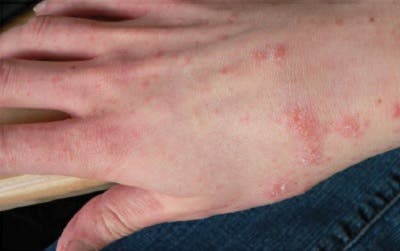
The CDC says very young children and infants infected with scabies burrows see them in the head, face, neck, palms, and soles. For others, burrowing areas are typically webbing between the fingers, in the skin folds on the wrist, elbow, or knee, and on the penis, breast, or shoulder blades.
While in the top layer of skin, the mites lay eggs which incubate for roughly four to six weeks before hatching.
After hatching, the young mites will stay on the hosts skin until they mature and can burrow into the skin themselves.
Diagnosis for scabies typically involves observing the rash-like conditions on the skin, as well as the presence of mite burrow spots. However, diagnosis should be confirmed by identifying the mite or mite eggs or fecal matter by carefully removing the mite from the end of its burrow using the tip of a needle or by obtaining a skin scraping to examine under a microscope for mites, eggs, or mite fecal matter.
The CDC says a person can still be infested even if mites, eggs, or fecal matter are not found; fewer than 10 to 15 mites may can present on an infested person who is otherwise healthy.
No over-the-counter medication to treat scabies exists; those with scabies must see a doctor to be prescribed scabicides for treatment. Patients under treatment should always follow their doctor or pharmacist's instructions when using the medication, as well as any instructions on the box or label of the medication, health officials say.
Infected patients should see relief from symptoms in about two to four weeks. The CDC says treatment is recommended for members of the same household as the person with scabies, particularly those persons who have had prolonged skin-to-skin contact with the infested person.
All people in a household with an infested person should be treated at the same time to prevent reinfestation, the CDC says.
Scabies cannot live away from human skin for more than two to three days, therefore clothes bedding, and towels used by a person with scabies can be decontaminated by machine-washing in hot water and drying using the hot cycle or by dry-cleaning. Items that cannot be washed or dry-cleaned can be decontaminated by removing any body contact for at least 72 hours.
Get more local news delivered straight to your inbox. Sign up for free Patch newsletters and alerts.