Schools
Mandarin Taught at Swain School
Mandarin at Swain is a required, non-credit, six-week exploratory course designed to give students basic conversational skills.

“Ni hao!”
The Mandarin greeting, “How do you do?” is likely to be overheard in the corridors of in Salisbury Township these days.
Since April, the school’s 25 seventh graders are learning the basics of the most widely spoken Chinese dialect. Mandarin is the language of nearly 1 billion people.
Find out what's happening in Salisburyfor free with the latest updates from Patch.
Taught by Bei Wang of Lower Macungie Township, the lessons add a melodic, exotic cadence to the classroom. Mandarin is a tonal language: the same word spoken with a rising or falling voice will give it a different meaning, as the way, in English, a rising or falling voice can turn a statement into a question. (Example: It’s raining. It’s raining?)
In a recent Mandarin class, Wang held up pieces of brightly colored fruit with one hand, and led students in a recitation of words and responses.
Find out what's happening in Salisburyfor free with the latest updates from Patch.
Wang, who was born in Shanghai, China’s largest city, is one of the area’s few teachers of Mandarin. She previously taught an after-school Mandarin class at Swain for grades 1 through 5, then taught a 5th grade social studies class on Chinese language and culture.
Offering Mandarin “fits into our emphasis of global studies,” says Kyle Armstrong, associate head for academics. “Our students are citizens of the world, and if we can communicate with people from China, if we can offer something from across the world, it opens their eyes a little bit.”
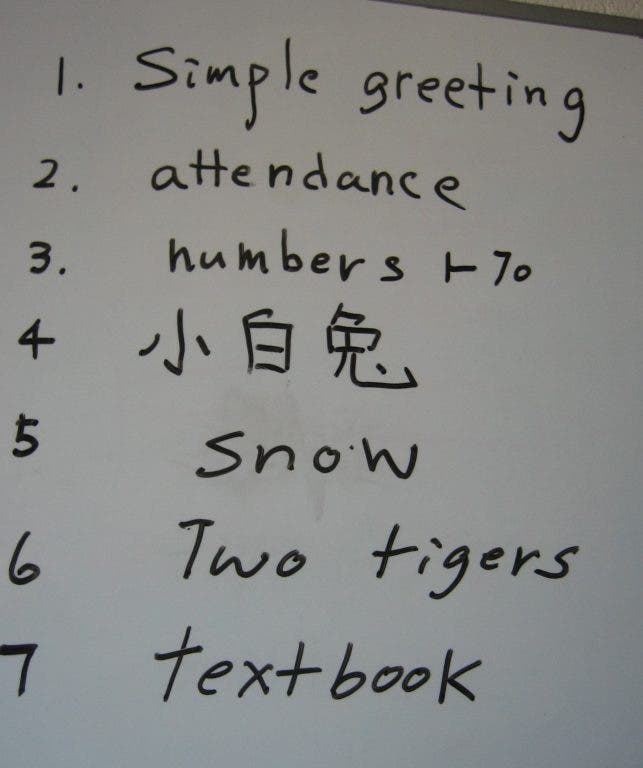
Mandarin at Swain is a required, non-credit, six-week exploratory course designed to give students basic conversational skills. They learn simple greetings, fruits, colors, and the words for family members, body parts, and animals.
“I also teach them a famous Chinese poem and some nursery rhymes, and we sing a Chinese song,” says Wang.
“Chinese is difficult to learn, but already they know the numbers. They really surprised me. They are very smart,” she says of her students.
While there are no plans to make Mandarin a core language at Swain, many independent schools across the country are offering at least a taste of Mandarin, says Armstrong. The National Association of Independent Schools, of which Swain is a member, has conducted annual trips to China to interview and hire teachers of Mandarin.
In the Lehigh Valley area, only a few schools offer Mandarin, including the Moravian Academy and Lehigh Carbon Community College. Southern Lehigh School District is hosting a guest teacher from China this year, and at the Lehigh Valley HuaXia Chinese School, a joint program with Northampton Community College, American children of Chinese heritage learn to speak their native tongue.
“The Chinese economy is getting strong. More and more people are coming from China and the American people want to know more Chinese,” says Bei Wang.