Health & Fitness
It's Mason Bee Season!
After a long and chilly winter, mason bee season is just beginning. Now is the time to get your bee nesting tubes and start placing them outside!


People in the Lehigh Valley are not the only ones who are celebrating the first warm days of spring. Mason bees are just now starting to find themselves in a whole new world of adventure, after spending a chilly winter inside a cramped but cozy cocoon. Yesterday, I saw my first mason bee of the 2013 season!
Last spring, I wrote about the mason bee homes that I kept right above my back patio door. While I drank my morning coffee, I watched mother bees bringing loads of pollen home to feed their young ones that they will never have a chance to meet. Two different species of bees were at work. Orchard mason bees (Osmia lignaria) are native and common in the Lehigh Valley. Hornfaced bees (Osmia cornifrons) were introduced to the Eastern United States from Japan in the 1970’s and are now very common (if not dominant) in this region. Both of these bees are about the same size as honey bees. Orchard mason bees are darker than honey bees and have a metallic blue-green sheen to them. Hornfaced Bees are browner and fuzzier than orchard mason bees and appear to have tiny “horns” protruding from their heads. Unlike harassed honey bees, or a few kinds of wasps, mason bees will not sting people. They are incredibly gentle and totally harmless. They will not produce any honey either, but that is a small price to pay for the pollination services they provide.
Mason bees have a lifestyle that is similar to carpenter bees, but they do not drill their own holes. They will not dive-bomb people either, so there is never any need for badminton rackets or other methods to keep them away from the house. Unlike honey bees and bumble bees, where a queen establishes a colony consisting mainly of sister worker bees, individual mason bee mothers gather pollen to feed their own larvae. They typically build nests in tubes that they find, such as dried reedy grasses or holes in wood that other insects have already drilled out.
Find out what's happening in South Whitehallfor free with the latest updates from Patch.
Mason bee season typically gets into high gear by mid-April and winds down by late-May. Conveniently, this coincides with the flowering times of many fruit trees. They are especially excited by our early spring flowers. The females spend their days gathering pollen and fashioning it along with nectar into pea-sized balls. After she lays an egg on the ball of pollen, she builds a mud barrier and repeats the process. This is why they are called “mason” bees. Each female will provide enough pollen balls for about 10-13 larvae during her short life.
Like other native bees, mason bees are very effective pollinators. Farmers who have incorporated them into their pollination plans have seen significant boosts in crop yields. Some farmers purchase native bees while others have discovered the benefit of providing natural habitats around their crops for the bees to thrive on their own.
Find out what's happening in South Whitehallfor free with the latest updates from Patch.
Mason bees are part of any healthy backyard ecosystem. There are easy ways to attract and encourage them to visit your own garden. One very popular method is setting out wooden bee blocks with holes already drilled in them. Placing out a bunch of pre-cut bamboo tubes will also do the trick. Some nesting systems are made with a variety of differently sized holes. These have the advantage of providing homes for different species of native bees, some of which may be active later in the summer. The nesting blocks or tubes should be placed in a dry, somewhat shady and protected spot. I have found that direct rain is the enemy of bee nests, since the pollen can get moldy when wet. I put my bee nesting tubes below an eve of my house facing south, so they get the morning warmth and plenty of shelter.
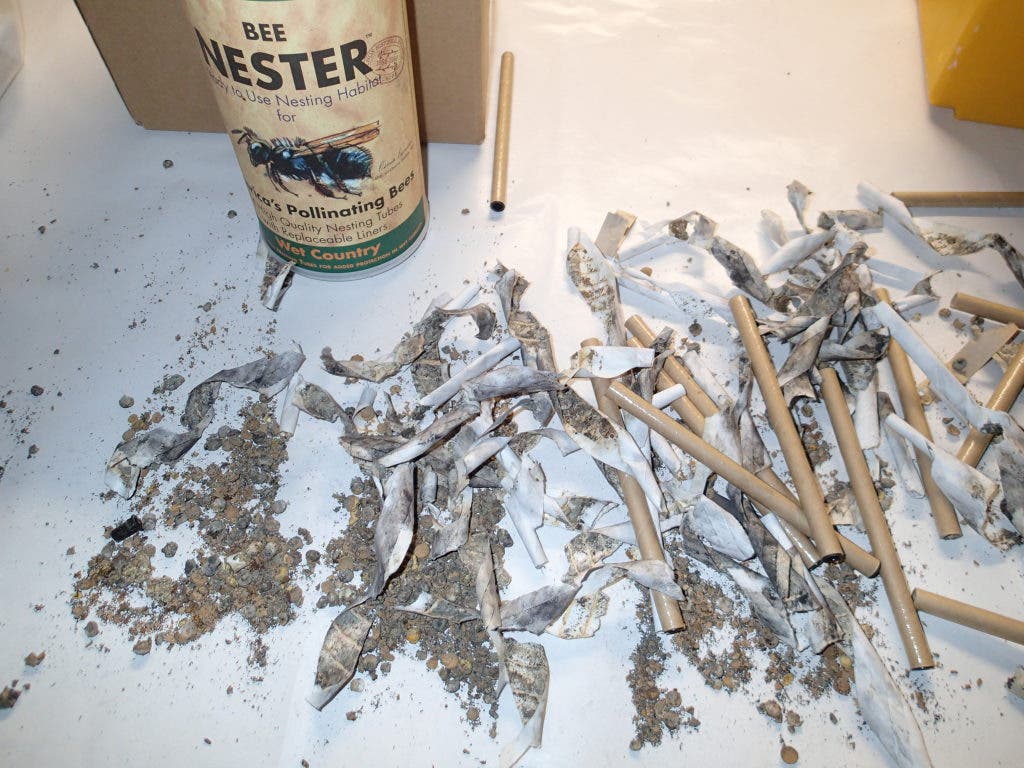
If you want to get serious about mason bees, there is a slightly more complicated method that works very well. It’s not hard but it does take a little time and planning. I’ve found that it’s worth the small amount of effort. Knox Cellars sells parasite-resistant cardboard bee tubes with disposable paper liners that come in a convenient can. Last May, when the tubes were filled and capped with mud, I put lids on the cans and stored them in my garage for the rest of the summer. This protected the growing bee larvae from hungry birds and parasitic wasps as they completed their development over the summer. Last October, I took all of the cocoons out of the paper tubes and washed them in a very mild bleach solution. This didn’t harm the adult bees hiding inside, since their cocoons are waterproof. Bleaching killed any harmful mold that might have been growing in the tubes. I also removed all of the cocoons that were parasitized by wasps. In all, I collected about 700 clean cocoons, which fit into a little cardboard box which I kept in the refrigerator for the winter. Storing them in the fridge protected them from the wild fluctuations in temperature that they would experience outside. As soon as I see a few more mason bees working on in the garden, I am going to take the little box of bees out of the fridge. I will poke some bee-sized holes in the box and place it outside, right next to the new and empty cans of tubes that I just set out for them this week. When the weather is warm enough, the new adults will chew themselves out of their cocoons. Within a few seconds, they are ready to fly. The males will fertilize the females and die within a few weeks. The females will be busy collecting pollen for this year’s class of larvae, and will be finished with their work (and lives) around the end of May.
This week, honey bee colony collapse disorder was prominently featured in a must-read article in the New York Times. The same stressors that impact our nation’s honey bee industry are also a threat to other local pollinators, like mason bees and bumble bees. Importantly, many common garden pesticides that are sold at local hardware stores can enter nectar and pollen at concentrations that are known to kill native bees. As the weather warms and we start making our garden plans, let’s all remember the bees and think about how their survival depends on the simple choices we can make!
This work by Marten Edwards is licensed under a Creative Commons Attribution-NonCommercial-NoDerivs 3.0 Unported License.