Health & Fitness
Suburbs Owe a Debt to Allentown
What does Allentown's Neighborhood Improvement Zone and the Earned Income Tax mean for me?
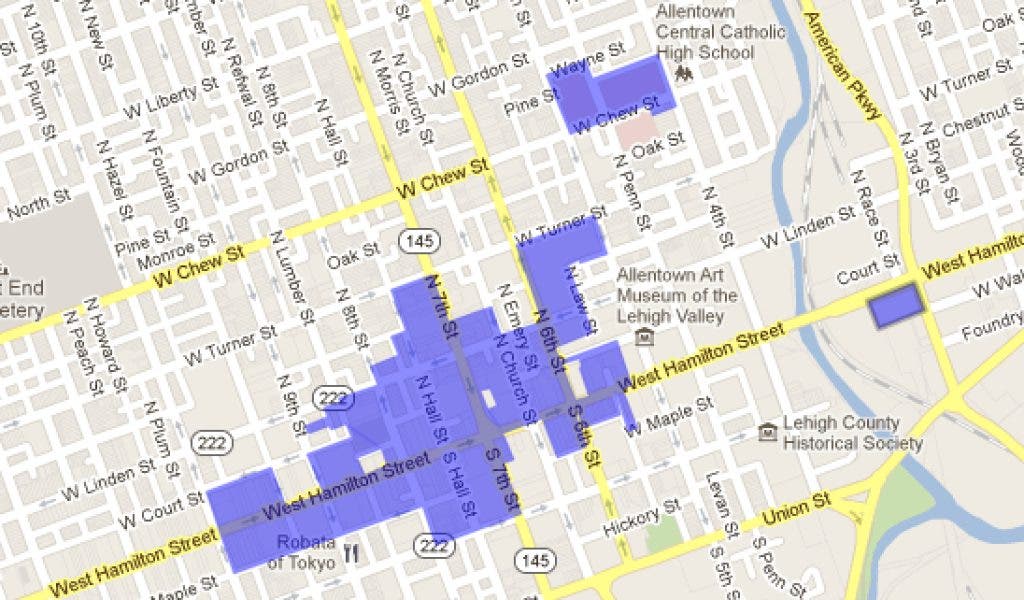
The new Earned Income Tax (EIT) situation in downtown Allentown's Neighborhood Improvement Zone has been in the news, and there has been a lot of discussion about it already.
The current situation for how local taxes are collected and allocated in Pennsylvania is complicated to say the least. The system that is currently in place was enacted in 1965 by the general assembly. (See 1965 Pa. Laws 1257.) That law, which became known as “The Local Tax Enabling Act,” was amended by Act of the General Assembly in 2008. (See 2008 Pa. Laws 197.) This Amendment is also known in common parlance as “Act 32.” Of the entire amended act, only section 317, paragraphs 2 and 3 (which are virtually identical to the original 1965 Act) are germane to our discussion.
Find out what's happening in South Whitehallfor free with the latest updates from Patch.
Unfortunately, the legalese of this act is so thick as to be virtually impenetrable. But, if you are curious, the legislation's text is available on the General Assembly’s website. Despite the turgid prose, the policy that the law creates is fairly simple. A person’s residential municipality (where they live) may levy an EIT on its residents. In addition to this, a person’s commercial municipality (where they work) can also levy an EIT. However, the residential municipality’s EIT levy will supersede and act as a deduction from the commercial municipality’s EIT.
Here is an example. Imagine that I live in Upper Macungie which has an EIT rate of 1.0 percent and work in the City of Allentown which has an EIT rate of 1.35 percent. For the calculations, let’s pretend that I made $100,000 last year. My boss will withhold $1,350 out of my pay (based on the higher of the two percentages I may owe). Of this total amount, Upper Macungie lays claim to $1,000. That amount will be deducted from the total amount collected from me, so Allentown’s share becomes only $350.
Find out what's happening in South Whitehallfor free with the latest updates from Patch.
What the law accomplishes is to take the tax on my earned income and to distribute it from the place that I work to the place that I live. Why was this done?
Unfortunately, the legislative journals of the General Assembly are not available online so I don’t have a definitive answer. (That is if you believe a definitive answer can be found by reading transcripts of legislative debates).
But I have two educated guesses. My first (less cynical) guess is that as suburbia was developing, rural/agricultural residents feared an increase in land/property taxes. As such, they demanded a guaranteed contribution from new residents based on income rather than property, which would have allowed agricultural operations to remain economically feasible. Because suburban development was still in its adolescence in 1965, the amount of money transferred out of the city would have been manageable for the city to offset through modest increases in property taxes.
My second guess suggests a much more cynical legislative situation. Suburbia was big business and becoming even bigger in 1965. It would have made sense for suburban developers to push for an EIT tax that was remitted to the residential municipality. Why? Consider the tax situation of a suburbanite where an EIT existed but where there was no provision for how it would be transferred between municipalities. If our imaginary suburbanite lived in Upper Macungie but worked in Allentown, she would pay two earned income taxes -- the 1.0 percent rate in Upper Macungie and the 1.35 percent rate in Allentown for a combined 2.35 percent EIT tax rate. Obviously, human nature being what it is, she would seek to minimize her tax burden by trying to live and work in the same municipality.
What happened once the 1965 Local Tax Enabling Act was passed? Now, the EIT followed our imaginary suburbanite around. She no longer had a tax penalty for living and working in two different places. The consequence of this was that she was free to move out to the suburbs and not pay a tax penalty. The state government essentially subsidized her move from the city into the ‘burbs at the expense of the city.
Was this law fair? There are two points view. On the one hand, someone could say, I “shouldn’t be taxed twice” because it reduces my ability to choose where I want to live. On the other hand, someone could say the law is unfair because people consume government resources both where they live and where they work.
I think the latter argument makes more sense analytically, because instead of being taxed twice, one could just as easily be taxed once at a combined rate. In fact, what really should have happened was that the Commonwealth should have collected a combined EIT and distributed it to the municipalities in proportion to the respective use of services by the taxee. This didn’t happen, and instead the General Assembly favored moving tax dollars exclusively to the residential municipalities, which made moving out to the suburbs realistic from a tax standpoint.
This was a political choice made in the positive law, and it was a choice that favored suburban real estate developers and those who envisioned the world as a place that divided where one worked from where one lived. It was a choice, frankly, that could have only been made when gasoline cost $1 a gallon (in 2012 dollars) and the environmental, human, and commercial effects of car traffic were still being learned.
And, it brings me to an important point. We made political choices about suburban life in an era that is different from our own — when costs and priories were different — and, before we realized that there would be incredible externalized costs, like a hissing, rattling snake of traffic on Route 22 every morning and evening as people attempt to flood from where they live to where they work and back home again. In fact, the question of how to fix Route 22 is really quite simple — structure incentives so people reduce their use of it. The number one way to do this is to make people live and work in the same place.
What other costs are involved in separating where people live and work? How about obesity, diabetes, heart disease. I recently returned from living in Dublin for a year. Within a month, I had put on 15 pounds and my legs looked noticeably less defined. Why? In Dublin I didn’t have a car. If I needed something, I walked to it. I wasn’t eating less, but I was walking more, much more. This walking culture was not inconvenient or taxing. In fact, in most cases, I did my shopping as I walked home from university. Encouraging people to live in an environment where walking or biking is the main modality of travel would save tremendous money in health costs, car payments, road funding, gasoline, gym memberships, etc. Instead, the 1965 Tax Enabling Act has encouraged us to spend incredible amounts of money on all these wasteful and polluting things.
As a final example, consider what happens to a neighborhood, when instead of walking to work or school everyone gets in their car instead. There is no more interaction with people in the neighborhood. I go Home -> Car -> Work -> Supermarket (Maybe) -> Home. Think about the difference when you walk. You go to the front step and say hello to your neighbor on their stoop; you walk by some kids playing before school; you pass a corner store where you might buy a paper; or you pass by any number of shops which you might frequent just by “stopping by.” And, that is all before work, maybe before even leaving your home block.
As soon as you get in the car, and whiz by in your private glass and steel enclosure, you destroy all those little but meaningful relationships. And, not only are those relationships lost, but there is a good chance that the neighborhood businesses depended on you “just stopping by” to pay their mortgage or rent. There is a reason that urban neighborhoods support little shops and why car culture supports massive supermarkets. The supermarket is a destination in itself; the bodega is part of the neighborhood’s livelihood and personality. If you support the small businessman, you should be supporting the downtown and urban life.
All this is why the Neighborhood Improvement Zone (NIZ) is such a powerful tool to achieve many diverse goals to revitalize the downtown, not least of which is incentivizing people to live and work in the same place. The framework which supports the Allentown NIZ was adopted by the General Assembly in 2009 and amended in 2011. (See 2009 Pa. Laws 537, 544-48; 2011 Pa. Laws 159, 161-64.)
That framework, through a complex process, allows a commercial municipality to keep the EIT of employees working within the NIZ without having to remit the monies to the employee’s residential municipality. The direct policy goal behind this is to help pay off capital investments made in the NIZ by the commercial municipality, but it also encourages people to live where they work so they can enjoy the full benefit of their EIT tax (both in government services and a lower property tax). At the same time, however, there has been a lot of chatter about how this will harm the suburban townships by reducing their tax base.
Maybe so, but the history of the taxing scheme shows how, since 1965, the entire Commonwealth has had a policy of draining the urban centers for the benefit of the suburbs (except for Philadelphia and Pittsburgh, which were exempted). That was the political choice that was made, but that choice also created any number of other externalities like traffic congestion, health issues, and the death of neighborhood shops. This policy certainly was not “fair” to the downtown businesses who were forced to close shop over the years. Nor was it “fair” to people who loved downtown Allentown and institutions like Hess’s and their strawberry pie.
Whenever the government chooses to favor one policy over another, there will be winners and there will be losers. For the last half century, we have made the choice through positive law to focus benefits on the suburban townships at great cost to the taxpayer and the urban cities. We have chosen to fund the irrational notion that it is OK to sit nearly motionless on a highway for an hour a day and burn petroleum to get to the office.
It is true that the NIZ will take a some tax revenue away from the suburban municipalities, in the process leading to imperceptibly higher property taxes in the townships. However, I am going to make an audacious claim and say that this is not bad or wrong.
Suburbia has benefited for a very long time from the EIT situation. In the process, it has also created tremendous inefficiencies and led to the destruction of urban neighborhoods and commerce. To put it mildly, we owe the city a debt. Maybe we repay that debt by moving back and aligning where we live with where we work. Maybe we repay that debt by handing over a little more in property tax. But the promissory note signed in 1965 is on the table, and it has come due.
And if that argument doesn’t move you, consider the fact that when the total EIT tax being withheld for the NIZ is divided among all affected Lehigh Valley residents, the individual tax burden comes to about $1.50. I presume we both have better things to worry about.