Politics & Government
Why is T/E Considering a New Earned Income Tax?
The simple answer is simple math, but there are difficult political questions behind it.
Earned Income Taxes or EIT’s affect every working age resident and within a municipality. Right now, the Tredyffrin Easttown School Board is considering levying an EIT.
You may be asking yourself 'Why? Don’t schools get their funding from real estate taxes?'
T/E’s reliance on real estate taxes is what led the school board to consider other income streams, explained Dr. Dave Davare, of the Pennsylvania School Board Association.
Find out what's happening in Tredyffrin-Easttownfor free with the latest updates from Patch.
Historically, 87 percent of T/E’s K-12 funding comes directly from real estate taxes. In many parts of Pennsylvania, local taxes generate about 35 percent of the funding needed for its public schools. The rest is supplemented by state and federal money.
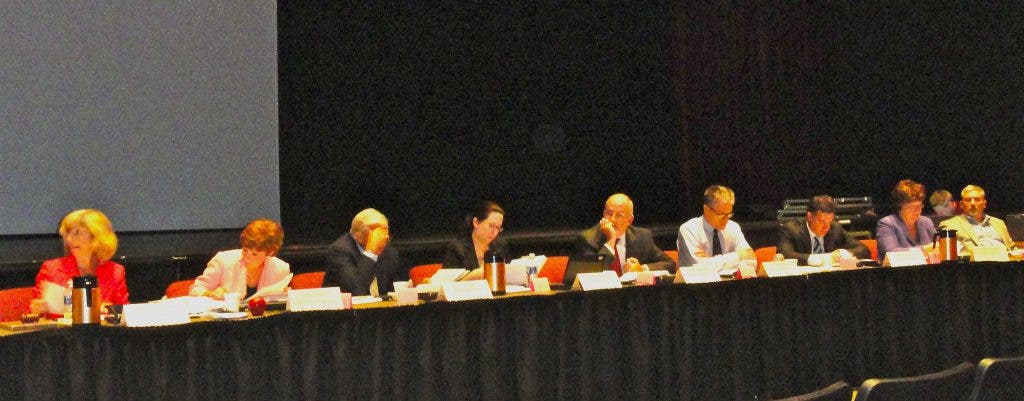
Davare was, and will be, in attendance at the Tax Study Group meetings. He provided the background information, and all of the statistical data that the group has to work with.
Find out what's happening in Tredyffrin-Easttownfor free with the latest updates from Patch.
“T/E is collecting typically, 96 percent of all possible real estate taxes,” said Davare. “The theoretical maximum is 98 percent.” Out in the western part of the state, districts are collecting 84 – 85 percent of their taxes.
Basically, T/E’s real estate taxes are tapped out. Every property owner's got to pay them. Unlike elsewhere in the state, the people responsible for paying T/E propert taxes are paying them. Factor in the pending property assessments, and the recent trends in sinking property values, and you have yourself a case of growing deficits.
The projected deficit leads to two central questions.
1) Should the school district cut programs and people to close the gap between costs and tax revenues? The School Board did vote to cut millions of dollars from the district's budget, months prior to passing a final 2011-2012 budget.
During its final budget deliberations last spring, the T/E School Board answered (in general terms) "no" on the question of making any additional cuts in the 2011-2012 budget. The gap in the 2011-2012 budget was then closed by using money the district's fund balance (think of the fund balance as the money the district had "in the bank").
So, if the board is not inclined to further cut programs that taxpayers and parents support the question then becomes:
2) Where should the money needed to fill the school district’s projected future budget deficit come from?
One possible answer lies within the EIT.
The unemployment rate in T/E is one of the lowest in Chester County. Of the district’s 39,482 residents, 58.7 percent are in the workforce.
An Earned Income Tax of 1 percent levied on nearly 60 percent of the resident population and also on those who commute in to work in Tredyffrin and Easttown would generate a projected $23 million in new revenue each year.
Editor's Note: An earlier version of this story did not include references to budget cuts the T/E school board approved in the spring, months prior to approving the final 2011-2012 budget in June.
Before taking its final vote on the 2011-2012 budget in June, the board voted to close a gap for 2011-2012 using money the district's fund balance (the money it had "in the bank"), rather than make any additional cuts.
.