Politics & Government
Upper Dublin Awarded $11.8 Million from State to Build Flood-Mitigating Structures
Commonwealth Finance Authority to approve grant Wednesday, officials say.

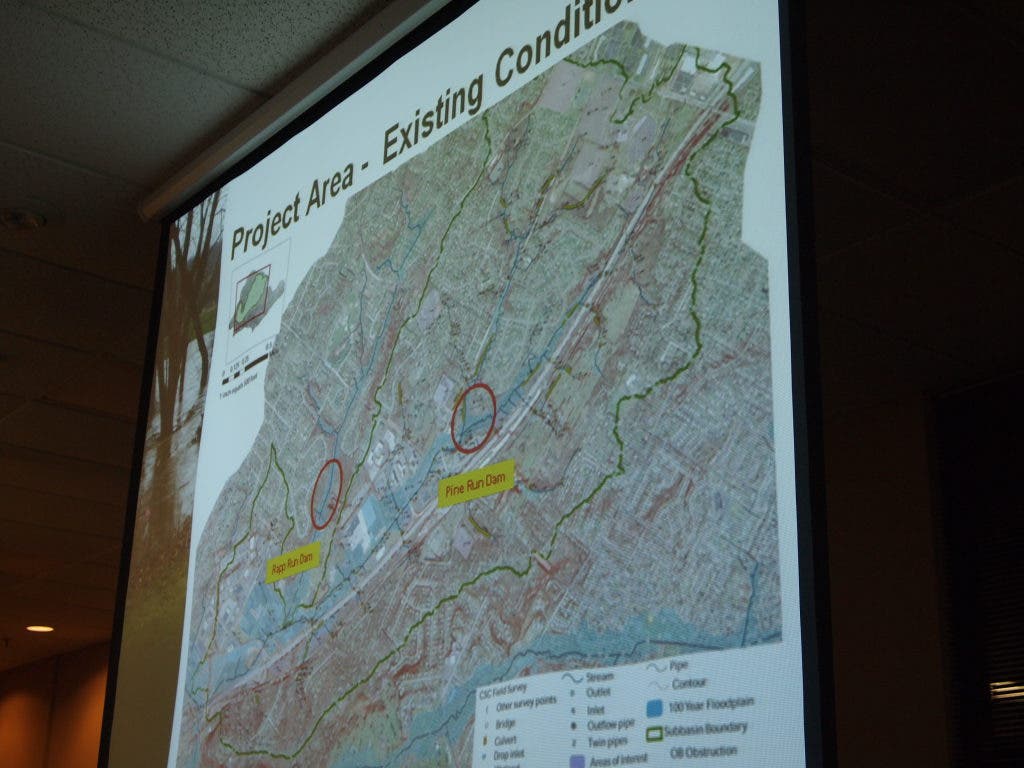
January is Superbowl time in America, as the country spends two weeks debating who is going to capture the biggest prize in the land. As far as Upper Dublin is concerned, the debate is done, the game is over, and the township just took home the championship trophy after a press release from State Senator Stewart Greenleaf's office announced that an $11.83 million H2O grant has been approved by the state to fund two sorely-needed '.
"This is a huge, huge win for Upper Dublin and its residents," said Board of Commissioners President Ira Tackel. "This was a completely bipartisan, incredible team effort. Everyone came to the table and everything was executed correctly … this is how you get things done."
The Commonwealth Finance Authority, which has the power to approve the grants, will formally decide on the matter Wednesday. However, according to township and state officials, the grant is a done deal. According to the press release, it was one of only five projects to be approved in this round of H20 grants.
Find out what's happening in Upper Dublinfor free with the latest updates from Patch.
Tackel said that in addition to Senator Greenleaf, representatives Tom Murt (R-152) and Todd Stephens (R-151), as well as the full board of commissioners, township staff, and URS engineers all contributed to the application process.
The press release cites a long history of flooding in the office park and surrounding areas as a reason for the approval of the grant.
Find out what's happening in Upper Dublinfor free with the latest updates from Patch.
"The property was developed in the early 1950s when public policy regulating flood plain management was first being developed," the release states. "The 65-building office park has regularly flooded over half a century."
The release also says that between 1978 and 2007, the Federal Emergency Management Agency (FEMA) paid flood insurance claims totaling $11.2 million as a result of the floods in the office park. In addition, it also cites an annual $250,00 decrease in local revenues from real estate tax assessments through the 1990s, the drowning of a 43-year-old worker in 1989, and other near tragedies.
“This flooding has resulted in millions of dollars in property damage and the loss of life over the years,” said Senator Greenleaf. “The Fort Washington Office Park is an important source of employment and tax revenue for Upper Dublin Township and its schools. We worked long and hard with the Commonwealth Finance Agency and the Pennsylvania Department of Environmental Protection to move this project forward."
URS engineer John Volk told the board in September that the structures would significantly mitigate flood damages.
“The structures would take a ten-year storm and make it equivalent to a 2- to 5-year storm. A 100-year storm with the dam? More like a 10- to 25-year event," Volk said.
A consultant added that the township could expect a return of $3.6 to $5.2 on every dollar invested, taking into account examined insurance payouts, delayed costs of the turnpike, business and residential damages, lost productivity and costs to the township for supplying emergency services.
The township commissioners made it a priority in the past year to take action on what they view as Upper Dublin's greatest challenge. Without acting to save the office park from flood waters, the commissioners reasoned that Upper Dublin would lose its key asset.
“It all comes down to ‘is the board ultimately going to find a way to fund this' and make a decision to actually build these dams?” said former board president Robert Pesavento in September. “If we don’t do that, we run the risk, a big risk, of losing a major portion of our tax base. If we don’t do this, we might as well move, because we’re going to become a township that has no business tax base, and it’s going to be all on the residents.”
With the status of the H2O application in question due to economic conditions and uncertainty surrounding the state budget, the board of commissioners had to make controversial decisions along the way. The first was of a total $1.2 million to URS to complete designs for the structures, with no guarantees the designs would ever be put to use.
The bigger decision took place during discussions for the 2012 budget, when the commissioners to begin construction on the projects. That translated into a 2.5 percent piece of an overall 5.91 percent tax increase, and roused criticisms from some residents that the board should instead draw down funds from its $12 million community reinvestment fund to pay for the structures.
"The board stuck its neck out," said Tackel, adding that he believes the commitment of the board helped show the state the township was serious. "[Those decisions] were huge signals that we were in it for the long haul, that the problem is important for the township and that we were going to act one way or another."
While the awarded $11.83 million appears to be close to the most recent estimate of a $12 million cost for the project in its entirety, township officials said those numbers had been revised down to a 'bare-bones' design, and that there was still a lot of math to shake out. In other words, it's too early to tell where the $3.5 million that was already approved will go.
"When it looked like we weren't going to get the funding, we scaled back things like pedestrian bridges and trails around the structures," said township manager Paul Leonard. "We have to review the very specific guidelines, what's an eligible expense or not… and [variables] like how far away the materials are going to come from."
"The township will do everything it can to continue on a fiscally prudent path, and one thing that can be assured going forward, is that the [projects] should have little effect on taxes," Tackel added. "We need to crunch all the numbers and see where we end up before we make any changes."
What is certain is that whatever the final cost, $11.83 million will not be coming from the township coffers, and that Upper Dublin just scored a major victory over its longtime flooding foe.
"Fortunately for us, all the stars aligned, and everyone did their job both politically and professionally," Tackel said. “We crossed our ‘T’s, came to the table prepared, and we were able to deliver.”
Get more local news delivered straight to your inbox. Sign up for free Patch newsletters and alerts.