Community Corner
Captain Radio Plays the Hits from Bygone Era
Folks at Southern Lehigh Library Sing Along
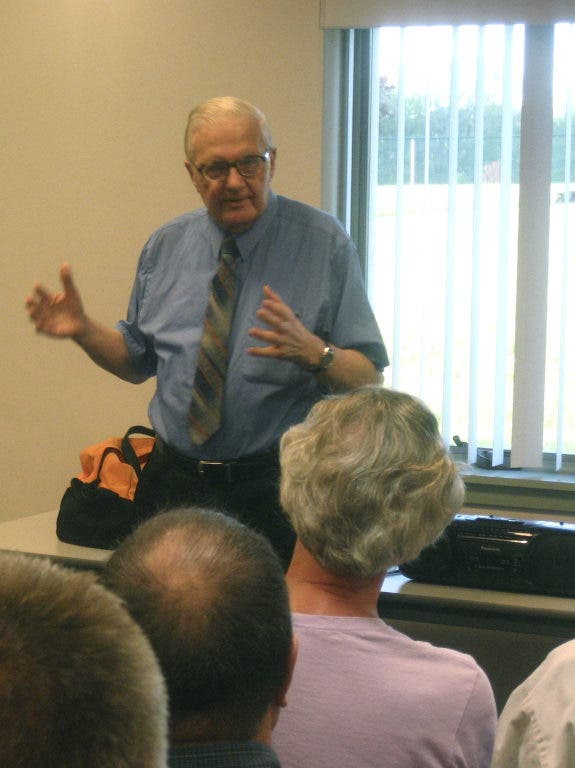


The theme was nostalgia Monday, May 10 at the Southern Lehigh Public Library. Captain Radio, also known as Joe Hehn, led listeners on a journey back in time to the heyday of radio
“We had a very good group,” said Sandy Andreucci, President of the Friends of SLPL, “I loved it; it certainly brings back a lot of memories.”
Armed with a boom box and a bag full of cassette tapes, Hehn captured the audience’s attention with his knowledge of radio history.
Find out what's happening in Upper Sauconfor free with the latest updates from Patch.
Quoting Orson Wells, Hehn reminded the audience that “radio is the theatre of your imagination.”
Hehn explained that in the days before television, people used to gather around the radio and listen not only to songs, but live performances of drama, mysteries and comedy.
Find out what's happening in Upper Sauconfor free with the latest updates from Patch.
Hehn said in his presentation that a million shows were recorded and saved by those that advertised on the radio, but, when television came along, advertisers destroyed some 900,000 recordings to rid television of its main source of competition. Hehn salvaged 30,000 shows and transferred them to cassette to help preserve and promote the history of radio. Since 1996, he has made it his mission to bring these nostalgic shows to anyone willing to listen.
Lynnette Seager, a librarian at SLPL was introduced to Hehn by Andreucci, long-time friend. Together they brought Captain Radio’s presentation to the library. “We were pleased with the turnout,” said Seager.
Hehn told stories that drew listener’s interest with each recording, occasionally dropping trivia questions to engage audience participation. With legends like Dinah Shore singing Easter Parade (1943), Al Jolson singing Oh, How We Danced (1951), Eddie Cantor singing Yes, We Have No Bananas Today (1923), and Tom Eldridge singing I’ll Be Seeing You (1944) each song brought a smile the audience as they sang along.
In addition to some of the greatest music of yesteryear, Hehn introduced folks to award-winning sports writer Bill Stern’s “The Portrait of a Diamond,” a story about how baseball player Connie Mac acquired a diamond from a convicted murderer and used to free a murderer while pursuing his baseball dreams.
“Hearing a story brings out the big differences—in TV you see everything,” said Hehn, “but on the radio, you see that in your imagination.”
It seems that almost anything that has happened on television, had its origins in radio and, somewhere in his bag, Hehn had a cassette to prove it. The first American Idol contest happened in 1943 on Major Bowes The Original Amateur Hour. Bob Hope first entertained troops in 1943 with a radio broadcast for airmen stations at March Field in California. Jack Benny floored audiences with comedy way before slap stick and physical comedy stole the show. Guy Lombardo charmed audiences and made the girls swoon.
The finale of Hehn’s show was Miss Kate Smith’s rendition of God Bless America (1938), which apparently was first entitled Thank You America before Smith suggested to Irving Berlin, the songwriter, that the title needed improvement. Because Smith improved the title, Berlin gave her 50% of the copy right. Smith and Berlin went on to donate all the royalties from this song to the Boy and Girl Scouts of America.
“You just don’t see that kind of thing anymore; it is unheard of,” said Hehn. His efforts to preserve the history of radio and educate listeners have not fallen on deaf ears, at least not at Southern Lehigh Library.