Politics & Government
Students Rally for School Choice, Senate Postpones Final Vote
Vote for S.B.1 postponed at least two weeks
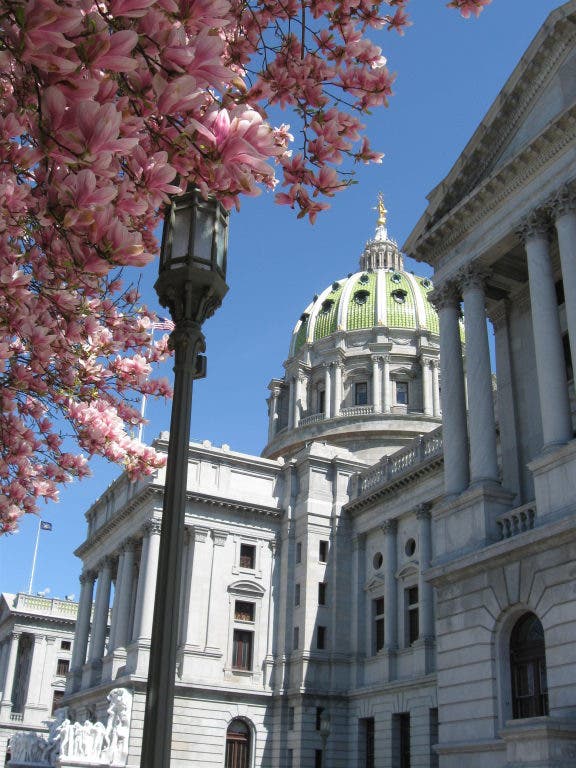
HARRISBURG — Students came to the capital by the school bus load Tuesday and told the Pennsylvania Senate that they wanted school choice and they wanted it now.
Now, it looks like they will have to wait another two weeks.
The push for school choice in Pennsylvania reached a fever pitch Tuesday, as the state Senate appeared ready to pass a voucher bill shortly after several thousand children and parents descended on the Capitol to support the bill’s passage.
Find out what's happening in Upper Sauconfor free with the latest updates from Patch.
Despite having the bill on the calendar, the state Senate decided not to have a final vote Tuesday and postponed the vote for at least two weeks.
The bill creates a comprehensive scholarship program for students to transfer from public schools to other public schools and private schools in the state, expands the existing Education Improvement Tax Credit program and creates a new board within the Department of Education to administer the program.
Find out what's happening in Upper Sauconfor free with the latest updates from Patch.
The bill establishes a four-year process for the implementation of the scholarship program. In the first two years, low-income students in the state’s 144 worst-performing school districts will be able to apply their school district’s state funding towards a different school of their choice. In the third year, all low-income students regardless of school district will have access to vouchers.
The Senate Appropriations Committee on Monday added an amendment creating a middle class scholarship program that would debut in the fourth year.
During Tuesday’s rally, both Gov. Tom Corbett and Lt. Gov. Jim Cawley spoke to the crowd.
While neither endorsed the Senate’s proposal, they spoke in broad terms about the need for choice in education. Cawley said the rally “marks a new day” for students in Pennsylvania, and Corbett promised students they would not have to keep coming to the Capitol for the next 25 years to make their point.
“We’re talking about the future of Pennsylvania,” Corbett said. “I’m very proud to be able to support the efforts to bring school choice to Pennsylvania; to allow parents to do what they believe is in the best interest of their students.”
State Sen. Jeffrey Piccola, R-Dauphin, the main sponsor of the voucher bill, said he is in the midst of conversations with the administration on its final form.
Budget Secretary Charles Zogby also stopped by the rally and supported the effort to change the way the state spends tax dollars on education.
“We spend $26 billion every year on public education, and we have far too many kids who are not achieving,” Zogby said. “And if we can put some of that money towards a plan which will allow them to achieve, that’s a good idea.”
The state Senate was set to vote on the bill Tuesday, but Republicans decided against holding a vote because some members of the caucus want to make minor changes to the bill, said Erik Arneson, spokesperson for Senate Republicans.
The level of support for S.B. 1 in the state House also is still in question, as Republican leadership has not publicly supported the bill as written.
Piccola said he has had conversations with leadership in the state House and expected the bill to undergo some changes in the lower chamber.
State Rep. Gordon Denlinger, R-Lancaster, estimated the bill would have the support of about 70 members of the Republican caucus, well short of the 102 votes necessary to pass legislation. Other members of the Republican caucus gave similar estimates.
While Republicans seem to be split on the bill, House Democrats are not unified in their opposition to the measure, either.
State Rep. Tony Payton, D-Philadelphia, said he plans to break with the leadership of his caucus and support the voucher bill in the House. He said there are “about 20 to 25 members” of the 90-member Democrat caucus that support the bill.
“Some of us put the kids first,” Payton said . “We know that this bill makes sense and that the parent should make the choice.”
Grassroots conservative groups have also been divided by the legislation.
Representatives from Freedom Works and the Kitchen Table Patriots, two influential Tea Party groups in the state, spoke at Tuesday’s rally in favor of the voucher bill.
At the same time, a coalition of Tea Party groups opposed to the legislation sent a letter to legislative leaders asking them to kill S.B. 1 in favor of more broad legislation giving choice to all Pennsylvania students instead of limiting the vouchers based on income.
“In order to achieve real school choice, middle income children must be given more than lip service,” said Sharon Cherubin, executive director of UNITEPA, a Lebanon County group opposed to S.B. 1.
The coalition praised the state Senate for amending the bill to include a middle class voucher program, which would take effect in the fourth year of the law.
Ana Puig, president of the Kitchen Table Patriots, said the voucher bill is a step in the right direction, even if some groups are not satisfied.
“We cannot afford universal choice right now, and we do not have the votes for universal choice,” Puig said. “We have to embrace incremental change to get this done.”
While some attack the bill for not going far enough, other are criticizing the cost of the legislation. A coalition of groups including teachers’ unions, opposed to the voucher bill said Monday that the proposal would cost Pennsylvania taxpayers more than $1 billion and would force local property tax increases.
“Spending taxpayer money on private school vouchers will make cuts to public school programs even more severe,” said Jim Testerman, president of the Pennsylvania State Education Association, the state’s largest public school teachers’ union. PSEA is part of the anti-voucher coalition.
State Sen. Daylin Leach, D-Montgomery on Tuesday said the bill created an “open-ended entitlement” for students.
Piccola said the bill would use only funds that currently are appropriated to school districts through the state’s basic education subsidy and would not require additional funds. Local tax revenues still would fund the local school district, even if a parent decided to redirect the state-level funding toward tuition at a private school or ad different public school.
Boehm is a journalist with the Pennsylvania Independent