Event Details
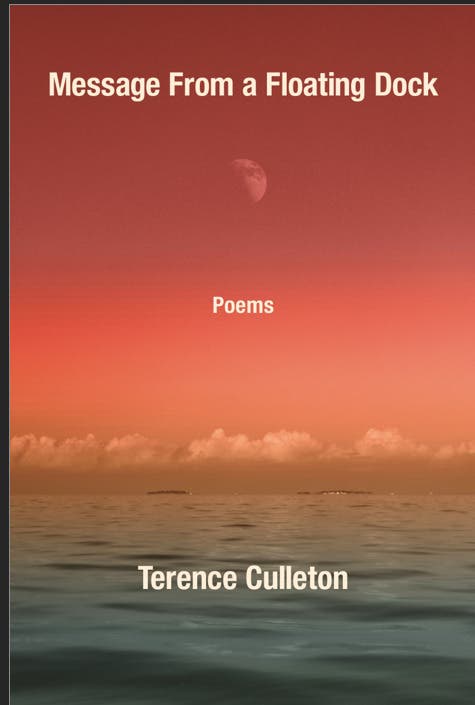
Langhorne PA, July 2026 — Former Bucks County Poet Laureate and retired George School English teacher Terence Culleton’s fourth collection of poems, Message From a Floating Dock, is now out through White Violet Press, the formalist imprint of Kelsay Books. Message From a Floating Dock is a collection of fifty-two formal lyric poems (traditionally metered and rhymed) divided into five sections, each section focusing on a different aspect of the book’s unifying themes: beauty, loss, memory, redemption, the wonder and complexity of childhood.
Of Message From a Floating Dock, award-winning poet and fiction writer Joseph Chelius has said: “Reading these poems, I am struck by Culleton’s poetic gifts—his eloquence and wit, his verbal inventiveness . . . and his appreciation for the ‘ungovernable’ forces of nature, as reflected in the beauty of the lanternfly as it does its gruesome work.”
“Nowadays,” Culleton says, “everything seems mediated by the competing interests of money, politics, our shared anxieties about the future. The title poem is an invitation to the reader to just let go of name-calling and outrage and slogans and opinions. Just be a part of a natural world that’s unaware of our anxieties and divisions. Be at one with the wind and tide.”
But Why Formal Poems?
“I grew up in a musical household,” Culleton explained. “A very opinionated household, too. There were disagreements and they could be pretty heated. It was the sixties after all. But whenever music played or song broke out the divisions sort of melted away. Formal poetry is rooted in song. Specifically, the music of human speech when it’s caught up in thoughts and impressions. Music brings us together.”
“Writing in form,” Culleton says, “engages the ear as well as the mind.” He hopes readers will hear the music of the form.
Publications and Recognitions
Many of the poems in Message From a Floating Dock have been featured in publications nationally and in the U.K. Several have been nominated by editors for the Pushcart Prize and Best of the Web.
“They’ve had some success out there,” Culleton notes of his formal work. “Which is nice. I’m glad there’s still some room in the world for traditional forms. Some folks think form is old-fashioned. Stilted, maybe. I worked pretty hard, though, to make these pieces as conversational as I could. I think that’s why so many of them found places in contemporary journals. Editors don’t want work that seems artificial or out-of-date. They do appreciate well-crafted formal work, though.”
Praise for Culleton’s poetry:
“[Culleton’s] poems are rife with motion. . . . That motility might seem at odds with , , , traditional form . . . but there’s a blessed rage for order . . . and the artifice is often pressured by the changes that [Culleton’s] poems document. [T]he skillful control is reminiscent of Richard Wilbur.”—Temple Cone, author of Sky Bright Psalms and Guzzle.
“Intelligent, humorous, mouth-fillingly musical, and always thought-provoking, Terence Culleton’s poems pay allegiance to the whole history of English prosody . . . close your eyes and let the sound of sense carry you away.”—C.E. Mann, author of After the Pledge of Allegiance
Praise for Message From a Floating Dock:
In Message From a Floating Dock, Terence Culleton explores with wit and deep reverence the random and transient nature of everyday life: a leashed dog chasing a hare; a strip mall ravaged by a storm; an abandoned suitcase: “a mess/of shredded straps/and moldy pocket-pleats.” But time is fluid, and the speaker also returns to what is remembered—childhood, the early loss of his mother, an understanding of faith, “its minor angels/that they are real or loved for real.” These poems, written in form, keenly observed, and rich in language, celebrate both the “ungovernable” and the beauty of life; in them Culleton finds “the world a place to sing about/no matter what.”—Cheryl Baldi, author of Cormorants at Dusk
In Message From A Floating Dock, Terence Culleton finds in language itself a means of preservation and renewal as fresh as its point of origin in the love, sorrow, and yearning that seized him as a child: “I’d live to have/that life again.” And so he does in these lyrics of exhilarating sonic invention and keen observation. Moments of fleeting perception gather into a narrative stream, revealing how what’s ephemeral, when recollected, can have intention and direction, but “dreams stay as they are, shine as they will.”—J.C. Todd, author, Beyond Repair
Where to purchase:
Message From a Floating Dock is available through Kelsay Books at http://kelsaybooks.com/products/message-from-a-floating-dock?_pos=1&_sid=229ff1097&_ss=ror on the author’s website athttp://terenceculletonpoetry.com
Also available on amazon.com