Health & Fitness
Love Your Bugs
Bugs, and other invertebrates, are currently in the midst of a mass extinction. Some appreciation and tolerance in your garden could help maybe just a little bit.

Closing down the garden this time of year is a depressing task, as I take inventory of the successes and failures of this season. As all gardeners know, every year is different. Depending on sun and rain, the plants and how they were started, bug pressure, and human neglect, some parts of the garden thrive and other parts are, well, asking to be replaced.
This year was (and still is) good for greens and root crops: swiss chard, kale, carrots, and beets will all make it into the winter (and through it, if I can get those cold frame hoops built). Potatoes and onion peaked too early, giving me a moderate (and tiny) crop. Tomatoes were lousy, really lousy, which I blame on my seed-starting too early and under too weak lights. Growing grapes was fruitless (literally) since birds roosting on the trellis nipped them as they emerged. I did manage to grow two melons for the first time, only to have something (squirrels, I’m guessing) eat them before they were fully ripe. And fall raspberries have succumbed to grey mold, as usual, but still a decent berry year.
Find out what's happening in Barringtonfor free with the latest updates from Patch.
You win some, you lose some. All in all, I don’t mind if it’s a draw at the end of the season.
With minor exceptions, I don’t typically use insecticides, herbicides, or fungicides in my garden; because I’m convinced I’ll poison myself or my daughter. I did attempt to control fungus on the raspberries with a copper-based spray, but the need was too great and my motivation too low to get past one or two applications. And once or twice I used a soap-based insecticide to get rid of cabbageworms, which are a perennial problem, although I tend to put up with a good deal of their damage.
Find out what's happening in Barringtonfor free with the latest updates from Patch.
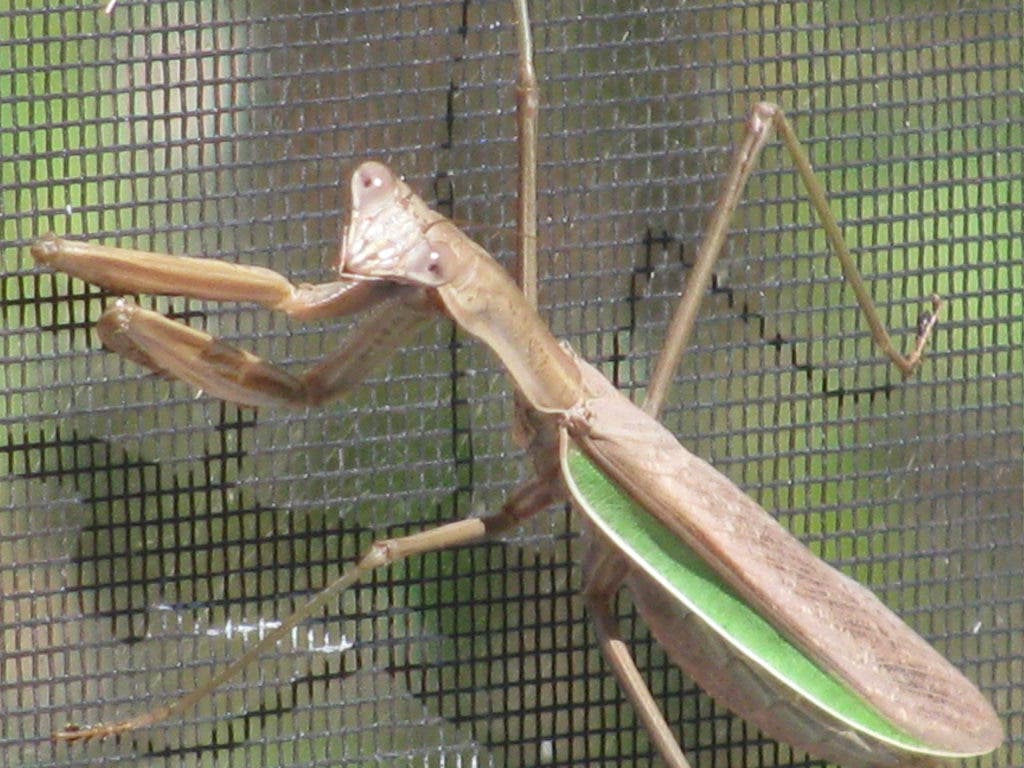
Bugs are seen as the gardener’s nemesis, but we don’t give them enough respect. Through my digging of dirt over the years, I’ve become fascinated with bugs, although I certainly have my preferences. While grand bugs like the preying mantis (which I delight in having in my garden) are quite captivating (pun intended), it’s hard to get excited about millipedes and sowbugs, although their role as decomposers in the garden is essential.
Pedro Cardoso, an entomologist at the Smithsonian Institute, recently came to the defense of bugs and other invertebrates in a recent article of Biological Conservation (Nov 2011). While the focus of his article was on conservation strategies, he presented some interesting facts:
- About 80 percent of all described (known) species on earth are invertebrates (animals without a backbone or spinal column) and 97 percent of all animal species are invertebrates.
- Invertebrates serve as pollinators, decomposers, predators, and parasitoids and are essential in nutrient recycling, decomposition, sediment filtering, and as prey (a food source for other species).
- There are about 30 phyla of invertebrates (depending on the taxonomic system used) including the more well-known arthropoda (insects, spiders, crabs, etc.), nemetoda (roundworms), annelid (earthworms), mollusca (mollusks, snails, slugs, octopus), porifera (sponges), and cnidaria (coral and jellyfish).
- Beetles alone comprise at least 10 times the number of species of all vertebrates together and over 25 percent of all described species.
Cardoso quotes Edward O. Wilson of the Museum of Comparative Zoology at Harvard: “[t]he truth is that we need invertebrates but they don’t need us. If human beings were to disappear tomorrow, the world would go on with little change… But if invertebrates were to disappear, I doubt the human species could last more than a few months…. Within a few decades the world would return to the state of a billion years ago, composed primarily of bacteria, algae, and a few other very simple multi-cellular plants.”
Cardoso also describes the accelerating mass extinction of invertebrates that is currently occurring as a result of human activities, such as habitat loss and introduction of exotic species, and estimates that at least 3,000 species are lost each day. Invertebrates are largely neglected in conservation studies, in part because people are not aware of the role invertebrates play in ecosystems and assume that protection of vertebrates also somehow protects invertebrates.
While my lack of pesticide use in the garden will no doubt have little influence on this mass extinction, it does give me an opportunity to see and learn to appreciate my suburban bugs. Every year my garden becomes host to grasshoppers, katydids, dragonflies, honey bees, bumblebees, and black swallowtail butterflies, as well as the less engaging earwigs, worms, spiders, and Japanese beetles.
Kids (more specifically, boys) love bugs, and I urge people to allow bugs to share their garden to give youngsters an opportunity to appreciate them. Plant herbs or a butterfly garden to attract bugs to your garden. Give them a little leeway in your vegetable garden. Or take a walk through some of our town’s conservation areas to see what resides there. Learn to appreciate this ancient form of life with which we share the planet.
As for the fungus on my raspberries; well, no one seems to have taken the torch to protect fungi from human intervention (although I may be wrong), but from my point of view, it’s in no danger of extinction. Given the amount of rain we get here in Rhode Island, I think fungi have found a happy home.