Health & Fitness
Say No to Grass
One of the biggest mysteries of our time is why men are so addicted to their lawns. It's time for a revolution.
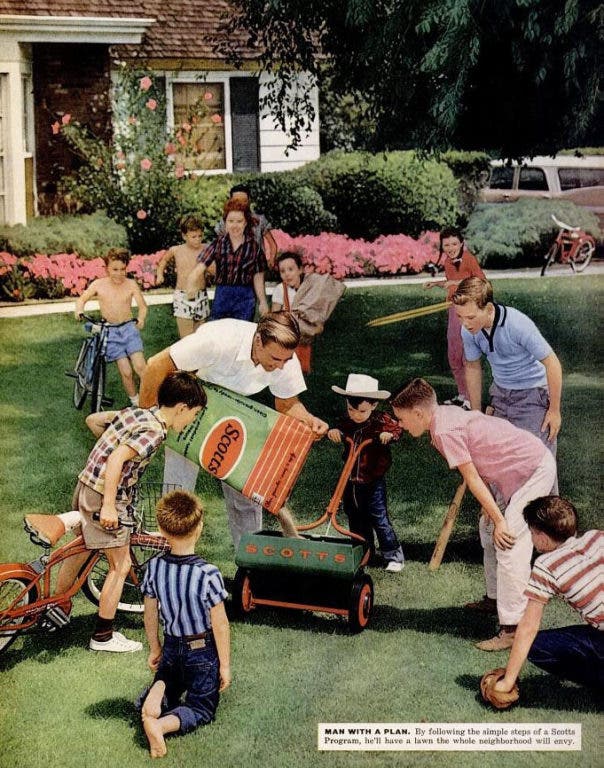
I can set my clock by it: Saturday morning at 9 am the lawnmowers start.
It’s a summertime ritual played out all over town, as the men rev up the heavy equipment and slash that grass into submission. Then they douse it with food and choke out any invaders with poisons; all in an effort to attain that smooth green field of grass; a smooth, insect-free, sterile, unnatural, and rather boring field of green.
To me, this is odd; the American Male’s obsession with grass. How did it come to be that this vegetative crew-cut has become a suburban standard by which a homeowner’s worth is judged?
Find out what's happening in Barringtonfor free with the latest updates from Patch.
Odd. Very odd.
It wasn’t always like this. Lawns first appeared in Europe in the eighteenth century, but did not become common in America until after the Civil War. Lawns were planted as a show of wealth, mimicking English estates. These early lawns typically included vegetable gardens, fruit trees, and grazing space for livestock and poultry. The homogenous green carpet lawn, with walkways and formalized plantings, were generally bred only by the wealthy that had the time and money to indulge in such a labor-intensive hobby.
Find out what's happening in Barringtonfor free with the latest updates from Patch.
In the early twentieth century, three groups broadened the popularity of a uniform, weed-free front lawn: the Garden Club of America, that spread the aesthetic from the City Beautiful Movement (an architectural and urban planning reform philosophy in North America in the late 1800s) through community landscape contests and school horticultural programs; the U.S. Golf Association, which promoted the uniformity and ruggedness of turf as the popularity of golf grew, and the US Department of Agriculture, which researched, imported, and bred grass species that would meet these new aesthetic standards.
World Wars I and II dampened the popularity of the suburban front lawn as supplies and equipment grew scarce. Citizens were encouraged to grow victory gardens to feed themselves so that commercially-grown crops could feed the troops. However, after the wars, the popularity of the front lawn re-grew as the aesthetic was again promoted by government and community organizations.
As expected with cultivation of a homogenous crop, lawn pest issues also grew. In response, chemical companies like Monsanto and Union Carbide introduced chemical weed and insect killers guaranteed to slay foreign intruders of the lawn. As homeowners were warned, “It’s time to take up arms against the weeds. From now on, when man and nature meet on the lawn, it’s dog eat dog….[Y]our best bet is… wholesale slaughter by chemical warfare, utilizing the impressive arsenal of chemicals now available to every lawn owner beset by weeds” (Changing Times, July 1955, Yes, You Can Have a Weed-Free Lawn). It was no longer a matter of impressing the Joneses, it was war.
By the early 1950s, many chemical products for lawn care entered the market, including 2,4-dichlorophenoxyacetic acid (2,4-D), chlordane, DDT, and toxaphene. There was no formal independent safety testing of these products. These products were generally viewed as benign; only slowly did the hazards of these chemicals become apparent. Banned products were replaced with newer, ostensibly less toxic products, but to this day still largely depend on disclosures from the manufacturers for information on safety.
As a result of this chemical use, “good” bugs as well as “bad” bugs were killed, plant diversity over large swaths of land was destroyed, and the chemicals ran off into water bodies and damaged wildlife. The yard became a chemically-dependent wasteland that needed constant attention. It was no longer a natural environment, but an artificial one imposed by man.
Today, lawns and gardens are sprayed with more pesticides per acre than is farmland, with weed killer the most-used yard chemical. According to recent U.S. EPA estimates for 2006-2007, 59 million homes in the U.S. used insecticides, 41 million used herbicides, and 14 million used fungicides. Billions of dollars (yes, billions) are spent by U.S. consumers yearly on home and garden pesticides. And the safety of these chemicals is still contentious.
2,4-D is the most widely used herbicide in the world and is contained in most weed-and-feed products. Exposure to 2,4-D has been reported to increase the risk of Non-Hodgkin’s lymphoma and amyotrophic lateral sclerosis (ALS, Lou Gehrig’s disease) (24d.org). Other lawn care chemicals have been shown to cause developmental or reproductive toxicity, neurotoxicity, and other adverse effects in laboratory animals. A Los Angeles study showed that parents’ use of pesticides in the home or garden during pregnancy was associated within an increase in childhood leukemia [Lowengart,et al. (1987) Journal of National Cancer Institute 79:39-46] and herbicide exposure before one year of age was found to increase a child's risk of asthma (Gilliland, et al. (2003) Early Life Risk Factors for Asthma: Findings from the Children's Health Study" International Conference of the American Thoracic Society, Mini-symposium, May 21].
Is this a surprise? After all, these chemicals are designed to kill or maim insects or plants; is it so far-fetched that they could affect humans?
So, despite the growing evidence that cultivating an unnatural, unproductive, and largely dead lawn is not benign, why does the American Male still aspire to this standard? Is it a morphing of the male urge to battle? Is the social pressure to show one’s command over nature that strong? Is there some twisted satisfaction in the weekly castration of the blade? I sure don’t get it; perhaps someone can explain it to me.
Myself, I’m an avid gardener, but production, not obedience, is my goal. Every summer for the last 13 years I have taken out grass left by the previous property owners to plant, well, anything but grass. I have flowers and vines, bushes and big grasses, fruits and a big vegetable garden in the front yard, and among them all, weeds. Lots of different kinds of weeds; some annoying but easily managed by occasional hand-picking, other subject to full-blown garden bed rehabs. And I have bugs: lots of bees, butterflies, beetles, and if I’m lucky again this year, some praying mantis. Very few grubs. And it is all delightful; my garden is a big riotous burst of life every season. My neighbors certainly won’t award me for the neatest, most well-manicured yard on the block, but I’m not looking for validation through my garden.
So, what can be done to wean the American Male off of the grass? What can be said to convince them (you?) that this is a silly and harmful waste of your time and money and that, in many people’s eyes, the monotonous green lawn in front of your house just says that you’re a willing victim of social pressure. And it’s probably not doing your health or the health of your family any good, either.
C’mon, buck the system! Stand up against conformity! Let a weed live!