Health & Fitness
Notable Building No. 3: Abbie M. Young House
Learn more about how a woman's house can reveal aspects of her personality.
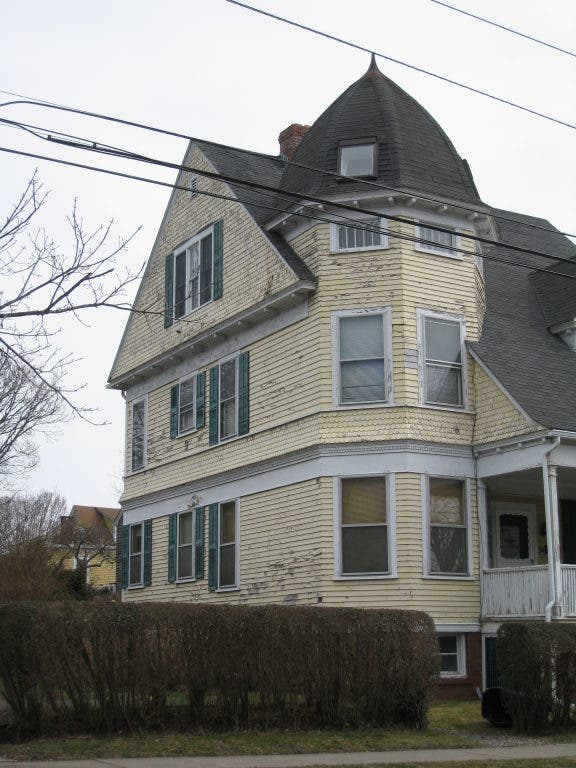


The tricky thing about researching women is that they often change their names. I think this is what’s happening with Abbie M. Young. I can’t find a birth record for her because Young is her married name. I don’t know what the M. stands for because it wasn’t recorded in the deeds. And, I think she married again, because there is no burial record for her in RI. All I know is that she was married to J.H. Young, who owned a pharmacy on the site of what is now Le Central Restaurant. Abbie remains a mystery.
But, her house is not. In 1889, Abbie built a stunning 2 ½ story Queen Anne house at 212 Hope Street. Visually, the house consists of three parts, the porch, the roof, and the tower. Together, these three hide what is actually a very large building. Step around to look at one of the sides and you’ll see. There are three full stories. This house is much bigger than it actually looks.
Design choices can tell us a lot about a person. On the front of the house, look closely at how deep the porch is, how steep the roof is, and where the windows are. You can’t see much of the actual house, can you? This design is about protecting privacy. The house isn’t uninviting. But, there are barriers placed between the hubbub of Hope Street and the interior of the building.
Find out what's happening in Bristol-Warrenfor free with the latest updates from Patch.
No self-respecting Queen Anne building would lack a tower. Here, it is three full stories with what must be an awesome view from the top. Do you wonder what she used that top space under the roof for? Me too!
Cut shingles are another feature of the Queen Anne style. The half-round ones are called “fish scale” shingles. They wrap around the building just above the first story. They also appear on the triangle of the dormer window on the second floor. The Queen Anne was a very English and very fashionable style in its day. Moreover, it was very flexible. You could do a lot with it.
Find out what's happening in Bristol-Warrenfor free with the latest updates from Patch.
Queen Anne houses usually have porches. The moldings of this porch are thin and delicate. They were made using a machine, not chiseled (if they were chiseled, they would be thicker and more robust). Also, the sequence of the moldings is very interesting. Look at the intersection of the porch and the tower. See how the moldings continue but the brackets do not? They change to a scallop motif. Huh. Most people would choose to continue one design or the other. Not here.
Maybe the tower or the porch were afterthoughts to the original design, I hear you think. Maybe, but I don’t think so. All the parts of the building are too dependent on each other to make that likely. It’s just quirky. Look again at the porch. See how the columns divide the porch space into unequal units? They could have been symmetric and even. But they’re not. This is a design choice. Someone chose this unequal pattern…..deliberately.
Who was that someone? Design intent is complicated in general. But here, the picture is even more muddy. The Charles Manchester House at 33 Central St. is a near-exact copy that predates Abbie’s house by a year. Its design came from a catalogue published by Chicago architect George A.W. Kintz. Both buildings may have been built by the same builder, Dennis Doran.
So, did Abbie get design inspiration from seeing Manchester’s house? Did she see the Kintz catalogue? Had she been to Chicago? Did she know Kintz? Did Dennis Doran sell her on the design independently of the Manchester commission? How did all this work?
Unless more information comes to light, we may never know. But, I’d like to put in a strong vote for Abbie. As the patron, she would have needed to approve the design. That places a great deal of power in her hands. And, in my opinion, it earns her a significant share of the design credit. After all, it was HER house. And, I’ll bet that like her house, she was both private and quirky. If she weren’t, we’d know a whole lot more about her.
Next up: Susan Gorham and Priscilla Talbee Lindsay
Last: