Health & Fitness
Notable Building No. 6: Harriet F. Munro House on Church Street
Discover one last house built by one of Bristol's more colorful women.
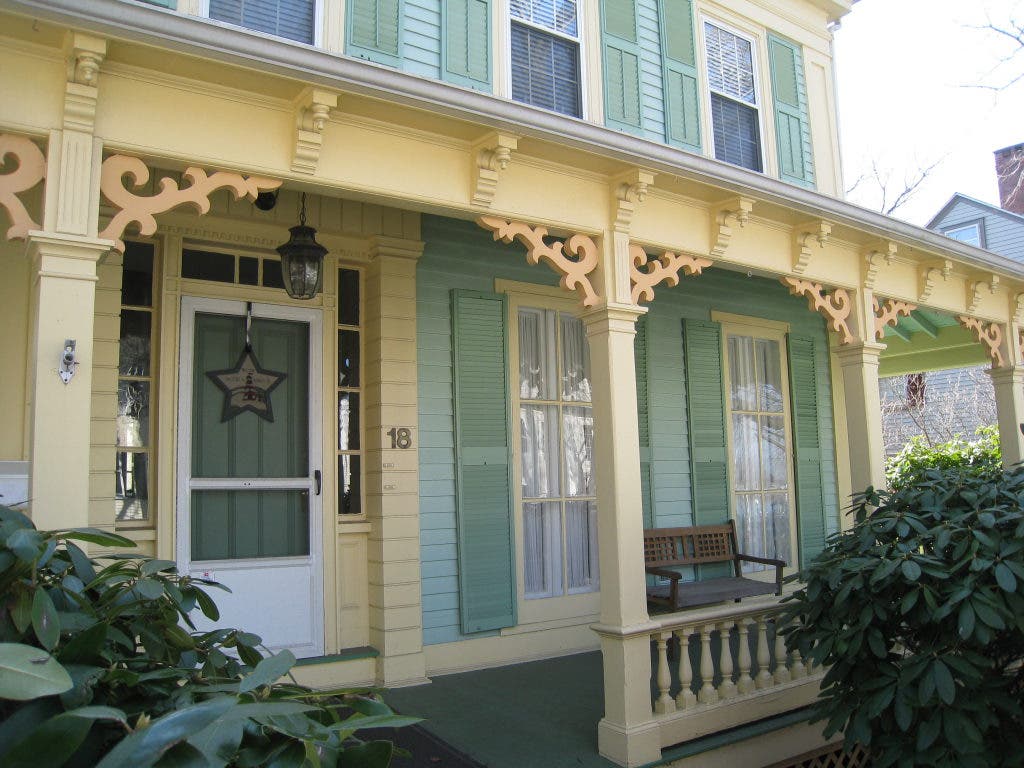


The Harriet F. Munro House is a really fun building! It’s a great place to end this tour.
Harriet Fales Munro was born in 1811 to Stephen Smith Fales and Phebe Wardwell Fales. Stephen was a “shipmaster,” which means he made a living from trade. He had interests abroad and even lived in Cuba for twenty years before returning to Bristol to die. His grave is in the North Burial Ground, if you want to go say hello. Phebe is there, too.
Harriet married William Wardwell Munro and in 1840, they purchased the lot at 18 Church St. from real estate developer Byron Diman. On it, they built a charming Greek Revival House. Yes, you read that right. The Harriet Munro House was originally Greek Revival. Look closely: under the porch is an end gable house (that means that the triangle of the roof faces the street). On the facade, the door is on the west (left) side with two tall windows adjacent to it on the right. The idea of a Greek temple is conveyed by the thick corner posts and the triangular roof. It’s actually a pretty typical Greek Revival building.
Find out what's happening in Bristol-Warrenfor free with the latest updates from Patch.
So, what happened? Well. In 1847, William died, leaving Harriet with two children and an estate worth about $37,000. This was a lot of money in those days. Harriet used it to remodel the house.
Look again at the facade and this time take note of everything that disguises the Greek Revival style—the porch, the brackets, the slight kick to the porch roof, the dormer, etc. Aren’t these features fantastic? This sense of style is very different from the orderly Greek Revival. In fact, it’s just about the opposite—fanciful versus rational. These features represent a different design mind at work. Harriet found her voice, I think.
Find out what's happening in Bristol-Warrenfor free with the latest updates from Patch.
The additions are very whimsical. Look closely at the decorations along the top of the porch. See the turned pendrils? Those are the little balls that hang down from the top of the bracket. Aren’t they fun? Pendrils are not usually used on brackets like these.
And, look at the scrolled brackets that run diagonally between the porch columns and the porch roof. Those are designed, but cut with a machine according to an original pattern. (We saw similar construction techniques at the Susan Gorham Cottage.) Now, move around to the west (left) side and step back. You might need to move across the street. Look up at the dormer windows. See the brackets repeating? But now, they’ve been rotated so that they stretch upwards, instead of out. What a great twist on the original! I just love this building!
I don’t know why Harriet made these changes so soon after its original construction. Perhaps she wanted to stay with the fashion. Maybe it was because she had some money burning a hole in her pocket. Maybe she had never really liked Greek Revival—maybe that was William’s idea. Who knows. But, it’s fun to see a woman changing the fashion of her house as she might change her outfit. And, they make the house hers, even if she wasn’t the sole originator of the design. My favorite part is that it happened in Bristol, where a Greek Revival building usually tends to stay Greek Revival.
And, I’m glad that Harriet got the chance to make these changes when she did. In her later years, she seems to have been pressed for money. She purchased two rental properties, one on Byfield St. in 1865 and one on “Crooked Land” in 1873. But, she sold both for the original purchase price—she didn’t make any money on the sales! And, also in 1873, she took out two mortgages on the rental properties. Were Harriet’s finances affected by the panic of 1873? Maybe, although she did pay off both the mortgages a few years later. There is no probate or inventory, so we can only guess. But, most telling is the final sale of this house, in 1882, by her son, William Henry Munro, and daughter, Mary E. Haszard (sic, according to the deed). They sold 18 Church St. for $2333.33 in January, 1882, about two months after Harriet’s death. Neither of them chose to live in Bristol. It appears that Harriet didn’t have much of a legacy to leave.
The Harriet F. Munro House, like the others I’ve profiled over the last couple of weeks, tells us a lot about how women thought about architecture in Bristol. These buildings were innovative, thoughtful, dramatic, and engaging—much as the women who built them must have been. Thanks for coming along with me. I’ve had a ton of fun—and I hope you did too!
Up Next: Take the full tour