Health & Fitness
Roots of Bristol Independence Day Celebration: PART XIII
On the Fourth of July, all roads lead to Bristol. Hope & High streets have been the principal routes of march for most of the history of the town's Fourth of July parade.
Street Striping
On the Fourth of July, all roads lead to Bristol. Two of the most important roads in town are Hope Street (Route 114) and High Street that runs parallel to Hope. These streets have been the principal routes of march for most of the history of the town’s Fourth of July parade.
First-time visitors have no difficulty in finding the parade route because the center traffic divider is painted with red, white and blue lines. Other towns also paint their street lines for special events but in Bristol the parade route lines are the patriotic tri-color all year long. It is this way because of a federal legislation passed in 1995. The following is an account of how it all came about.
Find out what's happening in Bristol-Warrenfor free with the latest updates from Patch.
In April 1963, the Providence Journal Bulletin published an article suggesting that the celebration committee had plans to paint a patriotic center stripe in the streets of the parade route. Something of the sort may indeed have been planned. Or, perhaps, the story was born of a trial balloon, sent aloft to gauge public opinion on the matter. Whatever the original basis of the story, it is now lost. The red, white and blue center stripe did not materialize in Bristol’s streets until 1969.
In the first year of patriotic street striping, only a portion of the route of march was painted. The portion being Hope Street from Franklin south to the intersection of High at the Lobster Pot Restaurant. In 1970, State Rep. Henry W. Pacheco, through the intercession of Gov. Frank Licht, was instrumental in having the entire parade oval (south on Hope Street from the west corner of Franklin Street to High Street, north the length of High Street to Franklin Street and west on Franklin to Hope Street) striped in the national colors.
Find out what's happening in Bristol-Warrenfor free with the latest updates from Patch.
Because politicians are naturally a contrary group, a difference of opinion arose between Democrat Rep. Pacheco and Republican Sen. Michael Balzano. Balzano called for limiting the striping to Hope Street, as in the previous year, and for using the remaining money to fill potholes along the parade route. He also cited the apprehension of High Street residents who feared their street would become a drag strip. State Director of Public Works Morris Chorney ended the dispute when he announced instructions were issued to paint the entire parade route.
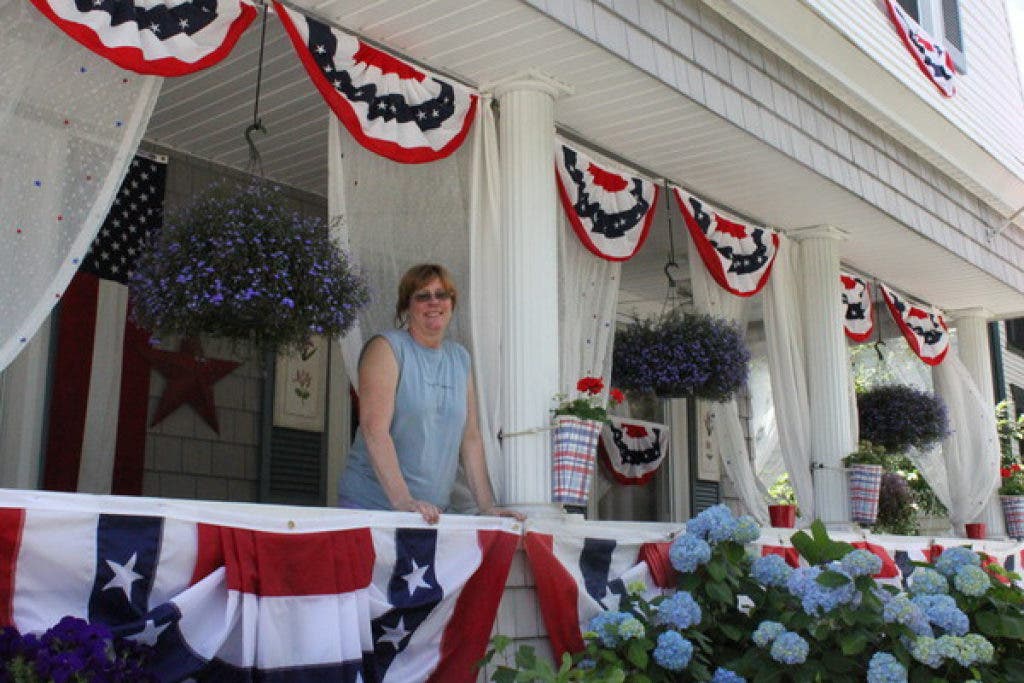
Bristol’s glorious Fourth was red, white and blue all the way; from flags and bunting to the stripes in the streets.
What has become a landmark in Bristol, and sometimes the most recognizable feature of the town to visitors, has caught on around the state. In 1980, Hugh Garman of the Rhode Island Department of Transportation, said, “Now we must have five or six towns that want the same thing.” He noted that in 1976 he painted red, white and blue lines in countless communities. “I think we must have painted the whole state.”
In 1976, the parade route was lengthened an additional mile. Beginning at Chestnut and Hope Streets, it continues to the intersection of High Street and concludes at State Street. Now, the striping job uses about 100 gallons of paint, 30 gallons more than the shorter route. The cost to the state for the 1980 striping was approximately $700.
In 1982 the DOT refused to paint the now traditional stripes down the center of the parade route streets. DOT Director Wood said that his budget for street painting would not allow the expense for Bristol’s Fourth of July tri-color striping.
Bristolians, not to be deprived of their tradition, passed the hat and raised more than the required $750 to pay the state for its street painting effort.
Again in 1983, the state DOT refused to paint the lines, complaining about the cost and that similar requests were coming in from all over the state. Newport gets a green line on Thames Street for its St. Patrick’s Day Parade, and Warwick gets a tri-color line for its Gaspee Days Parade.
Through the influence of local legislators, the General Assembly passed a bill allowing the DOT to paint the Bristol parade route. However, due to an oversight, the legislators did not include any money for the job. Gov. J. Joseph Garrahy rushed through a special appropriation bill that added the needed funds to the DOT street painting budget.
Since 1984, thanks to the efforts of the town’s state legislators the annual street striping has gone off generally without a hitch.
In the early 1990s, DOT Director and Bristol resident Retired U.S. Navy Captain William Bundy was concerned about the legality of having the red, white and blue stripes all year long. Tri-color traffic divider lines are not described in the Rhode Island Driver’s Manual. Because Hope Street is a state road, for safety reasons, Mr. Bundy had the double yellow stripes put back on Hope Street after each Fourth of July parade. Each year, this action caused trepidation among townsfolk.
To solve his dilemma, Bundy sent a letter to Sen. John H. Chafee requesting a formal waiver from the federal government, which would allow the tricolor stripes to remain after the parade.
Chafee, a long-time participant of the Bristol parade, replied, “I have fond memories of walking through Bristol, following the patriotic red, white and blue center lines along Hope and High Streets.” Chafee, who was at the time chairman of the Senate Committee on Environment and Public Works, said he would include the request for the waiver in the National Highway System bill.
Chafee introduced the legislation and was successful in having it become part of Federal Rules and Regulations. It states in Section 353(b): “Notwithstanding any other provision of law, a red, white, and blue center line in the Main Street of Bristol, Rhode Island, shall be deemed to comply with the requirements of Section 3B-a of the Manual on Uniform Traffic Control Devices of the Department of Transportation."
Since 1996, thanks to the National Highway System Designation Act of 1995, Bristol’s patriotic stripes have remained year round. Bundy celebrated by posting colorful traffic signs to indicate that the red, white and blue stripes mean two-way traffic.
With the new one-way traffic pattern on Hope and Thames Street that some folks are thinking should become permanent, which street will be Bristol's "Main" street and receive the tri-color lines? Any thought on that blog readers?