Health & Fitness
The Roots of Bristol’s 4th of July Celebration: Part VIII
Bristol's volunteer firefighters have always had a close relationship with Bristol's Fourth of July Celebration and played an important role in the activities of the day.
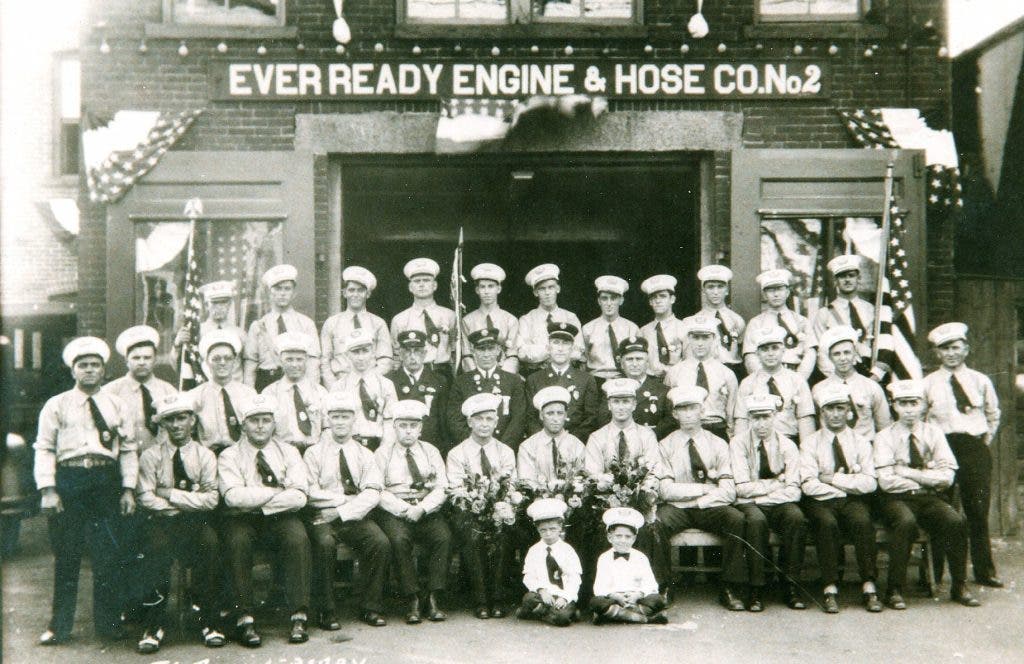

During the long history of our celebration, Bristol’s firefighters have acted in at least three distinct capacities. They display their patriotic zeal as marchers in the annual parade; they entertain us with displays of skill and professionalism as participants in the field day musters and water battles. Most importantly, they are always alert and ready to act for the public’s safety.
The fire companies always used the occasion of the parade as a vehicle to show off their stylish new uniforms and the advanced technology of newly acquired equipment. For example, the Phoenix report of the 1855 parade says, “The King Philip Engine Co., No. 4 made a very neat appearance on the 4th, in their new caps and sashes. Their engine was gaily decked with flowers and was drawn by two white horses.”
In 1883, the Fire Department under the direction of Captains Sparks (I've always thought Sparks was a great name for a fireman), Rawson, and Lawder was at its peak of performance and received the praise of all citizens. The Phoenix rose to complement the volunteers with these words:
Find out what's happening in Bristol-Warrenfor free with the latest updates from Patch.
The Fire Department in this town is just now in an admirable condition and reflects much credit upon the individual energy of the men. Captains Sparks, Rawson and Lawder are men well fitted for their positions as is evidenced by the discipline shown, and by the neat and attractive appearance of each company’s headquarters.
Next to our Glorious Fourth the event of the season will be the advent of the new carriage for [the] Hydraulic Fire Engine and Hose Company No. 1, arrived here Saturday morning from New York, via steamer from Fall River, and was taken to that Company’s house on Hope Street. It appears to be built in a workmanlike and substantial manner, [it] has four Archibald’s large size wheels, crane neck reel for carrying fifteen hundred feet of hose, drivers seat to carry three men, step in rear to carry three additional men, two tool boxes, one axe, one bar, two torches on the rear end, two side lamps, two fire department lanterns, one fifteen-inch gong, automatic breaks for the wheels and the hose reel—all carriage trimmings nickel-plated.
Find out what's happening in Bristol-Warrenfor free with the latest updates from Patch.
Weight about 1500 pounds. [It] can be drawn by one or two horses or by hand. The carriage is tastefully painted in vermilion and dark blue with gold stripes. In front the initial letters B.F.D. and in the rear HYDRAULION. It goes without saying, that the Hydraulion boys are proud of this thing of beauty.
We also understand that this piece of modern fire fighting apparatus was the highlight of the 1883 parade.
By 1888, the parade had grown considerably in the number of marching participants. A total of five divisions were in this particular march. Although, at this date, the procession still does not yet have an official title—but, all the elements with which we are familiar are present.
The Phoenix reported the order of the 1888 parade included these five divisions:
The lead division is the Chief Marshal’s Division; the First Division: Military; the Second Division: town officials; the Third Division: Bristol Fire Department; and last, the Fourth Division: sports clubs.
The Hydraulions and the King Philips turned out in good numbers and came in for their share of praise. The streets along the line of march were crowded with spectators among whom could be seen a large number of visitors from surrounding towns and cities all apparently enjoying the features of the occasion.
During the day two small fires occurred. The first about 7 o’clock in the morning was a small building in rear of Thames Street near Franklin, the other about 9:30 on Court Street by a kerosene stove taking fire. Damage light.
After the 1892 parade, the men of the Hydraulion Engine & Hose Company with the Narragansett Engine Company from Warren, and their guests went to the Church Street Firehouse where a banquet was served. The favor was returned in 1895 when the “Hydes” went to Warren on July 4, marched in the parade there, and were guests of the “Gansetts.”
The Dreadnaught Volunteers held a general reception at their hall for their friends, while the King Philip Steamer firemen extended a welcome to the celebration‘s Arrangement Committee at their hall. Later, all the fire companies and their guests met at the Grand Army Hall, and partook of a “luxurious dinner.”
What appears to be the first large Firemen’s Muster took place in 1920 when 14 tubs were in the playout. Two Bristol engines, Defender and King Philip, captured first and second prizes.
At the meeting held Tuesday, June 23, 1922, Chief Robert J. Anderson, a member of the Fireman’s Muster Committee reported that nine hand engines and four hose companies accepted invitations to the muster. The visiting firemen were also bringing five bands to participate in the parade.
The length of the 1922 parade was made longer with the addition of 13 fire companies with their “tubs,” and the many band and drum corps that accompanied the firefighters supplied ample music all along the parade route.
The old Hydraulion hand engine was brought out of storage after 20 years and appeared in the 1924 parade. The old tub, hand-drawn by members of the company, bore a placard, “Built for the Town of Bristol in 1836. Helped save the City of Fall River, 1843.”
Shortly after midnight, July 4, 1927, the D’Wolf Inn wharf was partially destroyed by a fire of suspicious origin. Soon after extinguishing the D’Wolf fire, at about 5 o’clock in the morning, a fire was discovered to the rear of Charles Falugo’s store on State Street. The resulting damage was slight.
Regardless of their exhausting night and morning of fighting two fires, the Bristol Volunteers turned out and made a respectable showing in the morning parade.
Answering the alarm at 9:45 in the evening, firefighters hauled four pieces of apparatus to Bristol Highlands. When they arrived, they found the railroad waiting shelter completely enveloped with flames. The structure was destroyed beyond repair.
The first of the annual firefighter’s water battles occurred in 1928. This is how the Phoenix reported the event:
The holding of a water battle is a new feature for the celebration and it was probably because of this that all the necessary arrangements were not made ahead of time, which caused quite a delay before the ‘players’ got started. Once they did, however, they went at it vigorously.
The Defiance and the Hydraulions were first to fight it out. From the very start it was evident that the Defiance team had the jump on the ‘Hydes.’ The latter seemed blinded by the water striking them on their heads and consequently their stream was directed at a tangent and rarely struck their opponents.
Having won the decision against their first opponents the Defiance boys found the going tougher when they battled the Ever Ready team. Nevertheless, after the time limit was expired the judges gave them the decision and it proved popular with the crowd. The game was not only new to the players but also to the onlookers whose one ambition seemed to be to close-up on the teams. However, a stream of water with 125 pounds of pressure is an effective instrument in driving the crowd back.
The 1933 contest began with the wet and dry hose coupling contests. More than 2,000 people gathered to witness the event on the west side of the common. In all, fire companies from eighteen sections of the state competed for the hose-coupling prize, the coveted Governor T.F. Green trophy, in the Bristol County Water Championship match.
The eventual trophy winner was the Massasoit Hook & Ladder Company of Warren who defeated Bristol’s Ever Ready Engine and Hose Company team. However, the Bristol aggregation returned to the hoses shortly after and defeated the Defiance Engine and Hose Company for the town championship.
The crowd that lingered on the common witnessed an exhibition of baseball between the two leaders in the Twilight League competition. Occupying the ball diamond for the balance of the afternoon, the Defiance Engine and Hose boys crossed bats with the Olympian Club.
In 1934, the firefighters supplied the principal entertainment on the afternoon of the Fourth. At 1 p.m., the wet and dry hose coupling contests were held on High Street in front of Court House, twenty teams from all over the state took part in the competition. At 2:15 The Ever Ready and Defiance Hose Company baseball teams replayed a game to break a tie. From 7 to 8 o’clock there was a water battle between the Defiance and the Ever Readys on the common.
Six teams of five companies were scheduled to compete in the 1939 water battle, but only two teams showed up; the Defiance and the Ever Ready Engine and Hose Companies. After waiting an hour for the other teams to arrive, the games began. The Defiance boys took the trophy by holding a steady stream of water on their opponents for 8-minutes, 34 1/5-seconds. The boys form the Hydraulion Engine and Hose Company took an active part in the water battle by supplying the water using the Hydraulion pumper. Elsewhere on the common, other members of the Ever Ready Company engaged the ball team from the United States Rubber Company, running roughshod over them by a score of 21-3.
For reasons unknown, the Bristol Fire Fighters were missing from the 1943 parade, as were the Antique Automobile Division each of whom usually made up their own division.
For the first time in a great many years, Senator Daniel G. Coggeshall did not head the Firemen’s Division of the 1945 parade. The veteran firefighter, whose name is synonymous with the Bristol Volunteer Firemen, requested that he be excused this year because of the recent death of his wife; Fire Chief Moses Moore took his place as Marshal of the Fireman’s Division.
The 1948 Fourth of July Water Battle failed to materialize as planned when the Dreadnaught team did not show up on the field of combat. Therefore, the Defiance Hose Company split into two teams, and a pick-up team that called itself the Highland Farm Boys mustered and played games in a no-title match.
Although the official bonfire did not materialize, in 1955, the town was not without its share of fires over the three-day holiday.
Controlling a series of minor blazes managed to keep the volunteer firefighters busy and away from their family picnics. Youngsters disappointed by cancellation of the official bonfire set fires around town. Fires were set at Mill Gut, on Thames Street and near the Midway Steak and Lobster House.
The Mill Gut fire was set in hurricane debris on the west side of the gut and the Defiance Co. extinguished it, at 2:45 Monday morning. It was reset Monday night and was again snuffed out by the Defiance and Hydraulion Fire Cos. An orange crate near the Bay View Cafe on Thames Street was set on fire; the Ever Ready Co put that out. At 12:30 a.m., a small fire was set near the Midway; the Defiance Co. extinguished it. Another fire at the town dump was allowed to burn itself out.
Members of the rescue squad were kept active Sunday night with patrols, watching places that were rumored ready to be set off by pranksters. The Chief reported no trouble developed in these cases.
Because of the summer-long drought in 1981, the firefighters staged a tug o’ war and field day instead of the usual water battle.
According to Chief Edward R. Borges there were several firsts for firefighters in the 1981 parade. The chief said it was the first time that the Bristol Fire Chief had as his aides past fire chiefs, as well as deputy chiefs and secretaries of the Board of Fire Engineers marching in the firefighter’s division,
Also marching with the firefighters for the first time were officials from the Fire Prevention Bureau and the State Fire Marshal’s Office. Chief Borges also announced proudly that for the first time in the history of the town the firefighters were marching as part of the First Division.
During the 1990 parade, the rescue squad was called to a Charles Street address when a birth was taking place in the yard. People were picnicking in the yard when quite suddenly one of the guests began to deliver her baby. The paramedics got there quickly, but according to David Basler, “the baby arrived so quickly, he had grass stains on him when we arrived.”
On Sunday afternoon, the Defiance Fire Company No.1 snatched their second first-place trophy in two weeks. The water battle victory added to the previous week's triumph in the muster.
These are just a few anecdotes of Bristol’s volunteers’ participation in our annual celebration of Independence Day; they are presented to illustrate the dedication to the principals that are the hallmark of Bristol’s stalwart citizen firefighters.