Health & Fitness
The Roots of Bristol’s 4th of July Celebrations: Part IV
How the Committee and the Chairmen are selected.
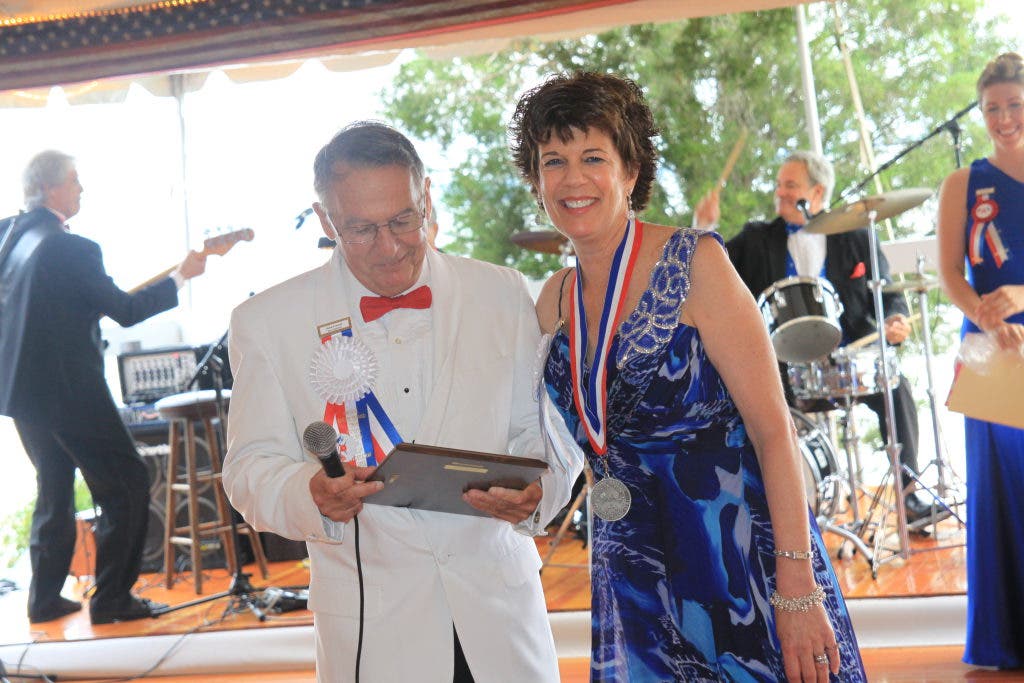
The Committee and The Chairmen
Long unknown and buried in dusty forgotten files the names of past Committee Chairmen surface.
The Early Years
During the early nineteenth-century the entire Fourth of July Committee generally consisted of three to five people. As the celebration grew in importance as a special civic activity, so, likewise the committee grew. Early Town Council records provide us with the names of committee members who were appointed at Town Meetings. Usually those appointed were prominent and respected citizens whose names are still recognized today. We can now add manes in chronological order to the exiting list of committeemen and fill the gaps in the list, which previously started with James D’Wolf, in 1820. We do not know if these men were called upon to act as a committee or they came forward to volunteer their services.
Find out what's happening in Bristol-Warrenfor free with the latest updates from Patch.
Further, we can only speculate as to the make-up of the committee; were all members equal or did they chose from among themselves, one to be their leader—Chairman. This same dilemma of first among equals, presented itself in 1975 when I was compiling the list of Chairmen. To solve the problem, I used two standards as a measure by which to judge which member of the committee was the leader: when an individual’s name appeared repeatedly in the press making announcements in the name of the committee, or failing that test; whom ever was the first person to be appointed by the Town Council in a particular year.
So, in at least the first half of the 19th century the names listed as “Chairman” are entirely speculative. For example, in 1822 and 1823 these men were appointed as a committee in the same order each year: Nath’l Bullock, Hezekiah Munro, Jr., and John D’Wolf, Jr., so for the record we call Nath’l Bullock, Chairman. Likewise, for the years 1824-25 George D’Wolf, Bryon Diman, and Jacob Babbitt were appointed a committee in that order; so we can say George D’Wolf was Chairman. Using these guidelines, we may assume that the following named men occupied the Chair of nineteenth-century Arrangements Committees.
Find out what's happening in Bristol-Warrenfor free with the latest updates from Patch.
1815-1816, Daniel Bradford; 1817, Colonel W’m Throop; 1818-19, No Record; 1820-1821, James D’Wolf; 1822-1823, Nath’l Bullock; 1824-1825, George D’Wolf; 1826-1827, Luke Daring; 1828-1829, W’m E. Morris; 1830, W’m E. Morris and John D’Wolf III; 1831-1833, No Record; 1834, Geo. H. Reynolds; 1835, Jacob Babbitt; 1826, Geo H. Reynolds; 1837, No Committee Appointed; 1838, J.M. Gooding; 1841-1843, No Record; 1844, W’m R. Taylor; 1839, No Committee Appointed; 1846, W’m R. Taylor; 1847-1848, No Committee Appointed; 1849, Jacob Babbitt Jr. and Richard Pearse; 1850, No Committee Appointed; 1851-1852, W’m R. Taylor; 1853, C. Esterbrooks.
The Committee
Until 1882 the committee was referred to by several interchangeable names, among which were: The Arrangements Committee; The Committee for Arrangements, and The Celebration Committee; it was not until 1883 that the committee was first called The Fourth of July Committee and it stuck.
In 1927, the committee consisted of eleven members, some of whom thought that number was just right; other members thought that their ranks should be expanded to fifteen. After a vote on the question, it was agreed that the size of the committee should be left to the discretion of the Town Council. By 1936 committee membership had swelled to 132. Now, membership is held consistently at the mid-90s.
These days people who wish to serve on the committee solicit an active member to submit their names to the Chairman. Each fall a subcommittee for membership is appointed by the Chairman to compile a list of nominations. The nomination of continuing members is automatic unless an individual has resigned or has not attended the required number of meetings during the previous celebration year.
Occasionally, when membership grows too large, new nominations are not accepted. The nomination list is forwarded to the Town Council for ratification and approval. It is rare for the Town Council to appoint individuals to the committee who have not been recommended by the members.
How The Chairman is Chosen
The chairman and other officers are chosen by a Nominating Committee, which is appointed by the Chairman. Members of the Nominating Committee are usually former chairmen or other members who have had extensive experience and have earned the respect of the members of the general committee. Though the Nominating Committee is autonomous, it may seek the opinion of the Chairman on his choices for Vice-Chairman and the other officers.
By tradition, and generally since R.S. Bosworth, Sr. chaired the committee (1948-1949), a Chairman holds his office for two one-year terms. The following year this same Chairman appoints a new Nominating Committee to select his successor and the other officers. Here the selection is a foregone conclusion, because the Vice-Chairman, following the same path of ascension as the Chairman under which he served, has held office for two years and expects to be nominated for the Chairmanship. The Nomination Committee, then, in effect selects the chairman-to-be two years in advance. Even though the Chairman appoints the Nomination Committee, it is not thought to be a rubber stamp for his wishes. If by the wisdom of the Nomination Committee, an incumbent Chairman is considered to have failed in carrying out the duties of the office in his first year, then the Nomination Committee could decide not to re-nominate him for the traditional second term. In the several years since 1953, when there have been one term Chairmen, it was by their choice not to accept a second term.
From the standpoint of the general committee there are certain qualities, which are incumbent to the making of a good Chairman. Through my experience on the general committee for ten years, as Chairman of several subcommittees, and as a member of the Executive Board for four celebration years, I learned firsthand what was expected of the person who was to assume one of the most important civic positions in town. The Chairman should be non-political, he should be unprejudiced in his personal beliefs, he should have prestige in the community and pay attention to and involve himself in civic matters. Additionally, committee experience is critical; the nominee should have served on and at some time chaired major sub-committees. In short, nomination and election to the post of Chairman of the Fourth of July Committee is a reward; it is an honor given to an able and deserving member.
The Chairmanship is rarely sought, and so, when it is bestowed upon a member it is considered an honor. And with the honor comes the obligation to fulfill that duty on behalf of and to the satisfaction of not only the committee -- but also the town.
A Notable Exception
Elections are democratic, and counter-nominations, opposing the official slate are entertained. Within the memory of old time members no challengers to the Nomination Committee’s selections have ever come from the floor -- with one notable exception.
Late in 1985, Gena Campbell waged a successful campaign to challenge the choice of the Nominating Committee: James Farley, Jr. Farley expected to be the Chairman for the 1986 celebration because he was Vice-Chairman for the two previous celebrations.
The Chairman of the 1985 committee called an election for new officers at a general meeting on September 16. In a paper ballot, Mrs. Campbell won by a reported wide margin, thus making her the first woman elected to chair the full Fourth of July Committee.
Thus feeling betrayed by the unfavorable turn of events in the change to the traditional line of succession, Farley took his dilemma to the Town Council. The council threw out the election calling it illegal, because the 1986 committee had not yet been appointed. A second election was held October 30, at the Bristol County Court House on High Street with all of the newly appointed members present. By a vote of 47 to 22, Farley defeated Campbell.
In a March 16, 1995, Phoenix interview, Campbell in her second term as General Committee Chairperson, said she believed the Town Council might not have had the legal authority to overrule the 1985 committee vote. She added that she could have had a lawyer challenge the council, but she did not want to mire the celebration in red tape.
Changing Times
All through the long history of Bristol’s Fourth of July Celebrations, the leadership was held by a self-perpetuating male autocracy.
That changed at the Committee’s September 1989 reorganization meeting, when by unanimous vote Elizabeth Anne Moreira was elected to chair the general committee. Though Ms. Moreira was the second woman to be elected to the Chairman’s position, she was the first woman to actually take the helm.
A 25-year veteran of the Committee, she had worked on several important sub-committees and held the elected offices of Recording Secretary and Vice Chairman.
Again for the 1994 and 1995 celebrations a Bristol woman has taken the leadership of the celebration committee; none other then Gena Campbell.
This precedent-setting election of woman to the post of General Chairperson was a sign of the future of the celebration committee. As greater numbers of women have joined the committee, the potential for women to become a dominant force and to assume more elected leadership roles is a self-fulfilling prophecy.
1990
Elizabeth A. Moreira
1991
Elizabeth A. Moreira
1992
Roger Dubord, Jr.
1993
Roger Dubord, Jr.
1994
Gena Campbell
1995
Gena Campbell
1996
Donna Marshall
1997
Donna Marshall
1998
Richard P. Luiz
1999
Richard P. Luiz
2000
Frances O’Donnell
2001
Frances O’Donnell
2002
Donna M. St.Angelo
2003
Donna M. St.Angelo
2004
James Tavares
2005
James Tavares
2006
Nat Squatrito
2007
Nat Squatrito
2008
David A. Burns
2009
David A. Burns
2010
Judy Squires
2011
Judy Squires