Schools
Silver Creek Collaboration Adds Goose Abatement
Keith Maloney of Save Bristol Harbor explains a new learning experience for Mt. Hope Students.

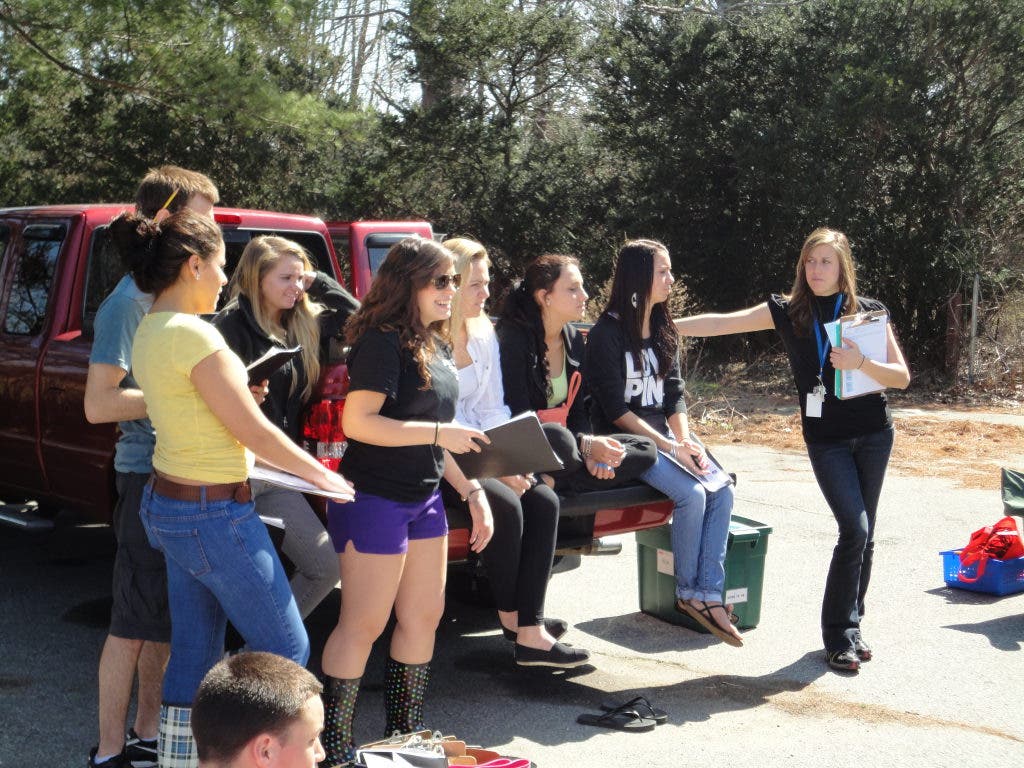

A collaboration among Save Bristol Harbor, Save the Bay, and the Town of Bristol was enacted four years ago to monitor and restore the health of the Silver Creek salt marsh in Bristol. This spring the field study includes goose abatement as a new learning experience.
Every three weeks students enrolled in the MHHS Environment Science and Marine Biology courses participate in a field study program in Silver Creek led by Save the Bay Educator Kati Maginel. She, along with MHHS science teacher Christine Bean and Save Bristol Harbor volunteers Bob Aldrich, Denise Arsenault, Bruce Carlsten and Keith Maloney, spend two hours each field day monitoring the health of the watershed. They do sampling and testing to measure water temperature, salinity, PH and dissolved oxygen levels. They also observe the growth changes of vegetation (particularly the receding amounts of phragmites) and the types and amount of fish and bird-life present. The hands-on learning experience and related curriculum give the students a comprehensive understanding of why a healthy salt marsh is so important to the health of Bristol harbor and, by extension, Narragansett Bay.
Recently, Save Bristol Harbor invited Jessica Blackledge of the Eastern Rhode Island Conservation District to present its program for goose abatement. Ms. Blackledge informed the students that the resident Canada Goose population is not native to this area, was introduced by humans in the 1940’s, reproduces at very high rates, i.e., doubling their population approximately every 6-7 years and poses a significant environmental hazard to the bay with its droppings (one goose produces four pounds of excrement every day). She explained there are many humane ways to manage the goose population and that one of the most effective is “egg oiling” which is approved by PETA (People for the Ethical Treatment of Animals) and the US Humane Society, among other animal rights organizations.
Find out what's happening in Bristol-Warrenfor free with the latest updates from Patch.
This method was presented to the students and will be implemented in Silver Creek, as well as other Bristol locations, in the coming weeks. Currently mature geese (>3 years old) are in the process of pairing off (they mate for life and can live up to 25 years) and will begin nesting in the near future; soon thereafter hens will begin laying an average of 6-8 eggs each. Once these nests are identified by volunteers and the hen and gander are humanely encouraged to leave the nest (using open umbrellas to do so), the eggs are tested in a bucket of fresh water to determine the degree of development. If the eggs are subject to oiling, corn oil is used to make the shells non-porous; as such, these eggs will not hatch. If they are found to be viable, the eggs will be returned to the nest and will hatch after approximately 2 weeks of incubation.
Ms. Blackledge will be returning to Silver Creek to lead the Mt. Hope High School students in this process sometime in April. Other sites around Bristol will also be visited for the same purpose.
Find out what's happening in Bristol-Warrenfor free with the latest updates from Patch.
If you are interested in volunteering in the Bristol goose abatement program, please contact Keith Maloney at ekm2x@cox.net or Bob Aldrich at bobbbeth@fullchanne.net.
The Eastern RI Conservation District will be offering training at other locations statewide over the next month; contact Jessica Blackledge at info@easternriconservation.org for additional information.
Article submitted by Keith Maloney
Get more local news delivered straight to your inbox. Sign up for free Patch newsletters and alerts.