Health & Fitness
Cranston Alzheimer's Research Pioneer Named a Time Magazine "100 Most Influential People"
Rudolph Tanzi created what has been called "Alzheimer's in a dish" — a breakthrough in efforts to better study the devastating disease.


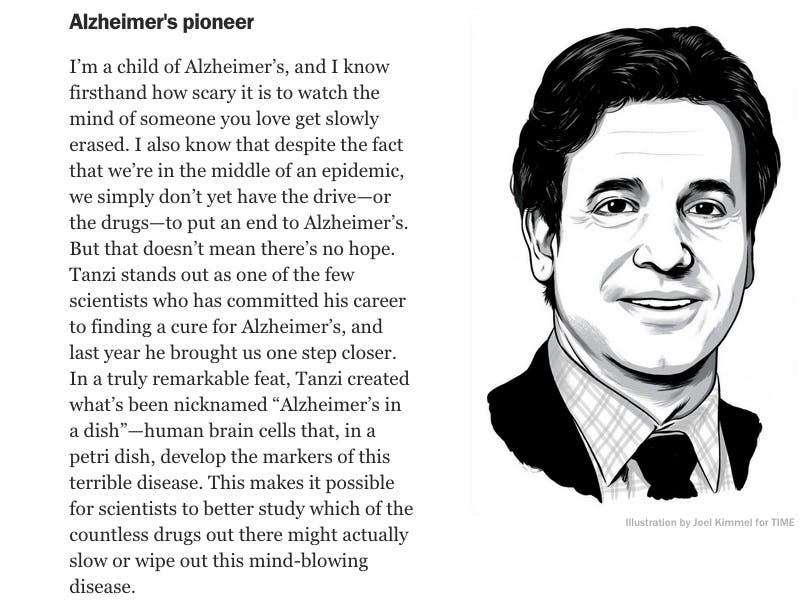
Cranston’s own Rudolph Tanzi has been named one of “the 100 Most Influential People” by Time Magazine for his research on the brain and Alzheimer’s diesease.
Tanzi, who holds the Joseph P. and Rose F. Kennedy Endowed Chair in Neurology at Harvard Medical School, created what has been called “Alzheimer’s in a dish” — a groundbreaking and transformative accomplishment that could lead to new understanding of the disease.
Explaining the reason Tanzi was selected, Maria Shriver wrote that she is a child of Alzheimers and “I know firsthand how scary it is to watch the mind of someone you love slowly get erased.”
Find out what's happening in Cranstonfor free with the latest updates from Patch.
“Tanzi stands out as one of the few scientists who has committed his career to finding a cure for Alzheimer’s.”
The reason the recent breakthrough is so important is that it lets scientists see how different drugs might slow the progression of the disease. It could lead to more rapid development of therapies and medications to go into clinical trials.
Find out what's happening in Cranstonfor free with the latest updates from Patch.
Tanzi will deliver the commencement address at the University of Rhode Island this year where he will receive an honorary Doctor of Science degree in recognition of his work.
Tanzi has set a goal of ending the disease by 2020.
GQ Magazine said Tanzi is a “Rock Star of Science.” Believe it or not, the neuroscientist also hosts Super Brain with Rudy Tanzi on PBS, co-wrote a New York Times Best Seller with Deepak Chopra and has recorded with Joe Perry, Aerosmith and other artists.
In 1980 he helped find the gene for Huntington’s disease—the first disease gene ever found by genetic linkage analysis.
Since then, he discovered the first three Alzheimer’s disease genes and several other genes for neurological disorders. As director of the Mass General Hospital’s Genetics and Aging Research Unit, he oversees several laboratories investigating the genetic causes of the disease while also developing several novel therapies for Alzheimer’s, two of which are in clinical trials.
Image Courtesy: Time Magazine
Get more local news delivered straight to your inbox. Sign up for free Patch newsletters and alerts.