Health & Fitness
Significant Townies And Their Houses
Around 1927, E. Gertrude Arnold walked up and down King Street telling us who lived where and when. Here are her thoughts on the house at 19 King Street.
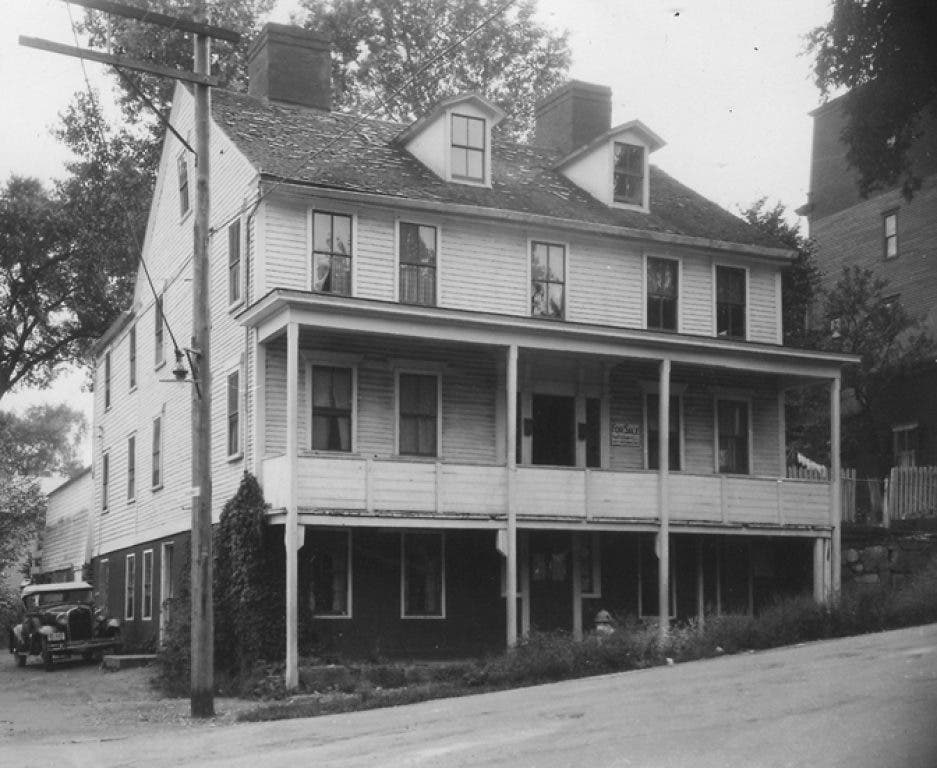

The following narrative is from A Walking Tour of King Street, by Emily Gertrude Arnold, ca. 1930. Miss Arnold was the official historian of the 250 Anniversary Celebration of the town in 1927. I could steal all her facts and make my own version of the story of Captain Salisbury, but why! She deserves a little respect in this historian community. — Alan F. Clarke
Captain Wiliam Page Salisbury,
Extraordinary Seaman
by E. Gertrude Arnold
Directly on the corner of King and Marlborough Streets stands the most beautiful residence of this, our most aristocratic street of long ago.
At the west end, it is two stories high but on the east, owing to a deep basement, there are three. This house has two beautiful front doors, one at the basement, the other on the second floor. The latter opens to a piazza the west end of which is on the ground level. This house is built just at the edge of a steep rise in the hill, therefore a flight of granite steps is necesary in the sidewalk. These are still in use, but years ago, as abutment was on the street side with a row of flagstones on the top.
One very dark night, before this was torn down, an old woman called Granny Railroad – there are conflicting stories as to why she was so called – walked down this abutment thinking it was the sidewalk and fell from the end into the gutter, some ten feet below. She escaped without injury except for a few bruises.
Except for the James Mitchell Varnum homestead, nowhere in [East] Greenwich is there to be found any such Colonial woodwork as is in this old Salisbury house.
Captain William Page Salisbury, who sailed as master of some of the finest ships belonging to the famous Brown and Ives Company of Providence, was a splendid seaman. Voyage after voyage he would bring his ships home safely and on time, no matter how many storms he encountered until “Salisbury’s Luck” became a byword with the mariners whenever they made a successful voyage.
The Captain, on returning from his long trips to the East Indies, brought home many handsome sets of Canton china, vases and beautiful bits of ivory and teakwood and until a short while ago, all these things had been kept together but now they are scattered to the four winds of heaven.
Captain Salisbury’s first wife died when they had been married but a few years and his second soon followed. On August 7, 1817, he married Mary, daughter of Ebenezer Spencer. She outlived him by a number of years. Much to the sorrow of the captain, there were never any children and when a small son arrived in his brother Cromwell’s family, they named him William P. Salisbury. This boy the captain always treated as his own son and when he died, left to him all of his large property. This heir lived in the old house for awhile, but later he built the fine residence at the corner of Melrose and Main Streets.
On a return voyage from China with a valuable cargo of tea and spices, Captain Salisbury’s ship ran into a hurricane. It was a terrible storm. The masts were carried away and it looked as if it was all hands for Davy Jones’ locker, but Capt. Salisbury, by his Yankee ingenuity, raised a jury-rig and under this bit of sail limped home. In Brown and Ives’ office they spent many an anxious hour watching for Salisbury’s ship. Finally they gave her up for lost and reported her so to the insurance company. Imagine their delight when one morning she was sighted down the bay. Just at this time there was a shortage of tea in the country and this ship’s cargo was worth thousands and thousands of dollars.
The insurance comapny, to express their gratitude to the captain, presented him with a beautiful silver tea service fittingly inscribed and it was one of the sights of our town to be taken to call on the captain and his wife, to be shown this tea service of which they were so justly proud.
After a number of years when he had amassed, for those years, a large fortune, the captain did as many an old tar has done before and since, retired from the sea, tried to do business on land and failed. Being no exception to the rule, he returned to the sea and took out the ship Roman for Liverpool. His ill luck on land still pursued him and when only a day’s sail from England, he was run into by the ship Richard Anderson and was so badly injured that in a few minutes they had to take to the boats. They rowed to the other ship, this though badly damaged, was still floating. The poor old captain’s heart was broken. To think that his luck had gone, that he had lost a ship. The shock was too much for him and in an hour’s time he lay dead. They buried him at Liverpool, England on March 16, 1840, and in the family lot at the South Burying Ground [First Avenue] there is a stone erected in his memory.
NOTE: Captain William Page Salisbury sailed ships owned by the Providence firm of Brown & Ives. Hope Brown Ives, daughter of Nicholas Brown and the Hope of Ann & Hope, was given by her father upon her marriage to Thomas Poynton Ives the estate which now houses Rocky Hill School. The house was renamed by her family as Hopelands and the Ives family eventually would, in the early 1800s, purchase almost the entire Potowomut Neck. Almost. We have Goddard State Park through the magnanimous generousity of her great-grandchildren. And that, children, is why we call it Ives Road.—AFC