Health & Fitness
Tax Time and Henry David Thoreau
As we pay our taxes, let us give some thought to the tax protests of Henry David Thoreau in the 19th and the Occupy movement this past fall, no matter what our beliefs on the topic.

The Occupy movement has either passed or is not getting any attention. When I assigned my Writing Culture students an essay on public space in the fall, I wrote the following along with them.
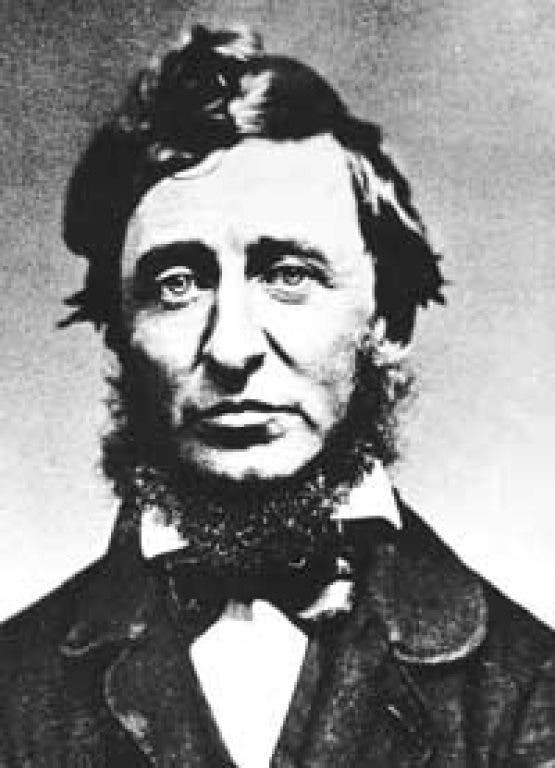
Thoreau published the essay “Civil Disobedience” in 1849. There are whole courses on this essay but, for the purposes of this blog, I notice primarily that he argued that if one opposed the ongoing war in Mexico and/or slavery, that the thing to do was to stop paying poll taxes. He criticized his contemporaries for seeing wrong and doing nothing about it. He accused them of serving “the machine of government” blindly and “sit[ting] down with their hands in their pockets, and say[ing] they know not what to do, and do[ing] nothing….”(228). He did not simply advocate what others should do; he acted. “I have paid no poll-tax for six years” (236). He was jailed, although bailed out by a relative within a day.
One of the issues underlying the Occupy movements in the United States this past fall is what Peter Morici, a professor at the Smith School of Business at the University of Maryland, calls the “economic bifurcation into the super affluent and the poor.” Taking his data from the Census Bureau report, Morici tells us “100 million Americans—one in three—live in or perilously close to poverty.” These poor are not simply those whom we would expect them to be, recent immigrants without English language skills, “but many are high school graduates or have been to college but can’t land a decent permanent job that permits skills building and initiates the climb to middle class affluence.... The problem isn’t too few educated Americans—degrees are worth less now—but too few good jobs for them to do.” On the other hand, there are the “super affluent,” those whom the Occupiers termed “the 1%.” Class divisions continue to sharpen in the United States and some think it is because of the tax laws and loopholes that allow the wealthiest to avoid paying an equal percentage in taxes.
Find out what's happening in East Greenwichfor free with the latest updates from Patch.
Not all of these super affluent individuals are comfortable with the discrepancies. New York Times writer, David Kocieniewski, refers to billionaires like Warren E. Buffet and Bill Gates who, along with the Democrats, want to end the tax breaks initiated by President George Busch in 2008 because these breaks add to the huge budget deficit and “contribute to the widening income gap between the richest and the rest of society, and shift the tax burden onto small business and the middle class” (para. 6 ). Keep in mind that the tax rate of the richest 400 people in the United States dropped from 30% in 1995 to 18% in 2008 as a result of Busch’s tax “reforms” (Kocieniewski para. 13). Yet, the Republicans object to an end of the tax breaks arguing that it “would harm the economy and cost jobs” (Kocieniewski para. 6 ). Neither does Morici support increased taxation of the wealthy as “many will just take their work and their income offshore.”
Kocieniewski’s New York Times article is actually an expose of Ronald S. Lauder, one of the heirs to the Estée Lauder estate and his tax avoidance strategies, while also detailing Lauder’s philanthropy; in fact, he received the Carnegie Foundation’s Medal of Philanthropy in November of 2011. For example, Lauder and his wife have donated many, many millions of dollars to rebuild Jewish communities in Eastern Europe that were devastated by the Nazis and by communists (para. 37).
Find out what's happening in East Greenwichfor free with the latest updates from Patch.
On the other hand, Kocieniewski reports many of the ways in which the Lauder estate avoids paying taxes, some so aggressive the IRS responded by changing tax laws:
- Early in 2011 Lauder created a tax shelter “to avoid as much as $10 million in federal income tax for years” (para. 9)
- After Estée Lauder died in 2004, the family challenged the I.R.S. in court and won a reprieve of $20 million in taxes (para. 19 )
- When the corporation, Estée Lauder, went public, a hedging strategy allowed the estate to avoid “$95 million in capital gains taxes” (para. 21 ).
Economic bifurcation indeed.
In the winter of 2011-12 people all over the world were outdoors occupying 747 public spaces. The authorities evicted them for many reasons. The protesters replied, “You can evict people, but you cannot evict an idea.”
As a former '60s activist, my favorite Occupy movement took place at the University of California-Berkeley. Chased out of their tent encampment early in the morning of November 17, 2011, by police, the Berkeley Occupiers tried something new. A YouTube video clip shows tents filled with helium balloons ascending in the sky. ABC 7 on-site journalist Jonathan Bloomberg tells the San Francisco TV audience that the clip shows the protestors bearing a sign saying “Our Space” that is held aloft by black and white balloons as they chant in call and response style, “Whose Space? Our space!” Bloomberg, treating the protest with due respect, says that the rising tent performance “flies in the face of the university regulation prohibiting tents,” punning on the word fly so that their escape from the law by aerial flight parallels their defiance of the law. This genre of protest is a clever way of avoiding legal consequences while continuing the local resistance to increasing tuition, etc. No, it was not the end; instead the students were pioneering their way upward claiming the air itself.
Bebeto Matthews NY Times
26 November, 2011
Ronald S. Lauder
Works Cited
Bloomberg, Jonathan. “Occupy Protestors Return to UC Berkeley. ABC7 KGO-TV.
East Bay News. 17 November 2011. Web. 3 December 2011.
http://abclocal.go.com/kgo/story?section=news/local/east_bay&id=8435331
Kocieniewski, David. “A Family’s Billions, Artfully Secured.” New York Times 26
November 2011. Web. 26 November 2011.
Morici, Peter. “Occupy Message Lives on after Ouster.” Commentary. Providence
Journal (24 November 2011). Print.
Thoreau, Henry David. “Civil Disobedience.” Walden and Civil Disobedience. Ed.
Owen Thomas. NY: Norton, 1966. Print. 224-243.