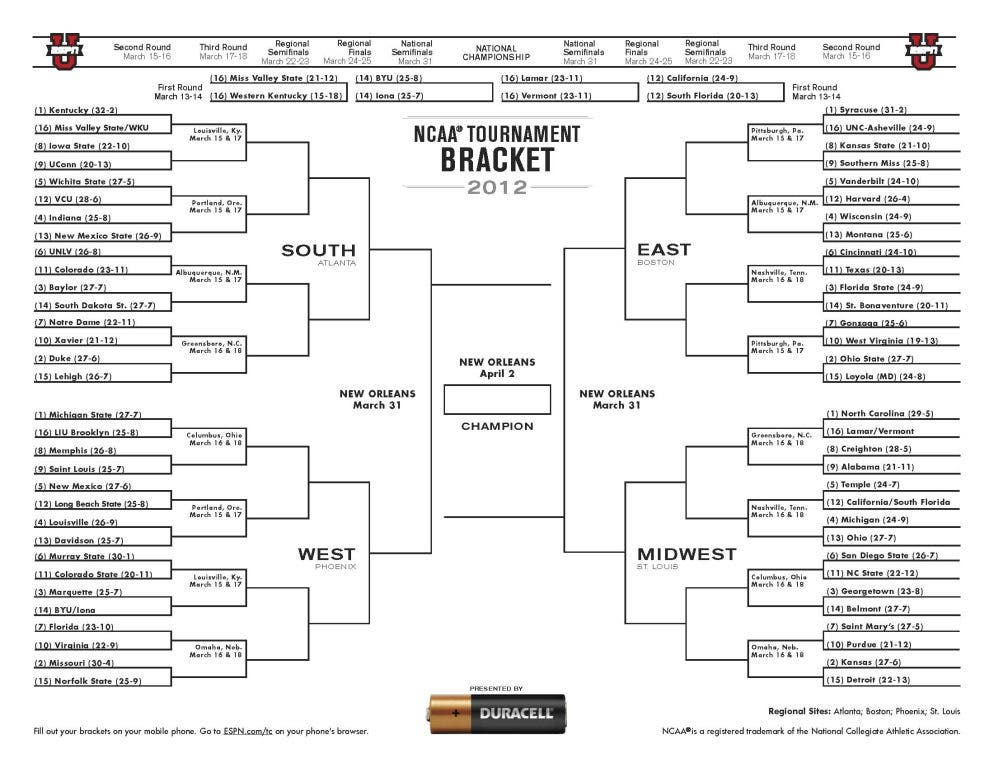
Technically, it’s the NCAA Men’s Division 1 Basketball Championship. But we all know it as March Madness, which kicked off in full force on Thursday afternoon. And that sound you hear – click, click, click – is the American workforce tracking the games on computers nationwide. According to one study, March Madness will be responsible for $192 million in lost productivity this year. Just imagine the emails: “Sorry, Kevin, but I have to move our Friday afternoon meeting to next week. Something came up.” Something like #8 Memphis versus #9 St. Louis.
When did March Madness enter the American sports lexicon? The term surfaced in 1939, the year the NCAA tourney debuted. But it didn’t refer to the college tournament. Coined by H.V. Porter, an official with the Illinois High School Association, March Madness described that state’s high school basketball tournament. The phrase didn’t become associated at the collegiate level until the 1980s, popularized by CBS sportscaster Brent Musburger. Not surprisingly, Musburger had worked in Chicago before joining the national network.
The tournament has given us other memorable phrases, such as the Final Four and Bracketology, which refers to the science of predicting the field for the tournament. After the first tip-off, though, theater trumps science. Top seeds fall, Cinderellas dance, and the game-by-game drama is exquisite.
Find out what's happening in East Greenwichfor free with the latest updates from Patch.
Major league baseball has given us 36 Game 7s in World Series history. March Madness offers the drama of 67 Games 7s – do or die – in three weeks.
In the midst of the madness, in some Providence sports bar, a basketball junkie will see ghosts and murmur that PC should have gone to the national championship game in 1973 to face Wooden and Walton and UCLA. If only Marvin hadn’t gone down with that leg injury in the semi-finals against Memphis State…
Find out what's happening in East Greenwichfor free with the latest updates from Patch.
Madness, indeed. Enjoy.