Community Corner
Call for Racial Justice Rings Loudly in Mostly White, Affluent East Greenwich
A march on Sunday was more than a protest about white supremacist flyers left on doorsteps.


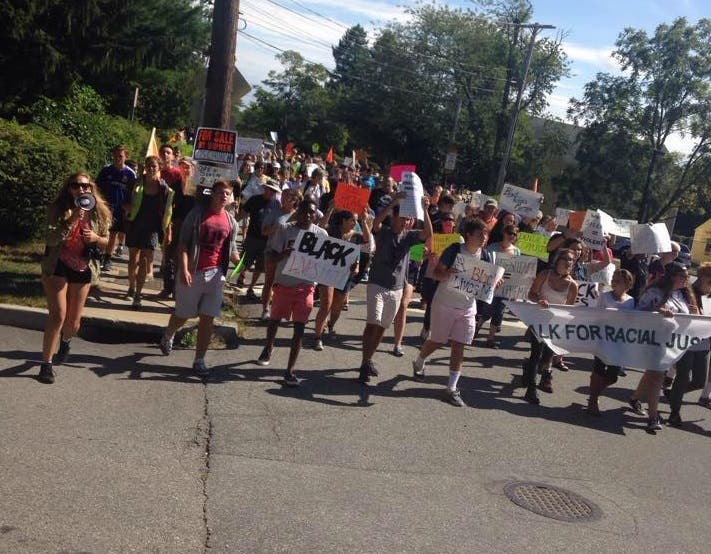
In East Greenwich, one of Rhode Island’s whitest and most affluent towns, a call to action has been sounded.
More than 200 people, a sea of young and old and mostly-white faces, gathered Sunday and marched while carrying “Black Lives Matter” banners and other signs in support of racial justice as they walked down Main Street.
Find out what's happening in East Greenwichfor free with the latest updates from Patch.
The march, organized by the White Noise Collective, was in part to loudly reject whatever motivated someone to distribute racist white supremacist pamphlets on doorsteps across town earlier this year.
And it was to take a stand against the actions this summer of a former School Committee member who smashed up a homeless black woman’s minivan at a local park in ride as she sat inside, terrified.
Find out what's happening in East Greenwichfor free with the latest updates from Patch.
It was also the signal of spreading community-wide reflection about privilege by people who benefit from being white and living in a place like East Greenwich, a safe community with top-ranked schools, a community of people whose children automatically have a better shot at being ready for college simply because their zip code is 02818.
Insulated, maybe. But these marchers are not content.
“White and affluent communities have huge potential and opportunity to use that heap of white privilege and economic privilege to disrupt racism,” said Rachel Bishop, who helped lead the organizing effort for Sunday’s march on behalf of the White Noise Collective.
“We can imagine what it might look like if communities across the country like East Greenwich started supporting the racial justice movement,” Bishop said. “Going in, it would be a powerful statement.”
The flyers, which were left on doorsteps and in plastic bags in the dark of night, declared the white race earth’s “most endangered species,” among other ugly messages. Residents were revolted, some called police. Others felt dismayed – how is such hate washing up on our doorsteps? they wondered.
And some others have been asking how to fight it.
The march is a symbolic gesture and served as an outlet for those frustrations. But it also led to tangible action.
The White Noise Collective raised $500. Half will go to Black Lives Matter, Bishop said. The other half will pay for a group of students to attend a college-level community education class run by Providence DARE, which stands for Direct Action for Rights and Equality.
Five local teenagers will get stipends to take the class and “learn black history they may not be able to learn otherwise in school,” Bishop said.
On Sunday, Sept. 27, there will be a screening f a documentary about civil rights activist Anne Braden, who was charged with sedition for trying to desegregate a Kentucky town in 1954 and became a prominent white voice in the civil rights movement. It will be held at Westminister Unitarian Church, where the march on Sunday started.
“We walk to let everyone know that we will not sit idly by and let racist actions go in this town without a response,”said Rev. Ellen Quaadgras of the church.
And the collective plans to launch a series of weekly talks beginning in October for people to come together, to ask the hard questions, to find common ground with people from all races, frankly and respectfully, Bishop said.
“It is an entry point for people into the racial justice movement,” Bishop said. “The idea is we want to plug people in so we can start directing ongoing conversations, to come together to talk about different issues and way white people can confront racism in our daily lives. Our conscious and unconscious biases, and ways we can fight structural racism given the positions of power we occupy.”
The conversations will lead to further action, though Bishop said the White Noise Collective will take its cues from racial justice organizations of color and is offering “help with their campaigns, for more bodies to show up at their events, to say to the racial justice movement ‘we are here as an asset for you,’” she said.
Many of the people who attended the march said they come from across the state. They said they live in mostly white communities and we “need to talk about these things,” Bishop said.
“We can all be anti-racist, regardless of what race we are, but it’s a matter of seeing reality and being open to the idea that people of color live and walk with racism,” Bishop said. “We know it to be true in our bones. Some white people need a little more help to see it - it’s not something we’ve experienced.
“There’s still a lot of work to be done in East Greenwich, but what I saw gave me a lot of hope for communities like this across the country,” she said. “People don’t just want to stand against racism. They want to disrupt it.”
This story has been edited to fix several typographical errors since it was first posted.
Get more local news delivered straight to your inbox. Sign up for free Patch newsletters and alerts.