Sports
Student-Athlete Concussion Law Expands Safety Requirements
With football double practices starting this week, coaches, trainers need to be even more vigilant when big hits occur.


The NFL isn't the only group trying to address the dangers of concussions. The General Assembly passed legislation in June to require concussion identification training for all coaches every year. That's in addition to legislation passed a year ago requiring the development of concussion prevention and identification guidelines.
According to EGHS football coach John George, these recent actions will help the sport.
"Nobody wants to play a kid with a head injury," said George last week. Double practice sessions for the football team begin today.
Find out what's happening in East Greenwichfor free with the latest updates from Patch.
The new law states that athletes who suffer a concussion must be immediately removed from play and not return until they receive written clearance from a licensed physician. The injured athlete must also get a parent or guardian to sign an information sheet about concussions and head injuries to inform them about all the risks and how to recognize one in the future. Under this law coaches also will have to take a refresher course each year about head injuries.
Although concussions can happen in numerous high school sports, they are perhaps most common in football. A lot of times the student athlete will show signs of a concussion but will not want to sub out of the game. This new law, to be enforced by the Rhode Island Interscholastic League and coaches, will make that harder.
Find out what's happening in East Greenwichfor free with the latest updates from Patch.
Coach George conceeds that some kids do try to hide head injury symptoms. "You definitely have to know your kids," he said, referring to those kids who may be so gung ho to play that they put themselves in danger.
According to George, six players suffered concussions last season.
"I think the new law a good idea because football is such a mentally and physically demanding game," said EGHS Avenger football captain Kevin Mason. "If your mind isn't working right you're not only going to make mistakes in the games but in life as well. Even though there's different severities with concussions, any damage to the brain ... can't be any good."
Mason, who will be a senior this year, was one of those who suffered a concussion last year. It was during an away game at Middletown and Mason still doesn't remember exactly how it happened but he came out of the game feeling sick and dizzy.
Mason then did some tests with the school trainer and he was told he could not go back into the game and his helmet was taken away. Kevin said he was frustrated that he couldn't return, "but now that I look at it, it was no doubt the best thing he could have done because I could've injured myself so much more with just one more hit."
There may still be football players and other high school athletes who have signs of a concussion but don't say anything so they can go back onto the field. But now coaches, trainers, adults and players will be more aware of how to identify an athlete with a concussion to prevent further injury.
George said that having a trainer - Tim Crandal - makes a big difference. "We are really lucky to have him," he said.
Most of the concussion requirements were put in place last year, said George. But this year, he said, athletes must undergo a baseline test of cognitive abilities that will be repeated in the event of a suspected concussion.
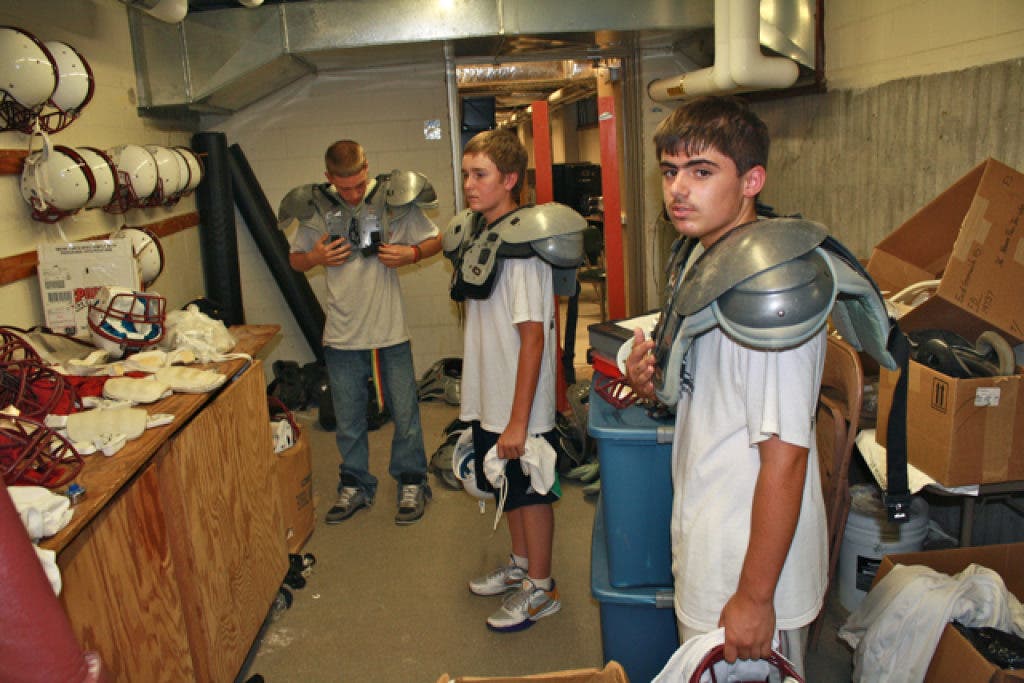
Listening to the new recruits as they got fitted for their pads, it's easy to see the difficulty faced by football officlals.
"It's no problem at all getting hit hard - it's a thrill," said Rory Cowman, who's going to be a sophomore. "If someone hits me hard, I get up and say, 'good hit.'"