Arts & Entertainment
In Rhode Island, African American Food and History are Tightly Linked
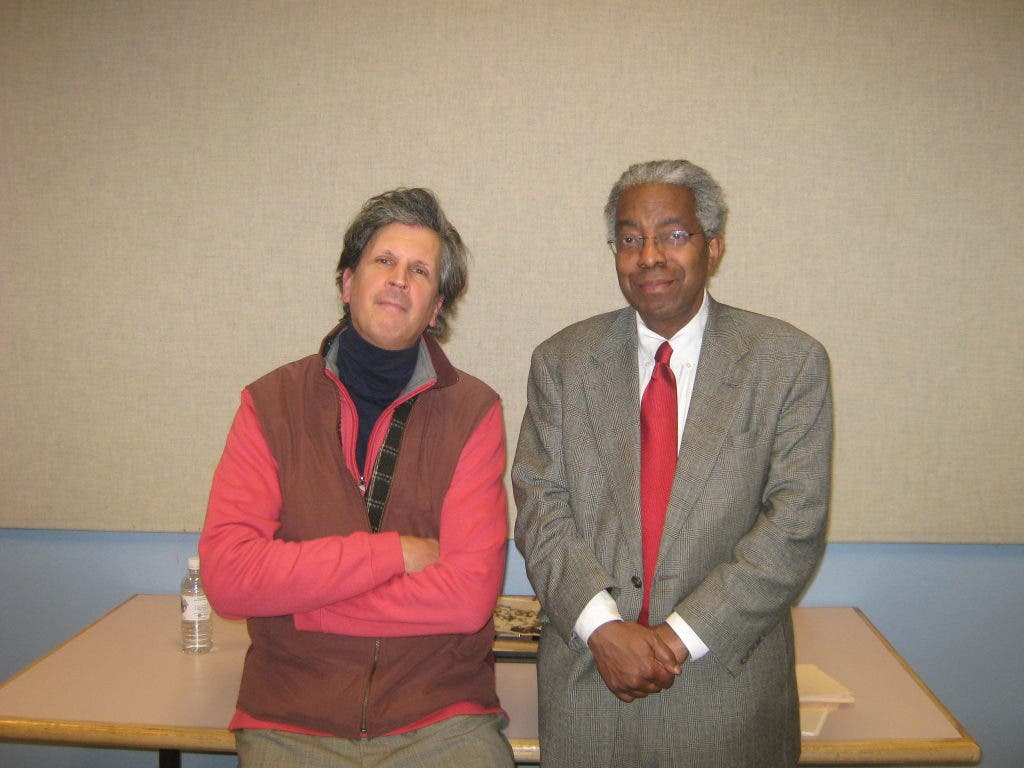
Local historians and rare book dealers Ray Rickman and Robb Dimmick spoke in East Providence Monday night about their exhibit on African American foodways in Rhode Island.
Jonny-Cake
1 cup stone ground white corn meal
½ teaspoon salt
Find out what's happening in East Providencefor free with the latest updates from Patch.
2 teaspoon sugar
1 ¼ cups boiling water
Find out what's happening in East Providencefor free with the latest updates from Patch.
Whisk together dry ingredients. Boil water and pour over meal mixture, whisking to prevent lumps. Let rest 10 minutes. Butter large skillet and heat to 375. Drop by spoonfuls, about 2 inches wide, and cook till golden brown. Flip and do the same. Serve with butter and maple syrup.
Jonny-cakes are the stuff of Rhode Island legend. They have also been staples of African American cuisine since slavery, along with turtle soup, plum cake, pickled oysters and other foods.
The recipe above comes from an 1882 book by Shepherd Tom called The Jonny-Cake Letters: Dedicated to Phillis, My Grandfather’s Colored Cook. Its author wrote that Phillis, a slave in South County, cooked jonny-cake that “made one’s mouth water to look at.”
Local historians Ray Rickman and Robb Dimmick shared the recipe Monday night at Weaver Library in East Providence. Rickman is a former President of the Rhode Island Black Heritage Society and Secretary of the Rhode Island Historical Society. Rickman and Dimmick are organizing an exhibition on African American foodways – cultural and social practices through food – for the Johnson and Wales’ Culinary Arts Museum.
Jonny-cakes are not just corn meal, sugar, and salt, Rickman and Dimmick said. Like many other traditional African American foods, jonny-cakes tell the story of a group whose culture was often defined by making do with what society threw at it.
The exhibit, sponsored by the Rhode Island Council for the Humanities, is called "Creative Survival: African American Foodways in Rhode Island." From slavery through the Civil Rights era, African Americans engaged in creative survival, inventing ways to make meals out of the carcasses cast off by white society, Dimmick said.
Before the Civil War, Rhode Islanders often traded food for slaves, Rickman said. At a recent auction, he came across a document from Newport that recorded such an exchange. It read:
Newport 12th November 1726
Then recd of Tho. Arnold Twenty One Barrels
Of Cyder & Thirty Seven pounds Four
Shillings In part of pay for Two Negroes
Documents detailing the state slave trade are surprisingly rare, considering that Rhode Island had more slaves per capita than any other state in New England and carried up to 100,000 slaves to America on its ships, according to the Report of the Brown University Steering Committee on Slavery and Justice.
Rickman said some estimate that up to 50 percent of Rhode Island residents were involved in slavery in some way, whether they insured slave ships, sold cloth for southerners to put on slaves or produced food that facilitated the slave trade.
One woman in South Kingstown baked Hardtacks, biscuits that could last 6 months, Rickman said. The men who traveled to Africa to kidnap slaves used the biscuits as sustenance on their long journeys to the continent.
Generations later, white Americans used food to discriminate against African Americans, Rickman said. Watermelon is a prime example, he said. The fruit is native to Africa, but it came to the United States through colonization and trade. When Africans came to America, they embraced the familiar fruit, and it became a central part of African American food culture. But later, white Americans used watermelon in their caricatures of African Americans, identifying the fruit with ignorance and low class, Rickman said. The image of the watermelon became a weapon against the black community.
“Even though white people ate them too, they began to use the watermelon against black people politically,” Rickman said.
Slavery also had an indirect effect on the foods African Americans ate generations later, Rickman said. The foods that make up African American cuisine were often a product of the poverty that ravaged the black community after slavery ended.
Rickman, who is African American, grew up in Detroit, Michigan before the Civil Rights era. During that time, most African Americans were poor, he said.
Dinners consisted of whatever Rickman’s parents could find.
“When we were kids, I didn’t know what a steak or a hamburger was,” Rickman said. “In our household on Sundays, we had chicken and dumplings, because it’s cheap.”
The dumplings were filled with chicken necks and innards the family would gather from free scraps left at restaurants at the end of the day.
“Black folks ate the food white folks didn’t want,” Rickman said. “You can’t even imagine this, how deep the roots of segregation go.”
The inclusion of dumplings in African American cuisine was another effect of discrimination, Rickman said. The only restaurants African Americans could go to in the 1920s were Chinese restaurants, which served dumplings, he said.
But the African American community also found empowerment through food.
George Thomas Downing, an African American resident of Newport during the mid-1800s, pioneered the oyster house in Rhode Island, selling the mollusks to white clientele, Dimmick said. George Downing's father, Thomas Downing, owned an oyster house in New York in the early century, according to the Columbia University Mapping the African American Past. Downing's Oyster House became a part of the Underground Railroad, as well as a symbol of African American entrepreneurialism.
George Thomas Downing followed his father’s lead in Rhode Island, making oyster pie, pickled oysters and poached turkey stuffed with oysters. Downing, who often snuck out late at night to intercept oyster fisherman before they came to shore, opened hotel-resorts in Providence and Newport, Dimmick said.
An outspoken abolitionist and a friend of fellow abolitionist Frederick Douglass, Downing won the disdain of some who disagreed with his politics, Dimmick said. But when someone burned his oyster house to the ground, he rebuilt it.
Downing was a “galvanizing and enduring symbol of black entrepreneurialism and culinary excellence,” Dimmick said. But as an important man of color, he has very little written about him, he said.
The blanks in African American history, particularly in Rhode Island, are the reason Rickman and Dimmick decided to organize the exhibit, they said.
“Often, people try to erase black history,” Rickman said, citing the recent controversy over the word “Plantations” in the official Rhode Island state name. When Roger Williams first established Rhode Island, the word “plantation” meant an exciting new settlement, a fresh start, Rickman said. And in any case, plantations and slavery are a part of African American history. By erasing, we risk forgetting, he said.
Rickman and Dimmick said they are disappointed by the lack of education and dearth of historical documents about African American culture in Rhode Island. They hope to bring a part the culture and history into the foreground through their exhibit, they said.
"Creative Survival: African American Foodways in Rhode Island" will open at Johnson and Wales on Sept. 22, 2011.