Community Corner
Advocates Say Bailey Brook Watershed Needs More Protection
A public forum sponsored by the grass roots Aquidneck Island Watershed Council recommends stricter enforcement of the buffer zone protecting a key drinking water source.
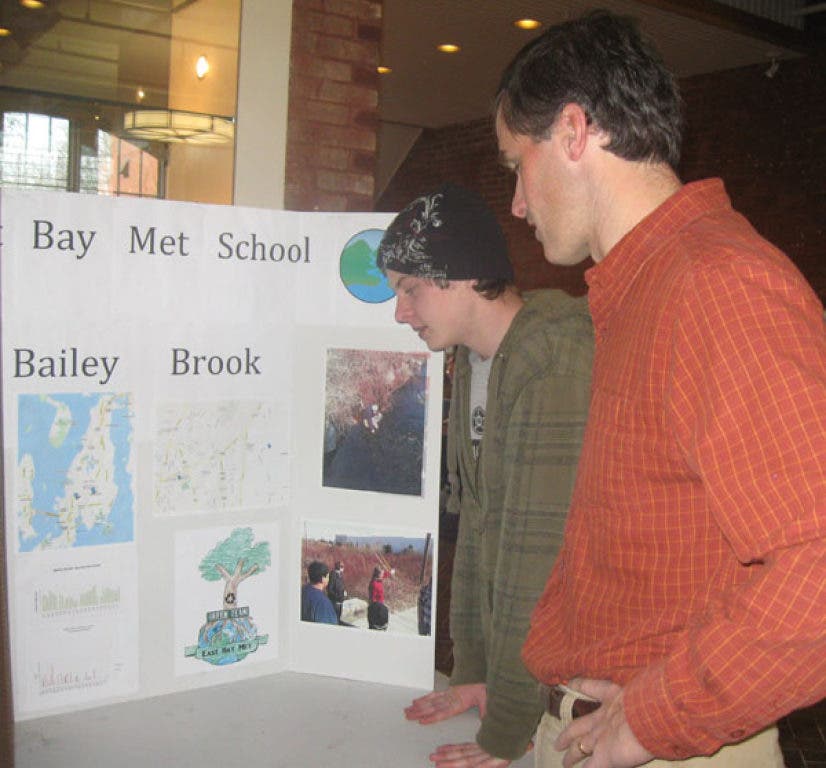

Water quality was the focus of a public forum/conference held on the campus of Salve Regina University recently, with key speakers giving reports on the status of watershed and coastal areas on Aquidneck Island. One common theme was the need to be ever more vigilant about protecting the watershed areas on the island, which are the source of drinking water for some 60,000 people.
Given particular attention during the public forum was the Bailey Brook watershed, which is located in the heart of Middletown and contains areas that are heavily developed.
Jim Marshall, president of the Aquidneck Island Watershed Council, a grassroots organization, referred to an engineering document (see attached PDF) showing a 2005 assessment of the buffer along Bailey Brook itself. Red outlines show areas where development has occurred within 200 feet of the stream itself.
Find out what's happening in Middletownfor free with the latest updates from Patch.
“What is a little disappointing is that the enforcement of the watershed protection district has not been as stellar as one would desire,” said Marshall, “but some of this development took place before studies were done, and goes back to the 1960s.”
A 200-foot riparian buffer zone is today widely recognized by federal, state, and local agencies. Middletown’s Watershed Protection District (WPD) regulations include development restrictions for areas within 200 feet of a water course or water body.
Find out what's happening in Middletownfor free with the latest updates from Patch.
Marshall suggested several things that could be done in existing developed areas that fall within the 200-foot buffer: “We should emphasize not using chemical fertilizers on any lawn in the watershed protection district, and we should encourage homeowners to construct rain gardens.”
Also making recommendations during the conference was Dr. Jameson Chace, associate professor of biology at Salve Regina University, who has played an active role in training and encouraging citizen scientists, such as the high school students at the East Bay Met School, who do regular testing of Bailey Brook and the Maidford River.
“The fundamental problem is that we have overbuilt landscapes on the island that we must first and foremost protect,” said Dr. Chace. “It’s hard to go into impervious areas and revert back, but we need to think about creative solutions, such as creating retention ponds and rain gardens. Ultimately, we need to protect as much land as we can, remediate land that has already been developed, and really identify the buffer zone perhaps even increasing it to 400 feet from 200 feet.”