Business & Tech
Tossing Back the Day's Catch
Lobstermen work twice as hard to land healthy lobsters as a mysterious shell disease continues to affect the industry.
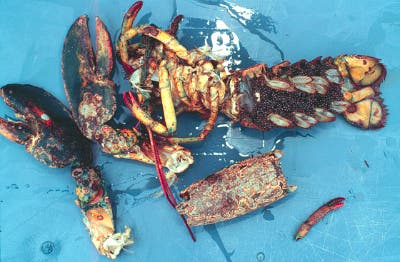

"We don't know what it is, but we know it's bad. That's enough, ain't it?"
Those were the words of Angus Cowan, 57, of Middletown, as he tossed a lobster from the stern of his scarred lobster boat back into the water as we slowly made our way back from Narragansett and past the state pier in Newport.
Both Angus Cowan and his partner lobsterman, Jimmy, 24, agreed to meet with me on condition that I refrain from using their real names. Like others in their industry, they fear being associated with "sick" lobsters. When I jokingly held up my iPhone to take their photo, hoping to elicit a laugh and return some of the rough but good-natured humor thrown my way during our trip, Cowan turned grim, threatening to throw the phone, and me, overboard.
Independent lobstermen are an increasingly rare breed in an industry dominated by the two major companies doing business here, Aquidneck Lobster Co. of Newport and the Newport Lobster Company of Middletown, from which most restaurants in Newport County purchase their lobster and fresh-trapped fish.
Before he tossed the crustacean back under the gray water of the bay, the lobster, its claws flailing awkwardly in Cowan's grip as he held it up for me to examine, did indeed look unhealthy. Its shell was dark brown, almost black in color, not bright pink-red. There were dark spots that disfigured its exoskeleton above the tail. It looked like the rusted fender of an old car pockmarked with body rot.
Cowan, who has been a independent lobsterman serving restaurants in Portsmouth, Middletown, Narragansett and Newport for approximately 30 years, has been approached by several local marine scientists to study his catch. But he's suspect of anyone, including this reporter, who inquires about the state of his business, especially in a down economy. He's even more suspect since "the blight," as he refers to it, has increasingly become a problem in these waters. Cowan calls the disfiguring disease affecting lobsters as "the blight" because of something his mother described in his native Ireland that every few years affected their vegetable garden. Jimmy, his partner, simply referred to it as "f---ing shell rot."
"The tourists, the restaurant owners, they don't care and they don't know," Cowan said with regard to the extra hours and pots he has to pull to make up a decent haul, and keep himself and his associate in business.
As reported by other media outlets recently, lobster shell disease was first noticed more than 10 years ago. While several wide-ranging theories abound about its origin – including environmental stress related to climate change, pollution, an unidentified invasive species and the spill of nearly a million gallons of home heating oil that occurred off Block Island in 1996 – scientists aren't any closer to establishing a definitive cause today than they were three years ago, when a Congressional mandate to study the problem created the New England Lobster Initiative at a cost of $3 million.
The Rhode Island lobster industry generates somewhere between $15 million and $20 million in annual revenue. Shell disease is believed to affect about 30 percent of the New England lobster population, but in other areas, such as Long Island Sound between Connecticut and Long Island, NY, the incidence may be as high as 50 or even 70 percent.
"There ain't nothing wrong with the meat, it's just the look of the shell. But try explaining that to some gaper on vacation from New York or New Jersey sitting down to table with his wife and kids on Thames Street. It ain't gonna happen. And so we spend twice as long pulling traps and tossing back the scabby ones," Cowan said.
One Portsmouth restaurant owner, as well as the head chef at a Middletown restaurant – both of whom declined to be identified for fear of being associated with diseased lobster, and the effect that might have on business – said separately that since they were made aware of the issue from lobstermen who regularly supply their establishments, they take a little more time in looking over the day's catch. While the chef mentioned that the meat from a lobster with shell disease could be removed from its shell to be used for lobster rolls or other dishes, with no one the wiser, he was careful to point out he had never purchased lobsters that looked anything but "perfectly normal."
David Bengtson, a professor and chairman of the Department of Fisheries, Animal and Veterinary Science at the University of Rhode Island, knows as much about the shell disease as anyone. With any disease, Bengston explained to me, it's helpful to look at the host, the pathogen and the environment as representing three interlocking rings. In this case, the three rings are the lobster, the infectious agent that causes the shell disease, and the shallow waters or shoreline reefs where the lobster lives.
"The incidence of disease depends on the degree to which these three rings interlock," Bengtson said. "In some waters, the pathogen affecting the lobsters may be more virulent. Or the waters may be more conducive to spreading the disease, because the temperature may be higher or lower than in other locations, or have higher concentrations of pollutants. Push the three rings toward one another and interlock them, you find you have a higher incidence of disease. Pull them apart, or to where all three factors no longer intersect, you have a lower incidence."
Similarly, the host may become more susceptible to secondary illnesses, because the primary pathogen has weakened its power of immunity, in the way that people with HIV can become vulnerable to opportunistic infections, such as tuberculosis or bacterial pneumonia.
This secondary disease model would underlie the theory advanced by Hans Laufer, a research professor in the Department of Molecular and Cellular Biology at the University of Connecticut. Laufer believes lobster shell disease is caused by non-biodegradable plastic byproducts in the waters that are absorbed into the bloodstream of the lobster, inhibiting the natural defenses that keep its shell hard, and in time making them more susceptible to bacteria or other infections that progressively eat away at its shell.
These non-biodegradable plastic byproducts, or alkylphenols, find their way to our oceans and shoreline by way of landfills and water treatment facilities. The main culprit? Plastic water bottles.
Motoring slowly toward another section of the bay where Cowan had several more traps, the rain drizzled in our faces. Cowan puled a half-pint of Evan Williams from a styrofoam cooler and offered me a swig before tossing the bottle to his young helper and taking one himself. Even though the swells were small, the thought of throwing back whiskey in the middle of a humid day did not seem appealing, and so I politely declined.
"I don't trust a man who don't drink," Cowan taunted, smiling. I started to explain to Cowan that while on occasion I enjoyed a drink, I generally didn't drink in the middle of the day, except on the weekend, maybe during a Red Sox game. But opportunity for bonhomie was gone, tossed back under the water like a bad lobster.
When I asked Cowan if he was aware of New England Lobster Initiative, or the work at the University of Rhode Island Graduate School of Oceanography, to determine the cause of the disease affecting the lobsters, Cowan spat what I believe was tobacco juice over the gunwale, which until then I hadn't noticed he was chewing.
"You give me $3 million to study sick lobsters, and I'd find out what the problem was," Cowan said before spitting again. "Either that, or I'd retire and take the money down to Costa Rica and party for a few years, which is probably what they're doing with it."