Community Corner
Search for Capt. Cook's Shipwrecked Endeavor Continues in Newport Harbor
Marine archaeologists are mapping shipwrecks in Newport Harbor hoping to find conclusive evidence the famous vessel is in RI waters


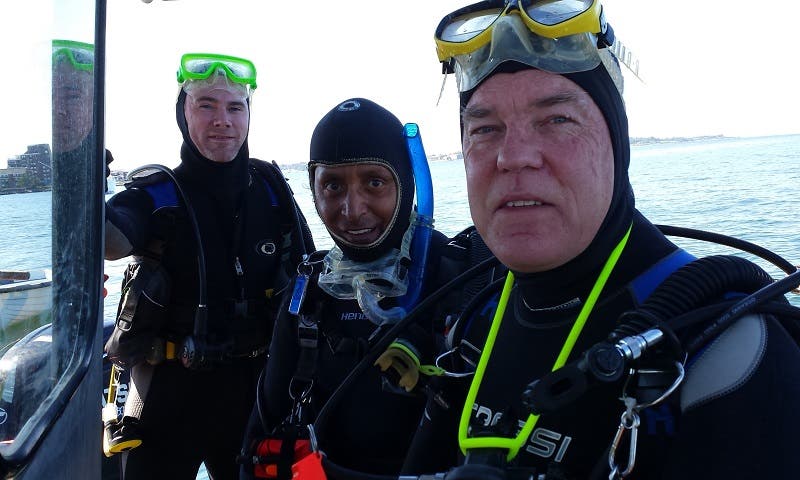
A team of marine archaeologists, scientists and volunteers continued their methodical work mapping shipwrecks in Newport Harbor last month in an ongoing effort to find and positively identify Capt. Cook’s famous vessel, the HM Bark Endeavor.
Eighteenth Century British Explorer Capt. James Cook explored more of the world than any man who ever lived and many researchers believe the Endeavor, his most-famous vessel, is among a fleet of 13 British transport ships sunk during the Revolutionary War in Newport Harbor.
When the vessel is believed to have been sunk in 1778, it by then had changed hands and was known as The Lord Sandwich. During a five day fieldwork exercise in September, members of the Rhode Island Marine Archaeology Project and the Australian National Maritime Museum mapped the ninth shipwreck site and completed a pre-disturbance site map of an 18th century ballast pile.
Find out what's happening in Portsmouthfor free with the latest updates from Patch.
To find the Endeavor, researchers must find and map all the 18th century shipwreck sites that still exist in Newport Harbor and “only then will the detailed work begin that may identify which site is which ship,” said Dr. Kathy Abbass, RIMAP director.
The most-recently mapped site was found in the fall of 2014 and “now that we have mapped it,” Abbass said, “we have nine ships of the thirteen in our database. Although it will take many years to prove it, we now have a 69 percent change that we have already located the Lord Sandwich ex. Endeavor.”
Find out what's happening in Portsmouthfor free with the latest updates from Patch.
The Australians have a keen interest in finding the Endeavor as it’s considered the continent’s founding vessel. Cook was the first to explore Australia after he arrived there in 1770.
The Endeavor’s resting place among the shipwrecks was first announced as a possibility more than 15 years ago, but it is only recently that RIMAP’s painstaking work has begun to attract national interest.
RIMAP released details from an exhaustive study last year detailing eight sights, which prompted ANMM officials to call for a meeting here in Rhode Island. The collaboration has helped put divers in the water but the project continues to depend on donations to stay afloat, Abbass said.
“Our work is based on public interest and volunteer support, so funding will determine how quickly the next phase of the research will progress.”
For further information about how to help, contact rhodeislandmap@yahoo.com.
We reported on RIMAP’s progress last year. Here’s the full text of that story:
Eighteenth Century British explorer Capt. James Cook explored more of the world than any man who ever lived and artifacts from his most famous vessel, the HM Bark Endeavor, could soon be rising from the waters off Newport thanks to decades of work by a local marine archaeology nonprofit.
Meanwhile, officials from the Australian National Maritime Museum are once again descending upon the area as interest piques on the fleet of 13 British transport ships sunk during the Revolutionary War in Newport Harbor. Australia was first explored by Cook aboard the Endeavor and any artifacts or treasures that emerge from the wreckage could be vital to their historic record since it’s considered their founding vessel.
Though the Endeavor’s potential resting place among those wrecks was announced 15 years ago, scientists and volunteers are now much closer to potentially identifying the exact location and begin excavating artifacts. RIMAP presented the results of an intensive, time-consuming mapping project in January that details eight sites. Those results prompted an upcoming meeting on March 25 between RIMAP and Kevin Sumption, director of the Australian museum, said RIMAP Founder and Executive Director Dr. Kathy Abbass.
“It is slow work and it takes a long time, but we’ve made great progress,” Abbass said, noting that the organization is hopeful that talks might lead to financial and logistical support in getting divers under the water.
“Rhode Island owns the ship if we find her, but the Aussies are very interested and they want to share it,” Abbass said. “But we don’t want to give her away.”
Excavating means RIMAP will need a facility to manage artifacts and they’re eyeing a site in Portsmouth near the High School that Abbass said is an “overgrown and unfortunately neglected” spot that happens to be Butts Hill Fort and the largest Revolutionary War earthwork in Southern New England and the center of the American line in the Battle of Rhode Island in 1778.
That makes it a perfect spot for RIMAP’s long term vision to build a facility that would enable them to greet visitors from around the world who would be interested in not just Capt. Cook and Endeavor but any and all artifacts that come from the wreckage sites as well as the overarching story of the war and the sea.
The National Park Service has given RIMAP grants to craft a management plan for Butt Hill Fort, but that’s a first step. And there’s no guarantee that they’ll find Endeavor or be able to confirm it even if they do. But they know that there is international interest in that ship and the enormous fundraising challenges that lie ahead will be much easier to meet as long as Capt. Cook’s name is attached.
“We can use it to our advantage,” Abbass said. “It would be a tremendous historic tourism destination.”
RIMAP is different from other organizations that do similar work in that it doesn’t fall under the auspices of a federal agency and isn’t part of any school or university. Some money comes in through grants but the bulk of the work is done by volunteers.
Abbass said that means the people who work on RIMAP’s projects don’t have to be graduate students enrolled in a marine science or archaeology program.
“We’re committed to that small, democratic approach to archeology,” Abbass said.
In fact, RIMAP offers classes in marine archaeology, site mapping, artifact management, history lessons and other classes out of the Masonic Temple in Portsmouth. Abbass said that having the public participate in this way gives the programs an extra boost of support in many ways. More than 800 people have passed through the program so far and more are always encouraged.
Teams will be trained by professionals in April and anyone who wants to be a diver can get involved, though you don’t have to be a diver to lend a hand.
Be sure to go to RIMAP’s Web site for more information, volunteer opportunities and details on their work on mapping shipwrecks in Newport Harbor and Capt. Cook’s story.
Attached photograph: L-R - Bill Burns, John Hoagland, Nigel Erskine on RIMAP research vessel, Newport Harbor, September 15, 2015. Photo by Greg DeAscentis.
Get more local news delivered straight to your inbox. Sign up for free Patch newsletters and alerts.