Schools
Viva La (Green) Revolution!
Could Portsmouth see a third wind turbine in the future? Proven success from the current two says "yes," as well as the possibility of other "green" projects.
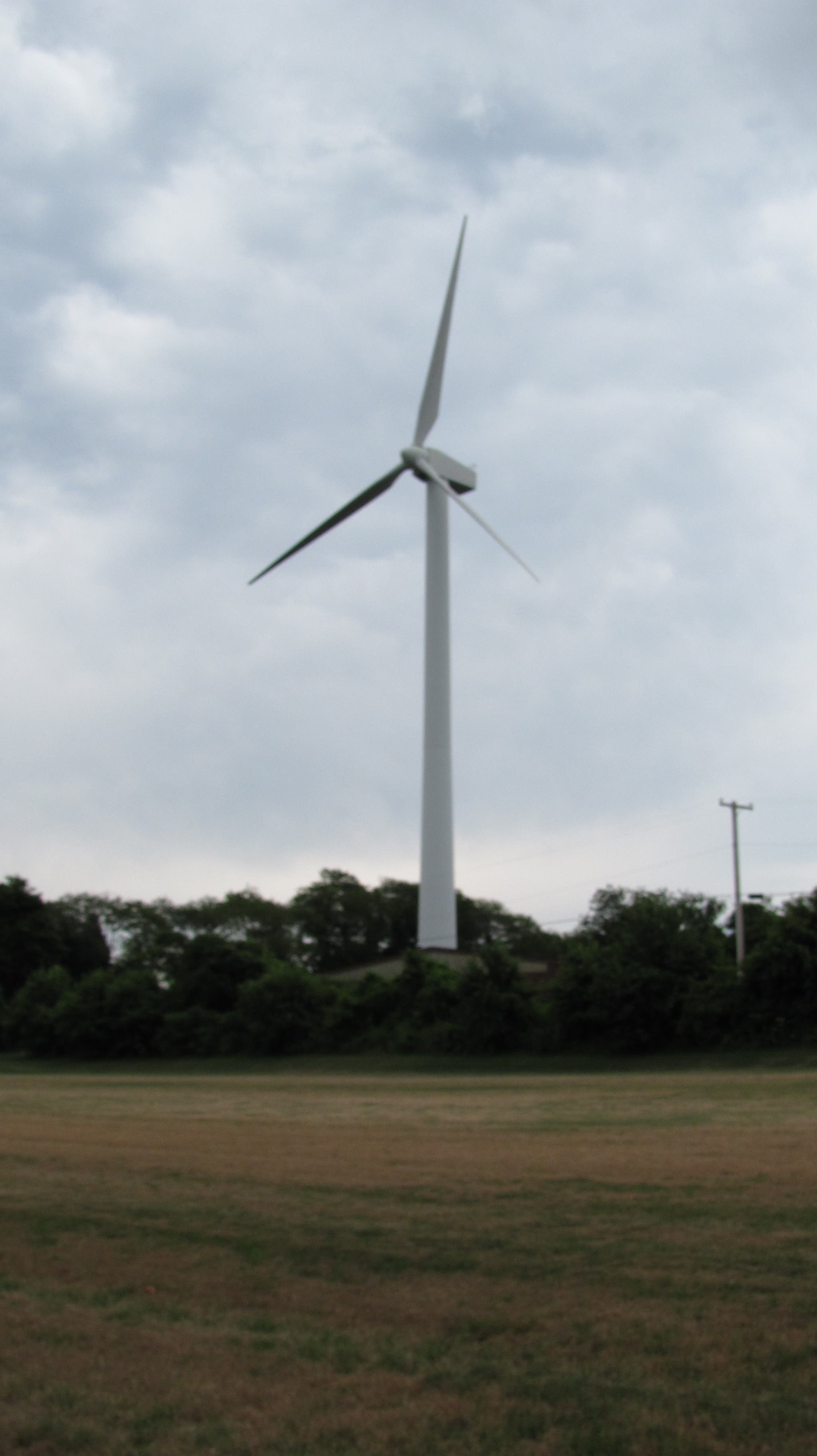

When it comes to kicking the nation's oil addiction, the winds of change have been blowing through Portsmouth for nearly a decade. Over the past several years, the town has become Rhode Island's leader in sustainable energy generation.
Portsmouth's "Green Revolution" began in 2004, when Portsmouth Abbey's Benedictine monks approved the purchase of a $1.2 million wind turbine to power its Cory's Lane campus. The turbine, which went online in 2006, rises 241 feet and is visible from miles around. It has an output of 1.2 million kilowatt hours of electricity – enough to supply approximately 200 homes.
That turbine was a catalyst for the town's next large scale wind power generator – this one involving the entire community. In late 2004, the Portsmouth Economic Development Committee established its Sustainable Energy Subcommittee. The volunteer group was tasked with addressing the town's energy needs for the next five years.
Find out what's happening in Portsmouthfor free with the latest updates from Patch.
After conducting an extensive feasibility study, in 2007, the subcommittee presented the facts to voters. A bond referendum authorizing the town to secure up to $3 million in bonds for the construction of the turbine at the middle school and/or high school was approved by 60 percent of Portsmouth voters.
On April 11, 2008, the town signed a $2.9 million contract to procure and install a 1.5 megawatt wind turbine generator on the high school grounds. The project broke ground with much fanfare on June 13, 2008. The bonds were financed through $2.6 million in zero-interest loans from the federal government, with the remaining $400,000 financed through a state-subsidized loan at two percent interest. Both loans are to be paid off over 13 years, making the project "revenue positive," according to Sustainable Energy Subcommittee Chairman Gary Gump.
Find out what's happening in Portsmouthfor free with the latest updates from Patch.
The wind turbine went online on March 18, 2009 and the town took over operation of the tower on March 24. State and local officials celebrated the milestone at a ceremony on May 12 of that year. The first municipally-owned wind turbine generator rises 336 feet above the landscape appropriately known historically as "Windmill Hill."
A year later, sustainable energy generation is already paying off. According to Gump, resale of renewable energy that the town generates to power its schools and municipal offices back to National Grid, combined with the sale of renewable energy certificates to People's Power and Light's New England Green Start program, nets the town about 15.388 cents per kilowatt-hour. He estimated that in the last fiscal year, town coffers netted about $200,000 in income. "Our town is making the numbers and they are a little better than what the forecast was in the original energy analysis," Gump said.
However, Finance Director Dave Faucher said that he could not confirm those numbers since official reconciliation of the books for the last quarter would not be finalized for about another month and energy certificate payments have not yet been received, but he expected that amount to be on target.
Portsmouth's winds of change intensified with the successful operation of the Portsmouth Abbey wind turbine, which increased interest, provided a model for success, and alleviated aesthetic concerns from neighbors. In the years ahead, renewable energy could be a Godsend for the town's environment and its economy.
"The Portsmouth Abbey wind turbine validated what we had been talking about for a long time," Gump said, while also crediting Brother Joseph Byron with assisting in the town's efforts to secure its initial renewable energy development grant. "If we hadn't had the Abbey machine up and running, I don't think that we would have taken as much interest in [wind power] going forward. The Abbey's machine was kind of a catalyst."
Looking to the future
Buoyed by the success of Portsmouth's two existing wind turbines, there are plans in the works for other private wind power generators in Portsmouth– at St. Mary's Episcopal Church and another at Hodges Badge Co., both on East Main Road.
The US Navy is also looking at the possibility of constructing wind turbines on its Tank Farm facilities on Burma Road. The Navy has reportedly applied for necessary approvals from the Federal Aviation Administration. The wind power potential of the site apparently helped save the tank farms from the latest round of base closures.
Under state law, municipalities are allowed up to 3.5 megawatts of renewable energy generating capacity to offset their energy use. The current wind turbine at the high school generates 1.5 megawatts of power. The Portsmouth Economic Development Committee's Sustainable Energy Subcommittee is considering proposing another municipally-owned wind turbine, though one at the middle school site was apparently shot down by the FAA due to its proximity to the airport in Middletown. They are also looking at solar power as another option. Construction of another turbine at the high school is also a possibility.
"We are looking at what financing options might be out there. Wind is the most efficient, but we're also looking at what other energy resources like solar panels, we might qualify for," Subcommittee Chairman Gary Gump said. "There's a large gymnasium over the high school that has a roof that is approximately correct to take advantage of solar power. We are exploring what potential power is available and what finance mechanisms might be available."
Portsmouth is also joining forces with other area communities in exploring alternative energy options. Last Spring, the towns of Portsmouth and Tiverton submitted a joint request to the state Office of Energy Resources for a $220,000 stimulus grant to help fund a study of the potential of a private entity's proposal for submersible turbines in the Sakonnet River between Tiverton and Portsmouth. That would likely be a more long-term project, Gump noted, as "the technology is not something that we can buy off the shelf."
Portsmouth is also one of nine local communities that have formed the East Bay Energy Consortium. It has received a grant to fund a feasibility study, Gump said, "for consolidating energy consumption for the nine communities and looking across all the communities for available space for the potential to install a number of wind generators that would do what we've done in Portsmouth."
Gump also pointed to the formation of the Aquidneck Island Energy Initiative, involving all three island communities, along with Navy officials. Gump described the initiative's mission as "all encompassing with [the goal of] generating more energy for municipal, commercial and residential [use] with a broad scale effort to increase efficiencies and reduce consumption." Jamestown has received the green light to construct a municipally-owned wind turbine on Conanicut Island, similar to the project in Portsmouth.
"Our focus is on economic development," Gump said. "We are trying to contain or reduce the town's cost to do business so that it makes it more attractive to economic development. The lower the cost of businesses, we improve the economic output. We are looking at what we can do to incrementally increase generation and what we can do to help the town reduce its energy consumption."