Health & Fitness
My Old Friend on My New Congressman
My long-time friend (who's a long-time Republican) finds Sanford's win another indication of how distorted from its original values the Republican Party has become.



I’ve been up all night and into the morning waiting for my old friend from high school to call from his overseas home. It’s a tradition that always happens after cheesy elections, which is certainly what I’d call last night’s Mark Sanford win.
On Nov. 8, 2000, Michael called me at 4:30 a.m. from his then-home in Tokyo, groaning and cursing, asking me how on earth did George W. Bush take the presidency.
Still awake at the time, I was surprised, and not just because of the negative numbers I continued to see crawl across my television screen at that moment. I was surprised because my good friend Michael is a die-hard Republican.
Find out what's happening in Summervillefor free with the latest updates from Patch.
He’s held faith high since our high school days at Holy Cross, and maintains morality as a must-have attribute for all politicians. Since the age of 15 practically every other word out of his mouth has been “Reaganomics.” Today a major player in global trade, he’s big-business and low-tax. Defense must be the top priority of the federal government, and social programs should always be reviewed with a microscope, he believes.
So why was he anti-Bush? Because W wasn’t an actual Republican, Michael believed. He finds the current GOP to be moving in a very anti-American direction, too. This current group only borrows the party name, he feels, steering the country to practices that mirror the Marxian programs on economy and society that he sees firsthand in his frequent travels through China.
Find out what's happening in Summervillefor free with the latest updates from Patch.
Both of our fathers fought wars in Asia against communism. While working throughout Asia today, Michael sees their efforts as meaningless; the Republican Party keeps pushing the U.S. in the same direction our dads’ fought against, we both agree.
So upset was he with the 2000 presidential election that Michael actually flew home to vote in the 2004 race. He didn’t trust his overseas mail-in ballot option, and wanted to push the buttons himself and in person.
In June 2010 while I watched the still unbelievable primary election results, guess who called me wanting to know who rigged the election for Alvin Greene? That’s right, from his then-home in Singapore, Michael had already seen reports on Greene’s months-prior arrest for lewd behavior. Hadn’t Republicans in South Carolina learned their lesson when caught doing the same fake-candidate plant in 1990, he wanted to know.
And why the hell did anyone fall for the pseudo-Democrat Ben Frasier, he asked. He said he’s heard Frasier’s name in jokes in the South Pacific (where the longtime candidate’s wife is from), too.
And here I am on May 8, waiting for my old friend Michael to call me from his Philippines home with more funny stories going around the globe. (And this is global news, too – see the images above of headline stories from around the world on Sanford’s win.)
To prep myself for a long conversation while waiting, I’ve been reading up on elections involving scandalous politicians.
Voters respond differently to financial and moral scandals involving politicians, a Yale Univ. study found. If a congressman pulls any ugly money-making scheme or abuse of power, it affects his voter support much more than a moral mistake.
But that theory isn’t applicable in this case; Sanford’s pulled tricks in both categories, and somehow still won yesterday’s election.
Maybe the difference in party alignment played a role. A Democrat involved in any type of scandal loses 11 percent of his own party vote, a study by St. Edward’s Univ. notes, but a Republican only drops by six percent in GOP voters’ support.
That one seems more applicable. Last year, GOP presidential candidate Mitt Romney led this same 1st Congressional District by 18 percent; Sanford only won by nine, indicating his record may have cost him votes from nine percent of Republicans in the district, New York Times political analyst Nat Silver notes today in an article.
That nine percent wasn’t enough in this race, though, and it won’t be enough to appease Michael, either.
When he comes home to the U.S., he usually brings a gag gift; once it was a fake Rolex he bought off the streets of Shanghai, another time a carton of Chinese cigarettes.
The last one sums up our shared perception of the Republican Party, though – a bumper sticker that reads “Save Your Job/Vote Republican.” Michael says he got it in Indonesia where the sticker was made.
This distortion of the traditional GOP to what it is today has not only made it embarrassing for Michael to admit he’s Republican. Because he travels throughout Asia and the Middle East, he’s had to hide his nationality, as well. To avoid damage to his reputation with clients and even to avoid attack, he’s carried fake documents that say he’s Canadian. The policies of the party and the actions of its elected officials are the reason for those threats, Michael says.
That’s a sarcastic indicator of what we both find the Republican Party to have become. It mimics those suggested by Karl Marx, whose economic theory, in a nutshell, calls for: allowing free trade in hopes of increasing imports of raw materials; removing any protective laws, taking away worker rights and restricting their income growth in order to attract companies; and keeping the money in the hands of a few who control the government.
He still hasn’t called, and I assume he’s hoping the wait will further brew the embarrassment, so I send him a text message.
“Well?” I ask, waiting for a long reply.
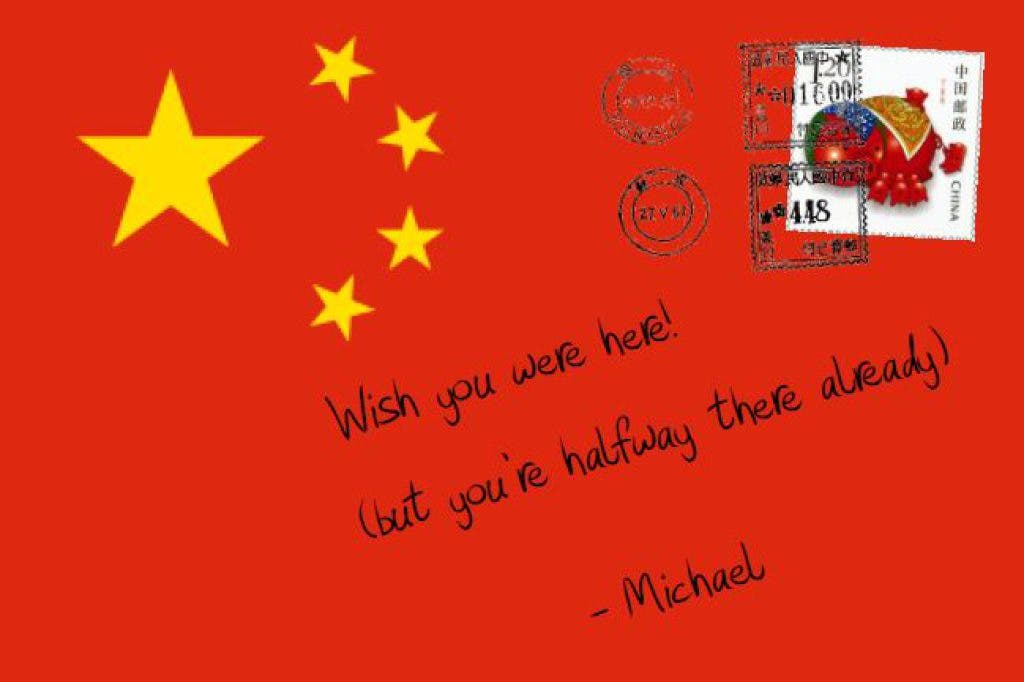
He answers, but only with a short and sharp retort. Attached to his message is an image of a Chinese postcard, decorated with its flag.
“Wish you were here! (but you’re halfway there already)” it reads.