Politics & Government
Residents Review Lowcountry Futures
Participants at Berkeley-Charleston-Dorchester Council of Governments' Our Region, Our Plan pinpoint transportation and economic development among top issues as tri-county continues to grow into 2040.

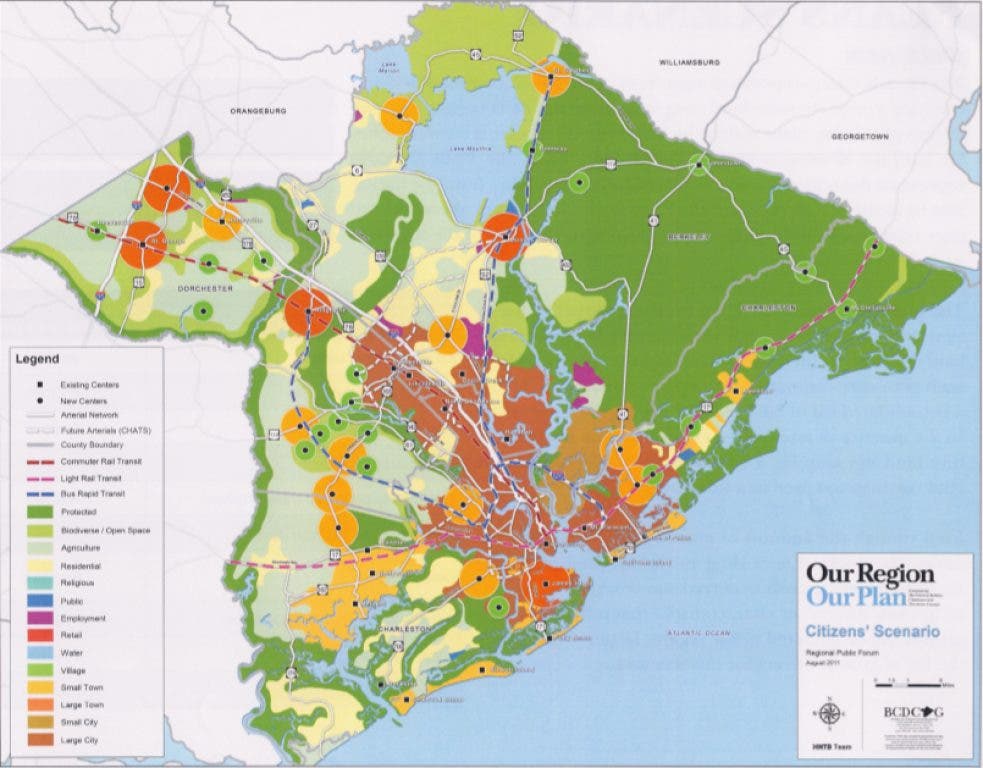

More than 200 people from across the region participated in Tuesday night's Our Region, Our Plan forum at Trident Technical College in North Charleston and four satellite locations in Summerville, Mount Pleasant, Moncks Corner and Hollywood.
Launched in 2008 by the Berkeley-Charleston-Dorchester Council of Government's Regional Land Planning Committee, Our Region, Our Plan is a planning process designed to create a shared vision of the tri-county region for the year 2040.
In 30 years, the Charleston region will grow by 101,000 jobs and 90,000 households, according to Tuesday's presentation.
Find out what's happening in Summervillefor free with the latest updates from Patch.
Our Region, Our Plan grouped participants at tables for discussions over important values and also polled participants for live responses.
Of participants, 66 percent strongly agreed that economic development was vital to the regional planning process. And, 73 percent strongly agreed that transportation is vital to the process.
Find out what's happening in Summervillefor free with the latest updates from Patch.
"This area is continuing to grow and we are very concerned about keeping our infrastructure up to speed," Dorchester County Council Chair and COG Regional Land Use Plan Committee Chair Larry Hargett.
To those that think the individual is greater than the whole in the tri-county, Hargett was quick with evidence.
Dorchester County led the state in growth last year, and Charleston and Berkeley weren't too far behind it.
Seven out of 10 Dorchester County residents commute out of the county to work, he said. If citizens act regionally then "why are we not involved with the whole region?" Hargett asked.
"We need to compete nationally with other areas," Hargett said. "We are improving. People can see that and people want to be involved."
He continued:
"It's going to help business. Business is going to tell you they don't do business in one community … The quality of life for employees to be homogeneous throughout the region is very important."
And this isn't about mandating changes, infringing upon municipal rights, according to project Director Phil Hanegraaf.
"We don't want to get into people's zoning," he said. "How they get there is their choice … This is not about local planning or usurping the need and the role of local planning, this is how do we take the things that we have and do more with them."
The four future scenarios discussed were:
• Trends: This is the status quo extending through 2040.
• Plans: This represents the sum of all the comprehensive plans in the region by individual government agencies.
• Citizens': This was created by the Our Region, Our Plan 2010 workshops.
• Green Infrastructure: This protects natural resources and promotes growth where transportation and utility infrastructure already exist.
These four plans are attached as .pdfs to this story.
Of those responding to the polling during the forum, 45 percent liked the Green Infrastructure scenario best, with the Citizens' scenario coming in a close second at 39 percent. The status quo Trends scenario received a meager 3 percent of the vote, and the Plans scenario, which factors in the ideal comprehensive plans from all governing bodies, received 14 percent of the vote.
Implementing one of the four evolving scenarios likely involves adopting its principles at the local level, as part of the comprehensive plan, according to Hanegraaf. It also involves working toward public transit systems.
Feedback from Tuesday's session will be woven into the existing scenarios. By end of September or beginning of October, COG will begin "expert quilting," where experts will be stitched together to weigh in on the plan.
"There's a fine line between envisioning and hallucinating," Hanegraaf said.
In November, the experts and COG will talk about implementation of the scenarios.
Who participated Tuesday?
Here are snippets from the results of the keypad polling from those who attended the event in North Charleston and its satellite locations.
Residency: 18 percent Summerville, 12 percent Mount Pleasant and 31 percent Charleston
Demographics: 85 percent white and 9 percent black
Age: 34 percent 55-64 and 7 percent 25-34
Gender: 61 percent male and 39 percent female
Get more local news delivered straight to your inbox. Sign up for free Patch newsletters and alerts.