Community Corner
Anatomy Of Fake News: Erroneous Texas Tweet Alleging Trump Protest At Center Of Study
Tweeted pic of lined-up buses man erroneously said were packed with Trump protesters was shared widely, serving as basis of new study.



AUSTIN, TX — Austin has emerged as ground zero in a study of how it is that fake news in our society goes viral, according to a published report.
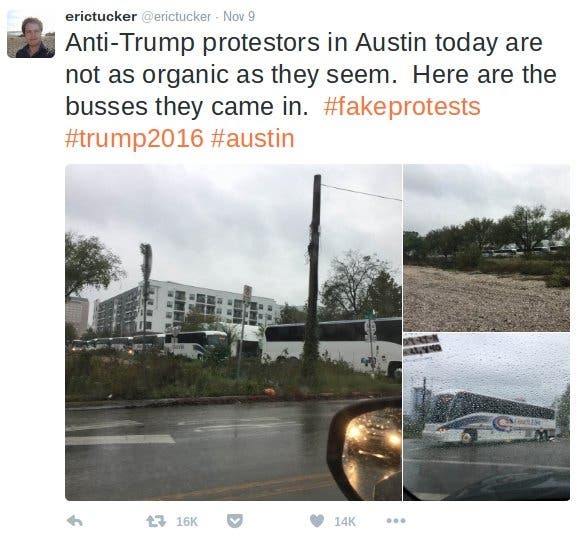
Just a few days after Donald Trump was elected, Eric Tucker, 35, came upon a sight he viewed as suspicious: A cavalcade of white buses stretched down a major downtown Austin artery as Business Insider wrote. As people now fancy themselves citizen journalists given the ability to snap pictures on their phones, Tucker reflexively snapped a few pictures. Then, with no factual basis for his theory as to why the phalanx of buses were there, he tweeted: "Anti-Trump protesters in Austin today are not as organic as they seem. Here are the busses [sic] they came in." For good measure, Tucker—in full "citizen journalist' mode, added the hashtags "#fakeprotests, #trump2016 and #austin.
A prolific Twitter user himself, Trump took to his own phone to respond to what he, too, viewed as mass protests about his ascendancy as the leader of the free world: "Just had a very open and successful presidential election," Trump tweeted. "Now professional protesters, incited by the media, are protesting. Very unfair!"
Find out what's happening in Austinfor free with the latest updates from Patch.
Just had a very open and successful presidential election. Now professional protesters, incited by the media, are protesting. Very unfair!
— Donald J. Trump (@realDonaldTrump) November 11, 2016
There was just one little problem: It wasn't true. A company named Tableau Software was staging a 13,000-person conferendce on the that day and had hired the bus company for transport, Business Insider noted. It hardly mattered at that point, the New York Times reported, noting the fake bit of news had been shared 350,000 times on Facebook and another 16,000 times on Twitter, primarily by right-wing Americans predisposed to the idea that liberals orchestrated such non-organic protests against the new president.
To his credit, Tucker acknowledged his error in a subsequent tweet. But that revised tweet/correction was retweeted just 29 times a full week after its posting.
Find out what's happening in Austinfor free with the latest updates from Patch.
That infamous bus example is at the center of a new study new study published June 26 in the journal Nature that looks into why fake posts like Tucker's can achieve such viral spreading, Business Insider noted.
it comes down to two factors, economists concluded. First, it has to do with our collective limited attention spans. Second is the fact that, at any given moment, we now have access to lots and lots of information — likely more than at any previous time in history, according to the study. Those two factors combined create a scenario in which facts compete with falsehoods for finite mental space, with falsehoods winning out, the study finds.
Diego F. M. Oliveira, the lead author of the study and a post-doctoral fellow at Indiana University and Northwestern University, tested the idea by creating a theoretical model for the spread of information. The model he created was loosely based on epidemiological models public health researchers use to study the spread of disease. Complementing the model were bots or "agents" producing message-laden memes (essentially fake news) on Twitter, Tumblr, Facebook and other social media fourms to re-share messages created or forwarded by their neighboring bots in a network.
"Quality is not a necessary ingredient for explaining popularity patterns in online social networks," Oliveira wrote. "Paradoxically, our behavioral mechanisms to cope with information overload may ... increas[e] the spread of misinformation and mak[e] us vulnerable to manipulation."
The upshot; The study suggests most people only focus on real news for short amounts of time, with fake news in the mix leading to more competition for our attention, researchers found. In consuming information, we make quick decisions about which "facts" to accept and which to discard, researchers noted. Along the way, we sometimes end up disregarding factual information simply because there is so much of it out there, according to the report.
It's also harder to distinguish truth from fiction among those getting their news solely from social media feeds, the research found. What's more, another recent study suggested that people base their evaluations of a piece of information more on the person who shared it than the organization that produced it, according to the report.
Like Tucker, the man who shared the bus sighting with his theory, people had no way of knowing whether the vehicles were there transporting anti-Trump protesters. But Tucker explained his reflexive action this way: “I’m a very busy businessman and I don’t have time to fact-check everything that I put out there," he told the Times. "Especially when I don’t think it’s going out there for wide consumption."
In other words, some don't let facts get in the way of a good story. And that's where we're at now in this age of social media.
Image via Shutterstock
Get more local news delivered straight to your inbox. Sign up for free Patch newsletters and alerts.