Community Corner
Austin Busts Open 300-Odd Piñatas In Celebrating Día de los Muertos
Two events took place concurrently on Saturday honoring the rich tradition of the Hispanic culture.


AUSTIN, TX — While many gear up for Halloween — grownups eager to show off their spooky or sexy costumes, children excited with anticipation of free candy — the city's Hispanic community gathered at two events Saturday showcasing age-old traditions from their culture.
Two events on Saturday highlighted cherished customs for Latinos: the 2nd Annual Piñata Festival staged on the ground of the Mexican American Cultural Center, and Viva la Vida, the 33rd annual festival and parade celebrating the Day of the Dead — Día de los Muertos.
Staged from noon to 4 p.m., the former event was founded by local architect David Goujon last year as a way to fund the Latinos in Architecture Scholarship Fund while providing a free event for the community to honor the Hispanic culture. Funds raised throughout the year allowed organizers, including key work by project captain Ingrid Gonzalez-Featherston, to purchase 300 piñatas for the community.
Find out what's happening in Austinfor free with the latest updates from Patch.
The event was staged on the Mexican American Cultural Center grounds at 600 River St. Along the hallway leading to the MACC, the colorful piñatas lined up against an exterior wall depicted animal representations or iconic cartoons from the Latino culture. Children would pick their favorites and then get in line to bust it open in a makeshift piñata-smashing area surrounded by fencing.

Three little girls excitedly waited in line to bust their piñata, made to resemble a colorful horse of many hues, complete with mane made of streaming paper. Asked who picked it out, they said in near-unison it was a collaborative effort, while giggling with excitement standing next in line to bash the thing open to release the candy within.
Find out what's happening in Austinfor free with the latest updates from Patch.
One of the little girls gave the faux horse a hug as if expressing condolences for its imminent demise and was later seen with fierce determination bashing the heck out the pretend horse — the same one she had tenderly embraced around the neck just moments prior — to unleash the candy it bore.
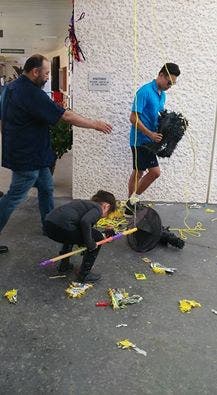
Off to the side of the section, mounds of broken piñatas attested to the popularity of the event among young and old alike. Seriously, who doesn't love a piñata?
"Last year, we had 300 people," Groujon said. "This year, we doubled that. We love this."
The piñatas were free for the picking but had to be busted on-site. The event is funded through grants and crowd-sourcing efforts, Groujon explained.
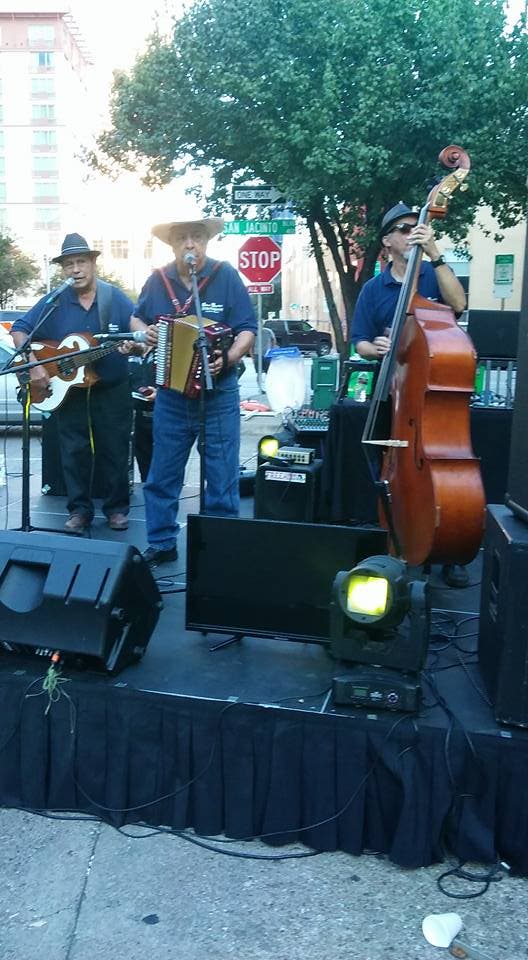
Past the piñata-bashing hub, live music entertained the crowds on the MACC grounds. Accordionist and singer Johnny Degollado, a 50-year Tejano music veteran, belted out such familiar conjunto standards as "La Cajera," "Viva Seguin" and others, ably assisted by J.J. Barrera on guitar and Vicente Alonso on the upright bass.
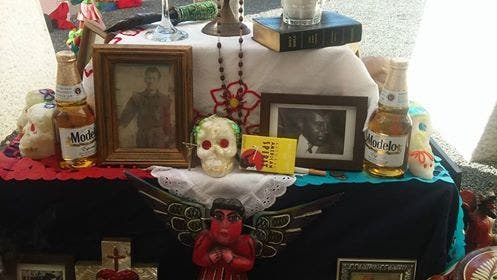
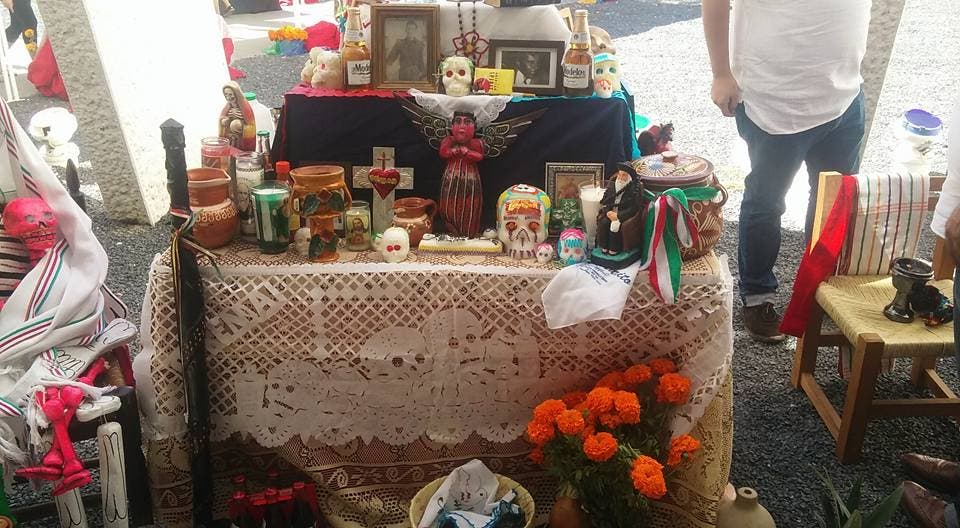
For the kids, there was face painting, drawing and sugar skull making. Car aficionados feasted their eyes on a assemblage of beautifully detailed low-rider cars vying for attendees' votes for best of show. Along the way, one saw altars honoring the departed, one such creation bearing ofrendas or offerings, to a dead soul with items enjoyed in life.
The altares, or altars honoring the dead, are central to the Day of the Dead commemoration. Ofrendas are an essential part of Day of the Dead, officially celebrated Nov. 1. But the altars upon which they're placed aren't set up for worshiping, a mistaken belief by some. The altars, rather, are erected as homage to dead relatives and loved ones. One altar honored Prince and David Bowie, both of whom died earlier this year.
Beyond the MACC grounds, a larger festival required the closure of downtown streets for Viva la Vida (Long Live Life), a Día de los Muertos celebration that featured a parade with mojigangas, music, food booths and other attractions.
The event took place between noon to 8 p.m. along 4th Street.
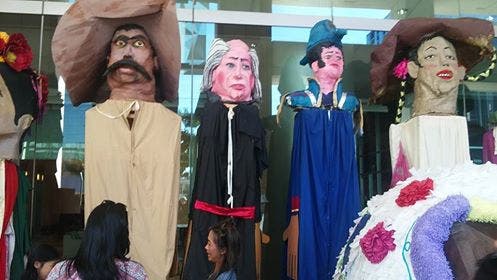
But let's go back to that word mojiganga. It's essentially a giant puppet, also used as sculpture, with the head and bust made of papier mâché. The creation is then mounted on a tall supporting A-frame structure.
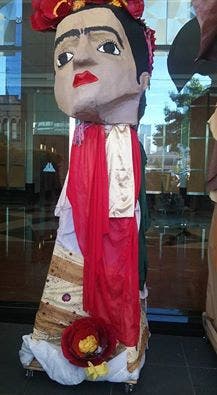
There were several mojigangas on display just a few steps from the Mexic-Arte Museum (the event's co-sponsor along with the City of Austin) at 419 Congress Ave., depicting iconic figures from Mexican history: Frida Kahlo, revolutionary Emiliano Zapata and Roman Catholic priest and leader of the Mexican War of Independence Miguel Hidalgo.
But the star attraction among the mojigangas was one depicting the beloved Mexican composer and singer Juan Gabriel, who died on Aug. 28. A depiction of the late artist was positioned next to the music stage outdoors, as if looking over the musicians — including Degollado, who earlier alerted a reporter he'd be headed to the event with his fellow musicians following the piñata festival.
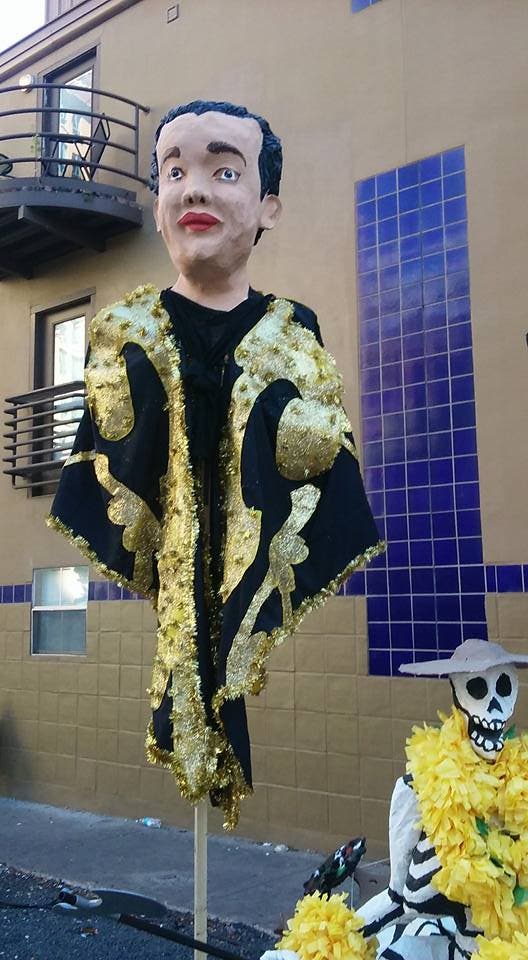
The Juan Gabriel mojiganga was created by Sergio Lejarazu of Jumpolin. He and his wife, Monica, sold their wares inside Brazos Hall during the festival alongside other vendors.
To the uninitiated, Día de los Muertos sounds rather macabre and scary. It's hardly that. Celebrated throughout Mexico and in many other Hispanic cultures, it's a way to pray for and remember friends and family members who have since passed on to help them in their spiritual journey. It's not an obsessive fixation on death, but, rather, a celebration of the life that of a loved one that has been extinguished in the corporeal sense.
In 2008, the tradition was inscribed in the Representative List of the Intangible Cultural Heritage of Humanity by UNESCO. "Caramba! It's about time, UNESCO!" came the collective cry from the world's Latinos when that recognition finally occurred. Well, not really; it went largely unnoticed.
But the distinction by the world body served to remind of the key role Día de los Muertos plays in the lives of untold millions throughout Latin America as a common thread in their culture's tapestry. The version in Austin was a celebration that would've made those it honored on Saturday smile. And perhaps, from somewhere near or perhaps very distant, they actually did smile over the festivities.
Viva la Vida, indeed. Long Live Life.
>>> Photos by Tony Cantu
Get more local news delivered straight to your inbox. Sign up for free Patch newsletters and alerts.