Business & Tech
Austin Economy Grows, But Not As Robustly As Some Had Hoped
Job creation was tied directly to population growth according to latest available data, pointing to need for diversifying local economy.



AUSTIN, TX — Slower growth trends and a general slowdown mark the latest market snapshot for Austin according to the latest economic data, even as the city emerged as one of the nation's sectors of highest job growth.
"Several trends are continuing," Drew Scheberle, senior vice president, Federal/State Advocacy & Education/Talent Development at the Austin Chamber, told Patch in a telephone interview. "And one we've seen is a slowdown. The second is more and more job creation in things tied to population growth: construction, hospitality and retail. In time, it leads to an imbalance and even bigger recession."
Ideally, one wants to see a more diversified economy reflected in the numbers, he added: "You want to have a diverse set of primary industries you base growth on: IT, health, medical, tech, semiconductor. These are industries that run in cycles. With a diverse economy, when one is down, the other picks up the slack."
Find out what's happening in Austinfor free with the latest updates from Patch.
The latest market snapshot comes by virtue of preliminary payroll jobs numbers by the Texas Workforce Commission (TWC) and the U.S. Bureau of Labor Statistics (BLS). Based on the newly released data, the Austin metropolitan area added 21,100 net new jobs, or 2.1%, in the 12 months ending in August.
Other highlights:
Find out what's happening in Austinfor free with the latest updates from Patch.
Despite those numbers, Scheberle said the city must update its land use code and tailor incentives packages to specific industries (rather than a one-size-fits-all template) to help the chamber lure industry. He also attributed the anti-immigration sentiment of the Trump administration as counter to luring foreign talent, particularly in the area of high tech.
"Part of it is our city changed its economic development polices three and a half years ago, and we've seen one economic development deal since then," Scheberle said. "Prior to that, we were seeing big projects on a fairly regular basis: Apple, Visa, Schwab. Now, we've only seen Merck."
Merck, one of the world's largest pharmaceutical companies, announced in June it was locating its newest IT hub in Austin. The hub teams up with local partners that include Dell Medical School at UT Austin, the Austin Healthcare Council and other regional entities in delivering innovative health solutions, officials said. The project involves a $20 million investment and creation of at least 600 jobs, helped along with a $6 million Texas Enterprise Fund (TEF) grant offer for Merck.
Related story: Merck To Build $20M IT Hub In Austin, Creating Up To 600 Local Jobs
"Collectively, city council hung too many ornaments on the same branch," Scheberle said of the current approach to economic development. He noted the current conditions for companies seeking to locate in Austin includes higher amounts of reporting, a big list of contractors for basic purchases. continued reporting to city "...on all sorts of important and extraneous measures," he said of companies lured via municipal incentives. "The juices did not meet the squeeze. There are far fewer projects coming here."
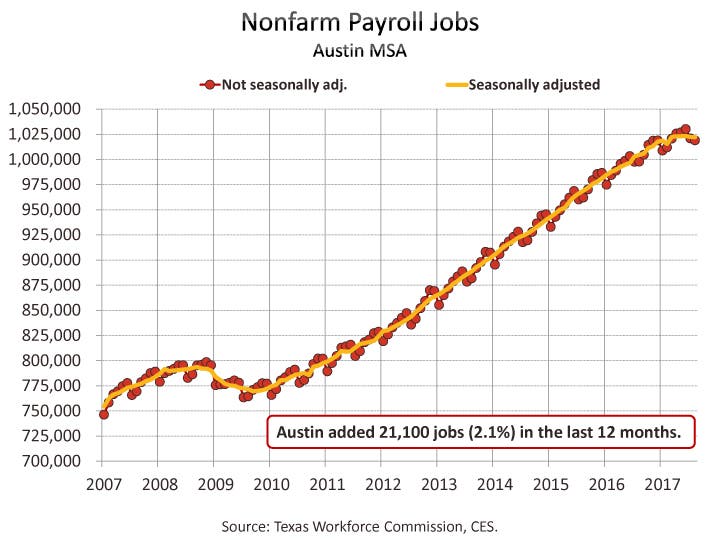
Still, the latest batch of numbers would be the envy of other municipalities even while failing to meet local expectations. Austin’s 2.1% growth makes it the 22nd best performing among the 50 largest metro areas, chamber officials noted. Dallas, gaining 2.8%, ranked seventh, while the other major Texas metros missed the top ten. Fort Worth grew by 2.6% (11th), San Antonio grew by 2.3% (20th), while Houston grew by 1.8% (31st) between August 2016 and August 2017.
Other highlights:
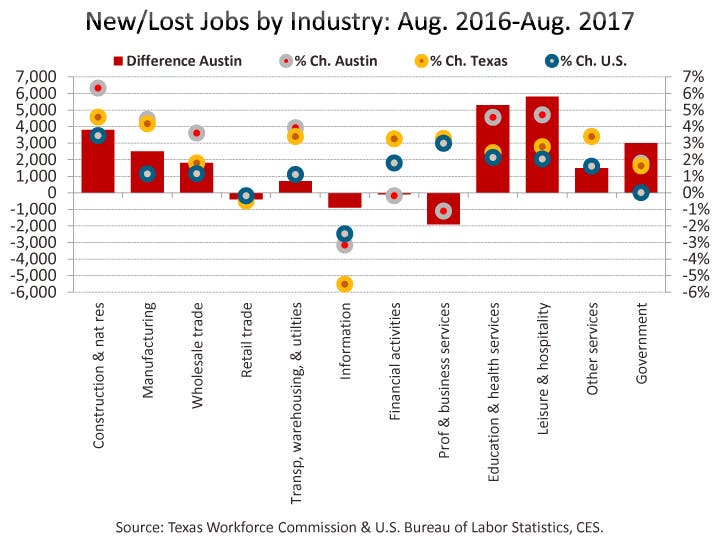
- For the year ending in August, private sector job growth in the Austin MSA is 2.2%, or 18,100 jobs, and with seven private industry divisions adding jobs and four losing jobs. Austin's sizable government sector (nearly 18% of jobs) saw slighter growth over the last 12 months, gaining 3,000 jobs or 1.8%, thus bringing the overall job growth rate to to 2.1%.
- Texas saw net private sector job growth of 2.5% with all private industries, except two, adding jobs over the last 12 months. Total job growth was 2.4% as the government sector, which accounts for over 16% of total state employment, gained 1.6%. For the nation, private sector growth is 1.7% for the 12 months ending in August with all private industries, but two, adding jobs. Overall job growth is a more modest 1.5% because the government sector was essentially unchanged.
- Jobs in August are down from the preceding month by 1,900 jobs or -0.2% in the not-seasonally-adjusted series for Austin, while on a seasonally adjusted basis, jobs are essentially unchanged (down by 100 or 0.0%). Seasonally adjusted jobs are up by 0.8% in San Antonio, up by 0.1% in Dallas, and unchanged in Houston and Fort Worth. Statewide, seasonally adjusted jobs are essentially unchanged in August (up by 5,500 or 0.0%). Nationally, seasonally adjusted jobs rose 0.1%.
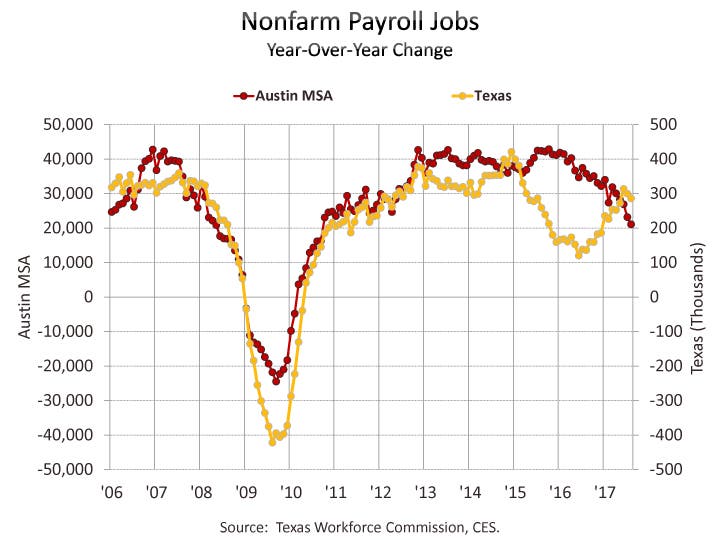
Scheberle offered a caveat in noting the latest numbers were still preliminary and subject to change. He cited last year as an example when year-to-year growth in January was posted at 4.7 percent, good enough for a second-place rank, later revised to 4.5 percent. By December, the preliminary growth logged in at 1.9 percent, later revised to 3.3 percent for a 25th-place ranking.
>>> Image via Shutterstock
Get more local news delivered straight to your inbox. Sign up for free Patch newsletters and alerts.