Community Corner
Coronavirus: Austin Bolsters Testing Amid Disproportionate Rates
Austin Public Health will set up more testing sites in key areas as Hispanics and nursing home residents are afflicted disportionately.


AUSTIN, TX — Austin Public Health announced plans to launch mobile and targeted testing sites in key locations in Austin-Travis County to help address the disproportionate impact of cases of the coronvirus on vulnerable populations, officials said Tuesday.
The targeted test sites will complement work being done by community partners such as CommUnity Care to increase testing availability to individuals who have not been able to receive testing through previously established programs, health officials said.
The aim of the effort, officials said, is to fill the gaps in the community via targeted testing, mobile testing, cluster testing, home testing, and static testing sites. The two key vulnerable groups identified by Austin Public Health are residents of nursing homes and communities of color.
Find out what's happening in Austinfor free with the latest updates from Patch.
Testing sites in predominantly white neighborhoods
During a May 28 briefing to update on coronavirus trends, Patch asked officials about disproportionate illness rates among Hispanics. Questions posed by Patch were in response to a National Public Radio study showing coronavirus testing locations disproportionately clustered in predominantly white neighborhoods in four of the biggest cities in Texas. In Austin, the NPR analysis showed that of the city's 25 public testing sites, 16 were in neighborhoods whiter than the city median.
Find out what's happening in Austinfor free with the latest updates from Patch.
In response to questions from Patch, Dr. Mark Escott, Interim Health Authority for Austin-Travis County, said the health authority was working with its GIS mapping team to ensure equity among testing sites. He ticked off a number of other organizations that provide additional testing sites throughout the community in addition to the public sites. He referred residents to the Austin Public Health website for information on testing site locations.
The public is alerted to free COVID-19 testing on the Austin Public Health website. "Are you experiencing symptoms of COVID-19?" the site reads. "Click the button below to use this online assessment to pre-register for FREE testing for you or a loved one. Schedule a no-cost, drive-through COVID-19 test at a local Austin Public Health facility. Please note that at this time, Austin Public Health testing sites are drive-through only. You must be in a vehicle to be tested at these sites."
Reacting to the NPR study, former Travis County Judge Sarah Eckhardt noted further testing site availability at various parks. While unfamiliar with the sites NPR was counting in its analysis, she pointed to the number of groups partnering with the city in amplifying the number of testing sites while encouraging employers to implement testing for their workers. Without such partnerships, "We would not be able to get to the level of testing saturation this community really needs to manage this viral infection," Eckhardt said.
More could be done, mayor says
In a subsequent telephone interview with Mayor Steve Adler the day after the briefing, he acknowledged the city could do more in providing ample testing sites. "Obviously, we haven't done enough to stop the disproportionate impact that we're seeing," the mayor said.
But it's not been for lack of trying, the mayor suggested: "We're playing real close attention to communities more susceptible to this virus, and that has always been a front-and-center and immediate priority. You find the people who are at risk where you see clusters, and then you try to immediately address them as quickly as you can."
Adler said the disproportionate local rates had been anticipated based on trends in other Texas cities. Informed by such evidence, the city moved early to install testing sites in the so-called "Eastern Crescent" peopled by a predominantly Hispanic population. But he acknowledged that full-fledged operation at some sites can't be justified given the low numbers availing themselves of testing: "There's not enough demand to stand those up with staff five days a week, scheduled with regular days and times," the mayor said.
Factors that may play into the lack of testing are culturally innate in a group overrepresented in blue-collar work that prevents the luxury of working from home, he suggested. Moreover, a general distrust of government among many Hispanics — including the undocumented or those with relatives who also lack citizenship papers — may further frustrate efforts to have them tested, Adler added.
He pointed to an effort about a month ago when health officials visited construction sites to offer testing. "A large proportion of construction workers declined to be tested," the mayor said. "Part of it is when you have people who are on the front lines that don't have the opportunity to work from home, and are faced with the difficult choice of 'do I work' or 'do I get paid' over fear of losing their jobs if they get tested."
Nursing home residents also disproportionately afflicted
Nursing home residents also are among the most vulnerable to infection. Austin Public Health figures show that 30 percent of nursing home residents who contract COVID-19 end up in the hospital — compared with 15 percent of COVID-19 patients among the general population. Health officials added the case fatality rate for nursing home residents is 22 percent compared with 1.7 percent for the general population.
Health officials provided graphs to illustrate the trends:
.jpg)
Austin Public Health graphic.
.jpg)
Austin Public Health graphic.
“COVID-19 has a devastating impact on our nursing homes and in our population over the age of 65," Escott said in a prepared statement. "This data conclusively demonstrates the critical importance of an overhaul of infection control procedures and nursing home design to mitigate the impact of COVID-19 as well as other communicable diseases."
With nursing home cases removed, the preliminary data show a rate of COVID-19 hospitalizations in March-April 2020 was 12 percent for White Non-Hispanic individuals, 17 percent for LatinX individuals and 18 percent for African American individuals, according to Austin Public Health data. Similarly, the COVID-19 fatality rate was 1.9 percent for White Non-Hispanic individuals, 1.6 percent for LatinX individuals, and 5.4 percent for African-American individuals.
“These statistics are concerning and unfortunately, not unexpected given the history of disparities in access to health care and in the social determinants of health impacting communities of color," Escott said. "While this data is preliminary and the actual magnitude of the impact on these communities is not yet certain, we will not sit idly by watching and waiting until we reach scientific certainty before taking action.”
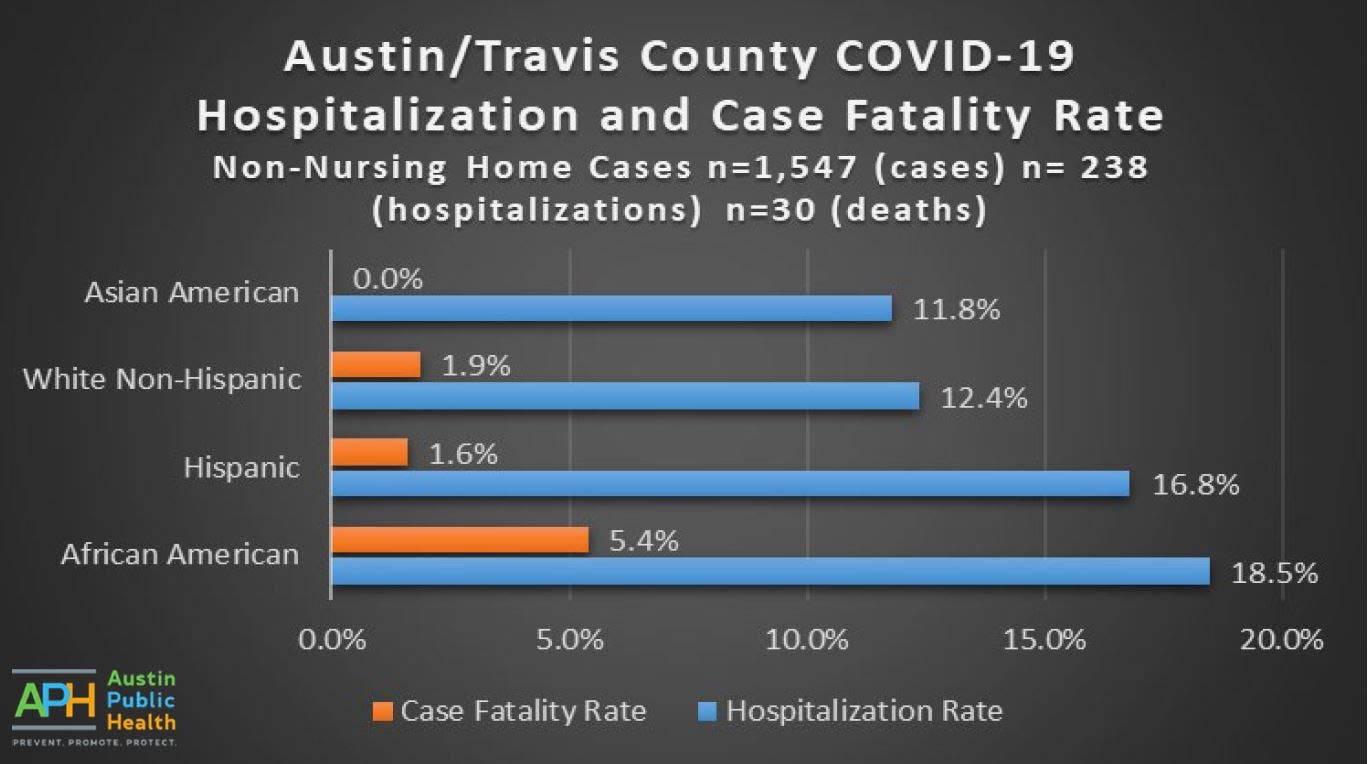
Austin Public Health graphic.
People of color predisposed to illnesses
COVID-19 aside, communities of color experience higher incidences of chronic conditions — such as hypertension, diabetes and heart disease — Escott said. Such residents disproportionately work in low-paying or hourly-wage jobs that leave them unable to provide care or interrupt work, are more likely to be uninsured, live in medically underserved areas, and live in ZIP codes with lower life expectancy, health officials noted.
“People of color are over-represented in every characteristic that puts you at risk for complications from COVID-19,” Brion Oaks, the city’s chief equity officer, said in a prepared statement. “They are also over-represented in essential work and employed in positions that do not allow working from home. We may be in the same storm, but we are not in the same boat. We must focus on supporting our communities of color and other vulnerable populations as we work to respond to this crisis.”
Health officilas said additional factors can also make an individual more vulnerable to COVID-19, including immigration status, multigenerational housing situations, concern about losing wages if quarantine is required, limited transportation options, or employment where telework is not possible.
“As a community, we’ve done a relatively good job keeping our total number of COVID-19 cases at bay,” Escott said. “But, our raw numbers should not distract us from the disturbing fact —supported by preliminary data — that communities of color are disproportionately impacted by COVID-19.” Escott added: “This message cannot fall on deaf ears. This disease is real and does not discriminate in who it infects. However, because of long-standing disparities in the social determinants of health, our communities of color are less likely to recover — physically and financially — from the impacts of this pandemic.”
Health officials said a so-called Testing Group has been created to oversee all Austin-Travis County testing efforts and ensure a collaborative approach among all other testing entities with a focus on priority populations. The aim is to provide support to those already existing entities, and through continuous evaluation meet the testing needs of the community.
The Testing Group, in conjunction with Austin Public Health's Social Services Branch and Equity, are in the process of identifying key locations throughout Austin-Travis County where mobile and targeted testing will be stationed, health officials said.
“The disparities we are seeing in COVID-19 impacts among Austin-Travis County’s diverse communities are disturbing but sadly not surprising in the context of nationwide inequities in access to health care, healthy food, and income,” Austin Public Health Director Stephanie Hayden said. “We must redouble our efforts to address these disparities, particularly in the eastern crescent of Travis County.”
Hayden added: “Our testing strategy is intended to be flexible to rapidly respond to emerging community needs to mitigate the spread of COVID-19 and reduce the impact on high-risk populations. It is going to take a community-wide effort to increase testing in targeted communities.”
Austin Public Health, in addition to mobile and targeted testing, is also working on community-informed communications and engagement strategy to target these vulnerable populations.The city is planning a conversation with communities of color currently scheduled for the morning of Saturday, June 13, to discuss ways to improve health outcomes among our most vulnerable populations. More details on this forum will be forthcoming.
“It will take more than testing to alleviate the unequal health outcomes in vulnerable Austin populations,” Hayden said. “We will have to continue this effort on a broader scale, with a focus on strengthening communities across Austin. We will also be working to provide targeted interventions, health education, face coverings, access to isolation facilities, and basic needs assistance.”
Individuals can see if they qualify for a free COVID-19 test by completing an online assessment at AustinTexas.gov/COVID19 or by calling (512) 972-5560. COVID-19 data can be found on the COVID-19 dashboard.
Hispanic community leaders voice their concerns
Before the Austin Public Health announcement centered on additional testing sites, community activist Paul Saldaña said he and other advocates for the Latinx community calling themselves the Austin Latino Coalition — including Austin City Council member Pio Renteria, Chicana activist Martha Cotera and Gina Hinojosa of the Texas House of Represenatives — met with city officials remotely in calling attention to the disproporationate rate in their community.
A remote meeting via Zoom lasting more than two hours grew testy amid a perception that city officials were averse to doing more to safeguard the Hispanic community, Saldaña told Patch in a recent telephone interview. In preparing for the meeting, Hispanic community leaders were armed with statistics showing disproportionate rates of confirmed coronavirus cases, hospitalizations and deaths among Hispanics, he said. Community leaders also prepared a presentation on the need for more direct outreach in Spanish in the way of public service announcements geared to the population.
"I don't mean to be disrespectful to the mayor, but he said Latinos live in multi-generational settings," Saldaña said, referring to cultural norms of housing customs among some Hispanics that may heighten the threat of infection. Saldaña suggested he found the observation reductive, and as painting Hispanic cultures as a monolith rather than suffused with nuance and myriad customs.
"I know that's not what he intended, but it was an epiphany," he said. "There's always an assumption that we're monolithic, but there are at least 25 subcultures of Latinos in Austin."
As for health officials' visits to construction sites, Saldaña suggested the effort was culturally tone deaf. Rather than arriving en masse to the sites in offering testing, he suggested health officials should have secured a third party to tag along as a figure of respect resonating among many Hispanics — the parish priest, for example — as part of the persuasion to get tested.
During the meeting, Saldaña said city officials also cited specific examples of information provided to Hispanics that was not culturally relevant and pointed to the dearth of literature in Spanish. There is a Spanish-language portal within the Austin Public Health website, Saldaña noted, but it's hardly user-friendly: "When you click on Spanish, it opens to another page with a 60-page PDF document if you can imagine that whole thing," he said. What's more, the language used is not universal despite the myriad idiosyncracies of Spanish among the various cultures, he added.
"In light of what we had discussed, our ask at the end of the conversation was we feel there should be a greater sense of urbgency, and perhaps putting together a Latino task force working with Austin Public Health to put together a mitigation plan — expanding the bandwidth of what the city is already doing."
Austin Latino Coalition call to action
The verdict: "It didn't end well," Saldaña said succinctly in noting the lack of a commitment from city officials for the ambitious outreach plan. "We were not asking for special treatment or preferential treatment," he said. "It was all based on their own data."
Saldaña said he also felt a sense some city officials were jealously guarding their own agendas and may have felt their turf being infiltrated by the group of advocates. "Politics and egos and personal agendas have taken precedence over developing a plan to address disproportionate rates among Hispanics," he said. "They're the ones who are dying or in the hospital. We have wasted so much valuable time, and we feel our concerns have been minimized and marginalized."
As Austin Public Health officials unveiled their plan to add testing sites, Saldaña issued something of a call to action from his group in the aftermath of the tense meeting with city officials. He sent Patch a copy of the statistics-laden missive titled Our Message to the Austin City Council.
"Our Latino community DESERVES better!" officials wrote. "As we enter week 15 of COVID-19, Latinos in Austin continue to be disproportionately impacted by this pandemic." They broke down the numbers:
- Latinos represent 66 percent of all COVID-19 hospitalizations;
- Latinos represent 55 percent of all COVID-19 cases;
- Latinos represent 38 percent of all COVID-19 deaths;
- Latinos positivity testing rate for COVID-19 is 24.55 percent or 3.5 times greater than the average positivity rate of 7 percent for non-Latinos.
"Among the concerns expressed by our Austin Latino Coalition and community is that very little to no public information, communications, public education, news briefings, prevention and outreach has been bilingual and culturally sensitive. We applaud our Latino Community partners in Spanish media like Univision 62 for joining our efforts to reiterate these concerns."
Meanwhile, the rate of illness among Hipanics in Austin continues to grow. According to the latest data on the Austin Public Health dashboard, Hispanics represent 56 percent of all recorded cases. The Hispanic population in Austin is just under 49 percent.
Get more local news delivered straight to your inbox. Sign up for free Patch newsletters and alerts.