Community Corner
Coronavirus: Austin Mayor Stresses Social Distancing Importance
There are unseen dividends to keeping our distance even while we watch the number of cases go up, Adler tells Patch in an interview.


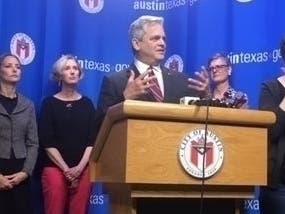
AUSTIN, TX — Austin will reap the dividends of social distancing amid the growing new coronavirus threat but only if they heed health officials' advice to practice the tactic, the mayor told Patch.
In a telephone interview with Patch on Sunday the day after issuing yet another coronavirus-rooted municipal order — one compelling retail stores to ensure patrons' physical distancing to avert illness spread — Austin Mayor Steve Adler said the city might not see immediate benefits from restrictions, but they will pay future dividends if heeded.
"One of the big changes that happened in the order last night was asking people to be aware of social distancing wherever they are," Adler said. "It's especially difficult when people are in stores. We need people to maintain that social distancing, and to remind people what we're seeing now was set into motion and locked in place two or three weeks ago — even before we canceled South by Southwest."
Find out what's happening in Austinfor free with the latest updates from Patch.
Don't miss the latest coronavirus updates from health and government officials in the Austin area. Sign up for Patch news alerts and newsletters for what you need to know daily
Given the growing threat of respiratory illness now known as COVID-19 — caused by a member of the coronavirus family that’s a close cousin to the SARS and MERS viruses sparking past outbreaks — Adler joined Travis County Judge Sarah Eckhardt in cancelling the massive festival for the first time in its history on March 6 while placing limits on crowd sizes not to exceed 2,500.
Find out what's happening in Austinfor free with the latest updates from Patch.
As the threat of illness has spread since then, crowd size limits have diminished correspondingly — subsequently lowered to 250 people, then 50 and now a mere 10. Such guidelines aren't random figures, but reflective of guidelines set forth by the Centers for Disease Control and Prevention rigorously rooted in epidemiological longitudinal evidence showing the effectiveness of such measures.
"The things we're doing now, and have done, are very important but we're not seeing the benefits yet," Adler said. "I want people to know that the numbers will continue to go up and go much higher. We're not trying to stop the speed but we need to flatten out that spike."
Related stories:
- Coronavirus: Austin Mayor To Issue 'Shelter-In-Place' Order
- Coronavirus: Austin Illness Count Up To 86
- Coronavirus: New Austin Order Targets Stores' Social Distancing
- Austin Mayor Pens Letter To City Amid Coronavirus
Amid a dizzying number of some dozen orders at local, county and state levels as the scourge of illness has spread, the area that stuck out as incongruous were grocery stores. Deemed as part of the so-called "critical infrastructure" given their provision of food and other necessary supplies, grocery stores were tacitly exempt from COVID-19-caused restrictions — community focal points where large gatherings of people still gathered in inadvertent rebuke to the new social order.
"The decision to take on stores is where we saw that's where people are getting closer together," Adler said.
But it's not just stores where people are gathering en masse. Patch asked Adler about anecdotes related to enforcement — one at a West Campus lot where young people congregate for sustenance from an assemblage of food trucks. Austin Public Health officials have confirmed evidence of community spread of the virus — as opposed to its reach rooted on foreign travel to areas of high COVID-19 concentration — while saying an investigation is rooted on five clusters.
Does the latest city order targeting stores mean grocery stores are among those disease-spreading clusters? Are food truck areas among those groupings?
Adler demurred: "I'm not sure about geographical area," he said. Ultimately, adoption of a social-distancing culture for the time being overrides geography, he suggested: "I don't think it's important because this is a virus spreading widely. People need to adopt a couture of enforcing and living social distancing — of not going out unless they need to, period. Ultimately, it's going to be so widespread that it's going to be culture, not region," he said, defining the targets in controlling the scourge.
Young people in particular need to heed the advice: "Social distancing is part of our laws now," Adler said. "It can be enforced, and will be enforced by the city. As a practical mater, it's going to be impossible to enforce everywhere," he conceded. "People will do this because it's the right thing to do to protect their neighbors. Younger people get the virus just like everybody else, and they carry it. They become the delivery tool, so they need to especially take care and do everything they can to keep everybody as safe as possible."
From his vantage point, residents seem to be heeding the advice: "You can see it in Austin where the roads are pretty empty. It gives us some measure of hope. It takes all of us doing our part. This is something that is within our grasp to be able to handle. The hopefulness is we have the ability to decide how this hits us. It's something we need to do together."
Get more local news delivered straight to your inbox. Sign up for free Patch newsletters and alerts.