Business & Tech
Coronavirus: Report Shows Financial Impact In Austin
The Central Texas economy has been hard hit by the pandemic, with the loss of nearly 130K jobs from February through April.


AUSTIN, TX — The Central Texas economy has been hard hit from effects of the coronavirus as illustrated in an Austin Chamber of Commerce study showing the loss of nearly 130,000 jobs in the past three months.
In its "CenTex Economy in Perspective" report, chamber researcher Beverly Kerr found that between February and April, Austin lost 129,200 jobs or 11.4 percent (11.7 percent on a seasonally adjusted basis. The city's leisure and hospitality industry was especially impacted, losing nearly half of the jobs the industry had pre-pandemic, according to the findings.
Still, Austin’s 9.1 percent year-over-year job loss is more moderate than the declines seen in most major metros, according to the research. Austin's seasonally adjusted unemployment rate is 11.5 percent in April, up from 3.6 percent in March and 2.6 percent in February.
Find out what's happening in Austinfor free with the latest updates from Patch.
The release of new labor market data by federal and state workforce agencies represents estimates through April, Kerr noted in an emailed advisory. The two surveys that provide labor market estimates relate to a particular week or pay period in the month, she explained. In the household survey, the reference period is generally the calendar week that contains the 12th day of the month. In the establishment survey, the reference period is the pay period including the 12th. As such, only limited coronavirus pandemic impacts were reflected in last month’s release of March data and this month gives a fuller picture, the researcher noted.
Nonfarm payroll jobs
Find out what's happening in Austinfor free with the latest updates from Patch.
The Austin metropolitan area has 100,500 fewer jobs (or 9.1 percent) in April than it did in April 2019 according to Friday's releases of preliminary Current Employment Statistics (CES) payroll jobs numbers by the Texas Workforce Commission (TWC) and the U.S. Bureau of Labor Statistics (BLS).
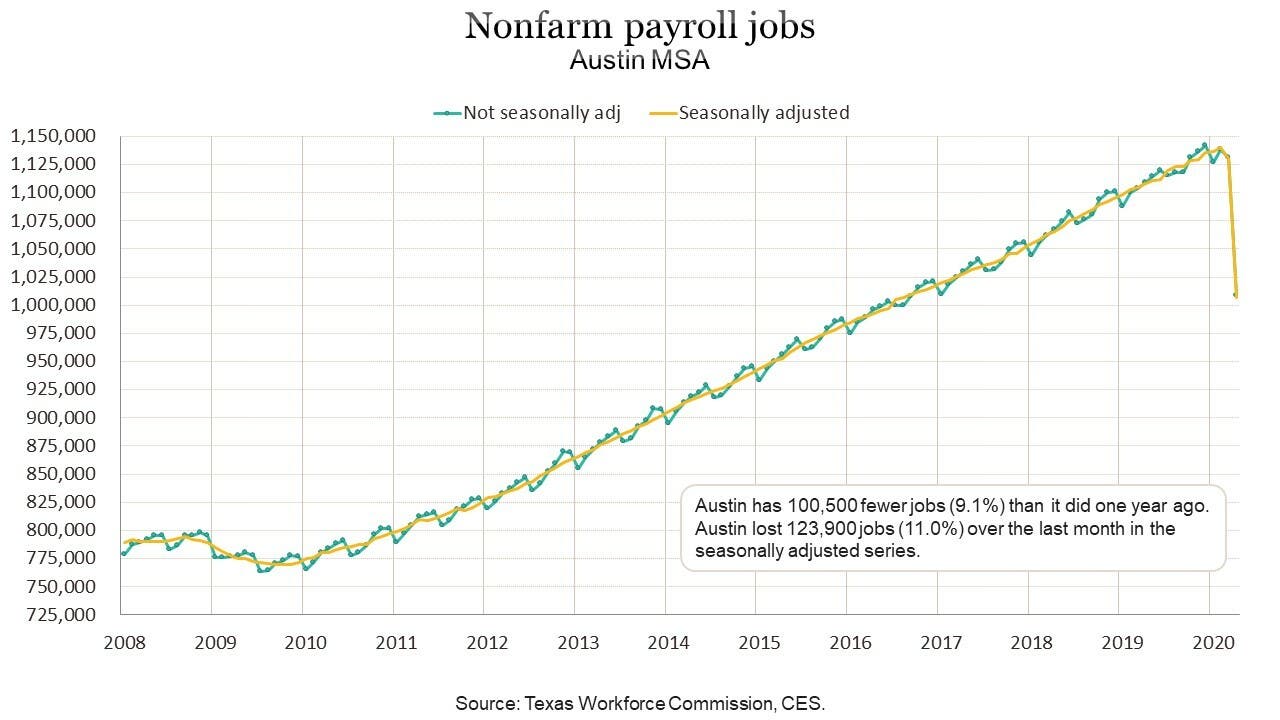
Austin’s jobs in April now total 1,008,700, according to the report. The last time Austin had approximately the same number of jobs was September 2016. In February, before the impacts from COVID-19, Austin recorded 1,137,900 jobs (38,000 jobs or 3.5 percent above the same month of 2019—a fairly average trajectory for Austin in recent years). Combining job losses for March with those of April, Austin lost 129,200 jobs, or 11.4 percent in the last two months.
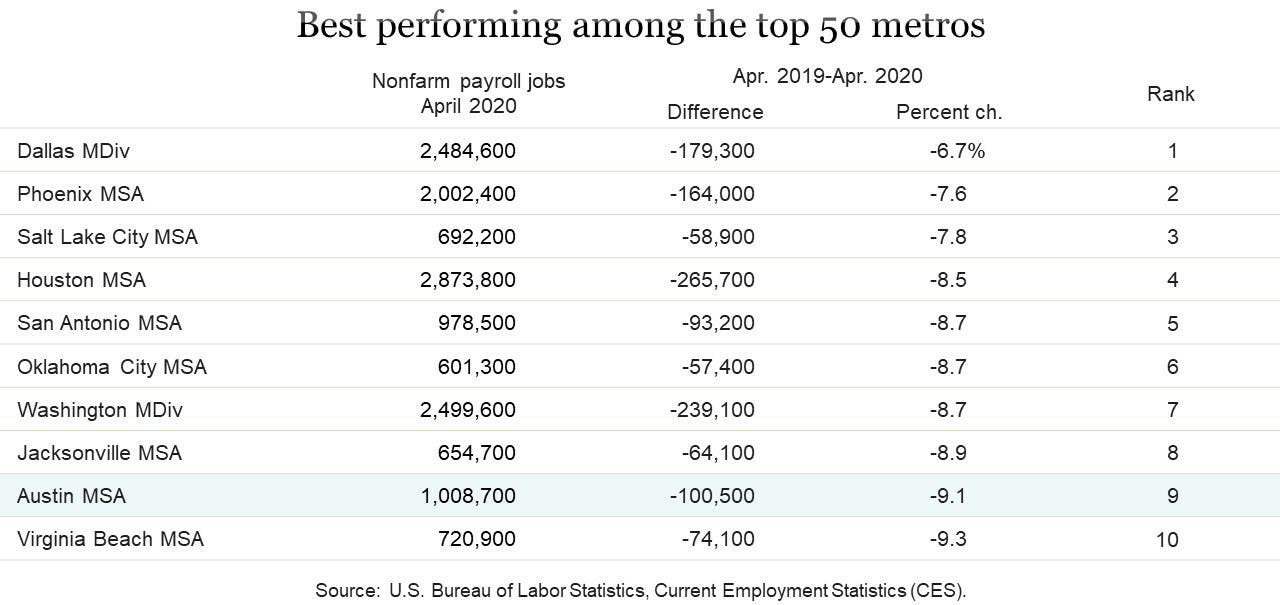
As dismal as these losses are, Austin’s year-over-year decline of 9.1 percent makes it the ninth “best performing” among the 50 largest metro areas. Dallas has the smallest decline (6.7 percent) among large metros and Houston and San Antonio, losing 8.5 percent and 8.7 percent respectively, also made the top ten. Fort Worth (-9.6 percent) ranked 13th. The deepest losses among major metros were in Warren (25.9 percent), Detroit (22.2 percent), Nassau-Suffolk (21.7 percent), and Las Vegas (20.7 percent).
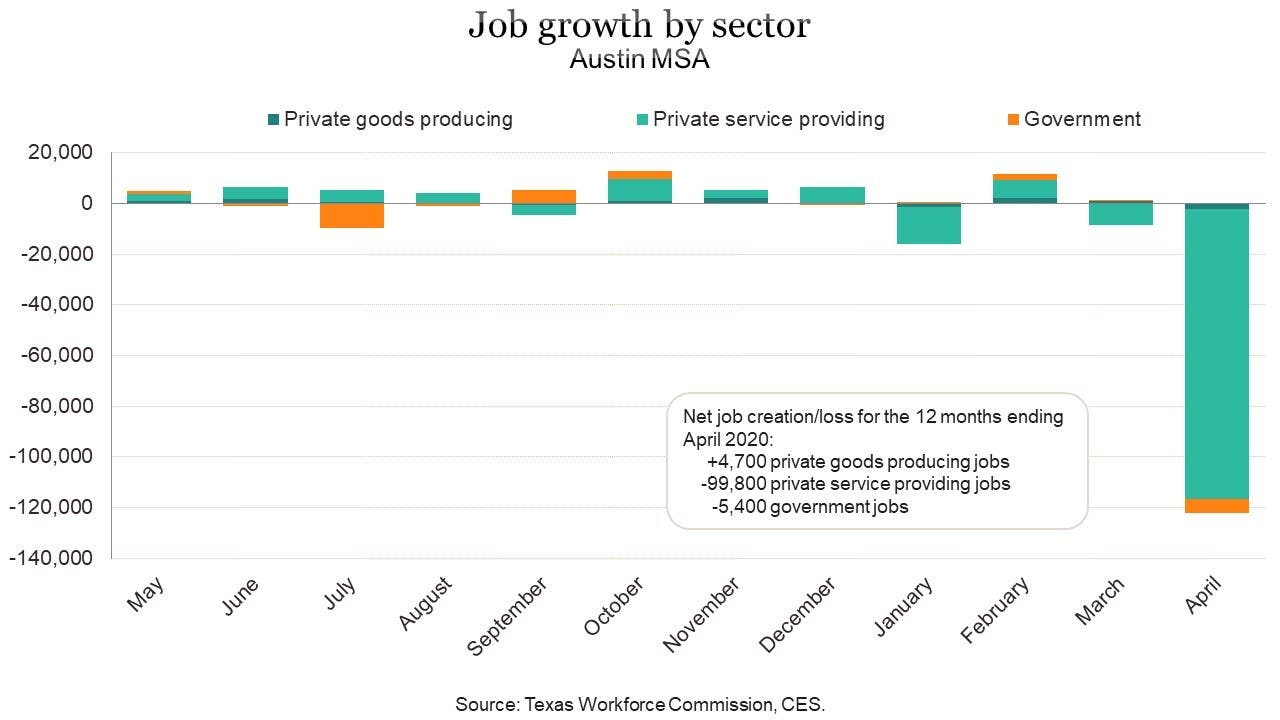
For the year ending in April, private sector job loss in the Austin MSA is 10.3 percent, or 95,100 jobs, with losses occurring in six of the 11 major private industry sectors. Austin's sizable government sector (17 percent of jobs) shrank by a relatively moderate 5,400 jobs or 2.9 percent, thus bringing the overall growth rate to 9.1 percent.
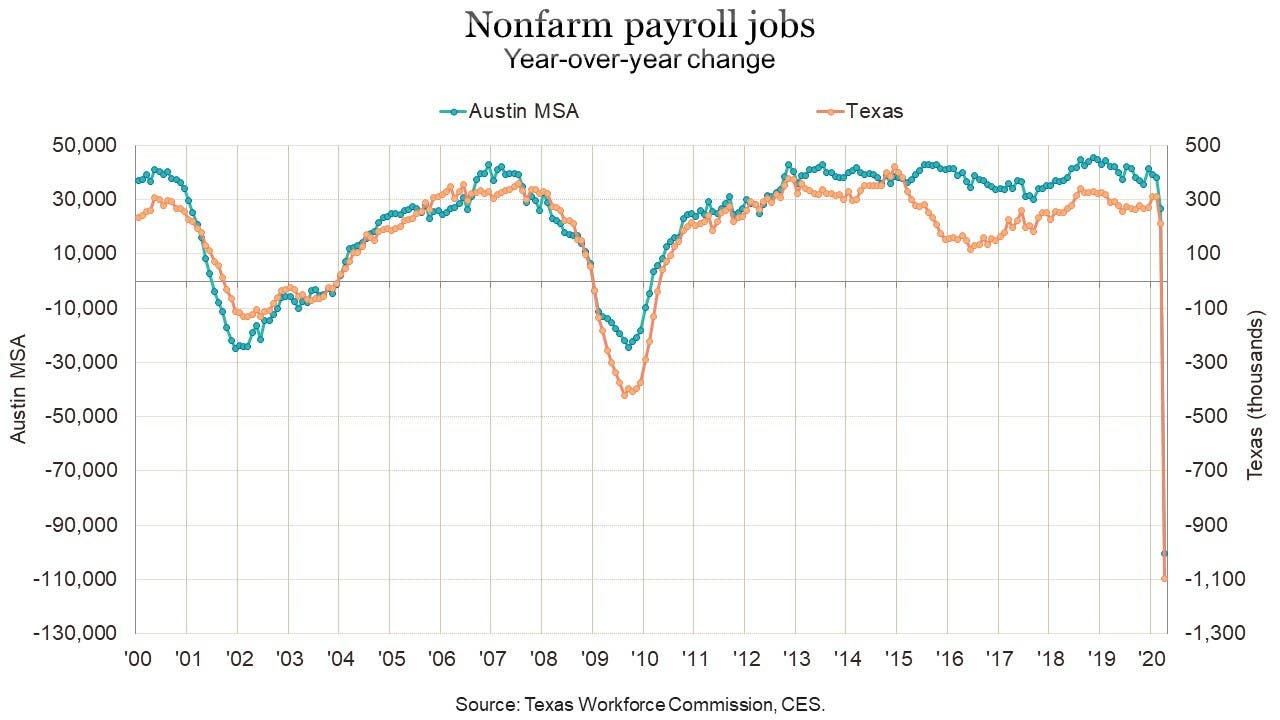
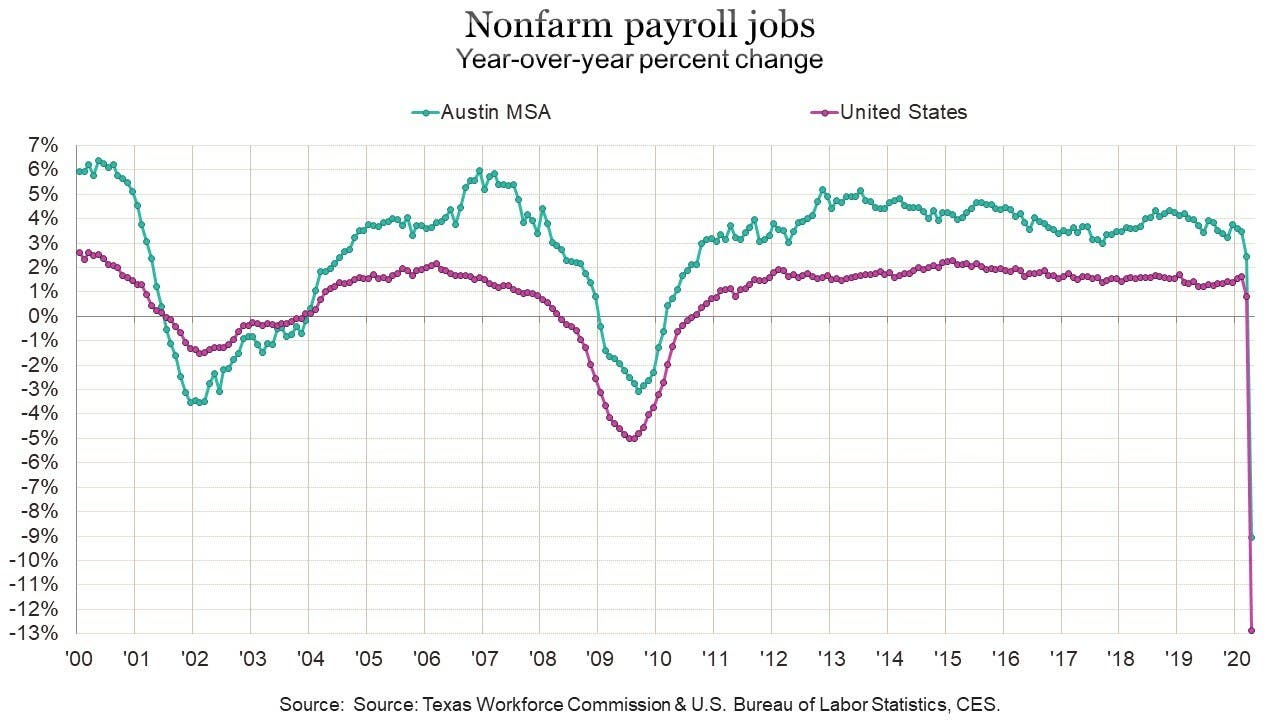
Texas saw net private sector job losses of 10.1 percent with all private industries, but one, losing jobs over the last 12 months. Total job losses were only 8.6 percent as the government sector, which accounts for 15 percent of total state employment, had only slight losses (0.4 percent). For the nation, private sector losses were 14.5 percent for the 12 months ending in April with all private industries, losing jobs. Overall job growth was 12.9% as government sector’s losses were relatively moderate (3.6 percent).
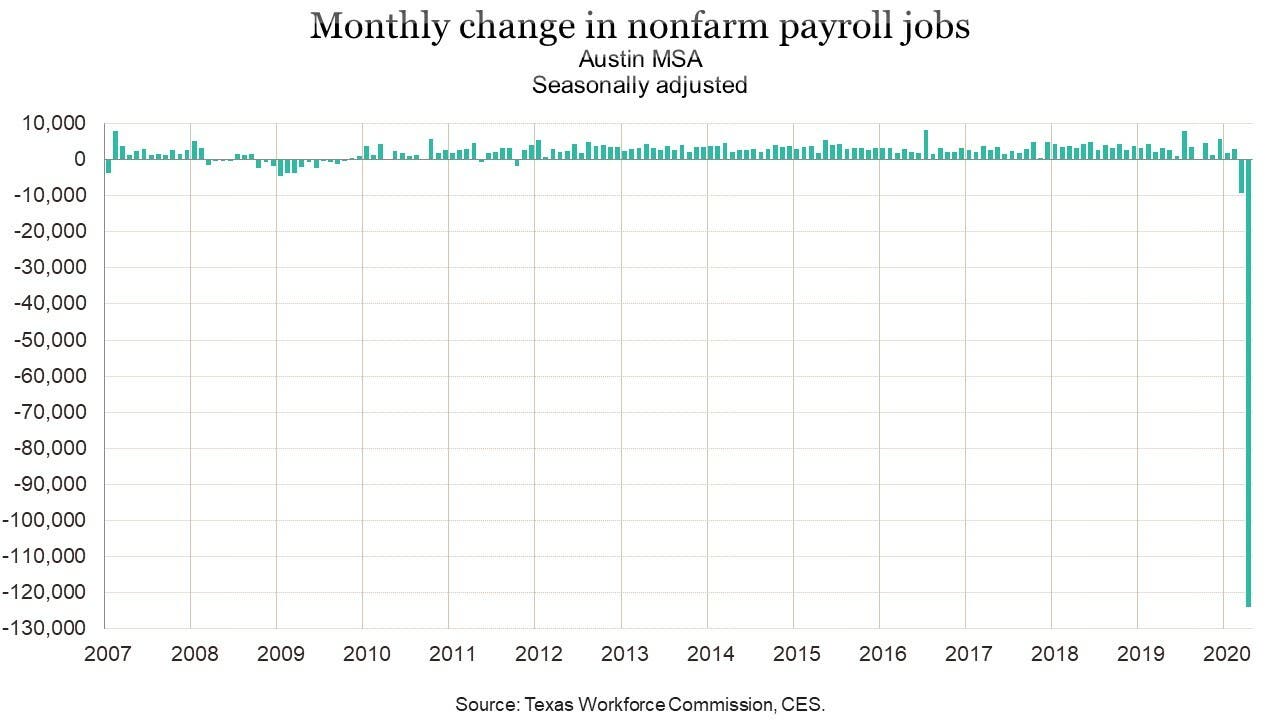
Jobs in April are down by 122,000 jobs or 10.8 percent from March in the not-seasonally-adjusted series for Austin. In the seasonally adjusted series, job losses are greater, down by 123,900 jobs or 11.0 percent. Seasonally adjusted jobs are down by 9.2 percent in Dallas, 9.9 percent in San Antonio and Houston, and 10.9 percent in Fort Worth. Statewide, seasonally adjusted jobs are down 1,298,900 or 10.0 percent. Nationally, seasonally adjusted jobs are down from March by 20.5 million or 13.5 percent.
In Austin, five private industry sectors have positive growth over the last 12 months, most notably construction and natural resources (+4,200); transportation, warehousing and utilities (+1,400); and financial activities (+3,900) which are each up by 6 percent or more.
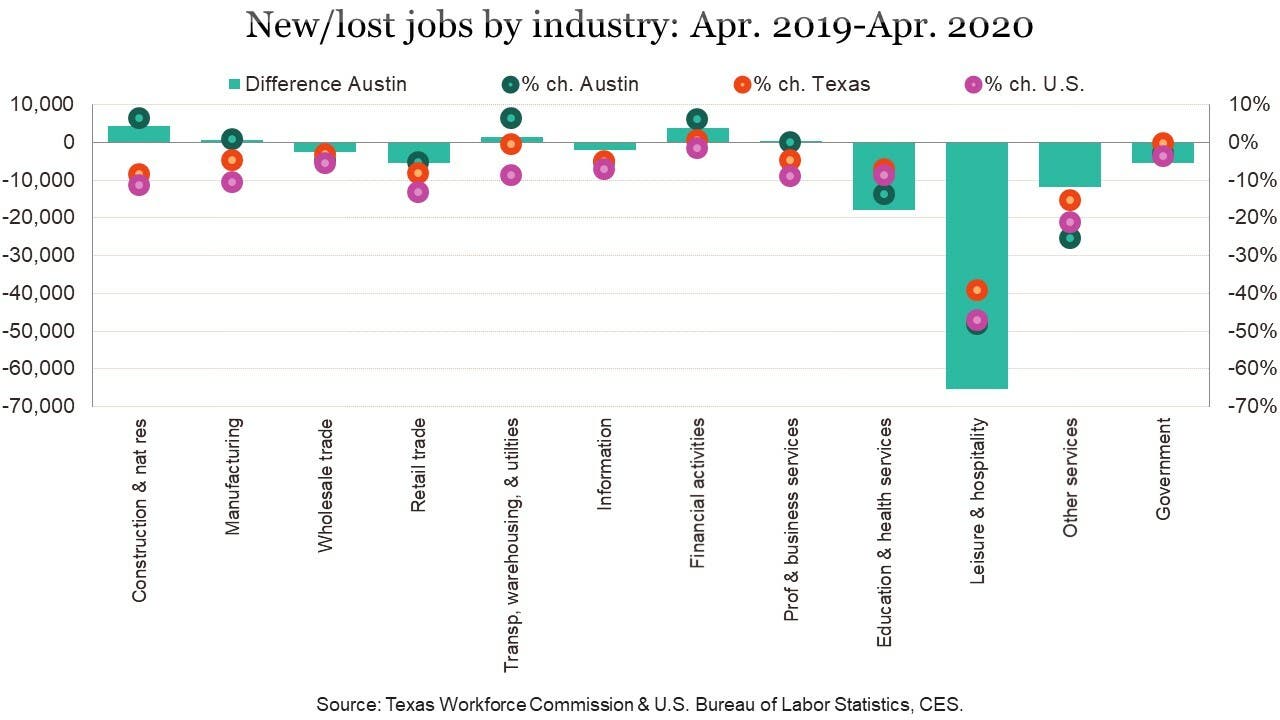
The greatest number of job losses, and greatest percent change, over the last year happened in leisure and hospitality (65,300 or 48.3 percent), education and health services (17,900 or 13.9 percent), and other services (11,000 jobs or 25.4 percent). More moderate contractions happened in wholesale trade (2,500 or 4.9 percent), retail trade (5,600 or 5.2 percent), and information (2,000 or 5.2 percent).
Compared to our last pre-pandemic month, February, all industries have lost jobs except financial activities which is up by 1,100 jobs (1.6 percent) and construction and natural resources which is unchanged. The most notable losses over the last two months are leisure and hospitality (67,500 or 49.1 percent), education and health services (21,000 or 15.9 percent), other services (14,100 or 28.7 percent), and retail trade (9,700 or 8.7 percent).
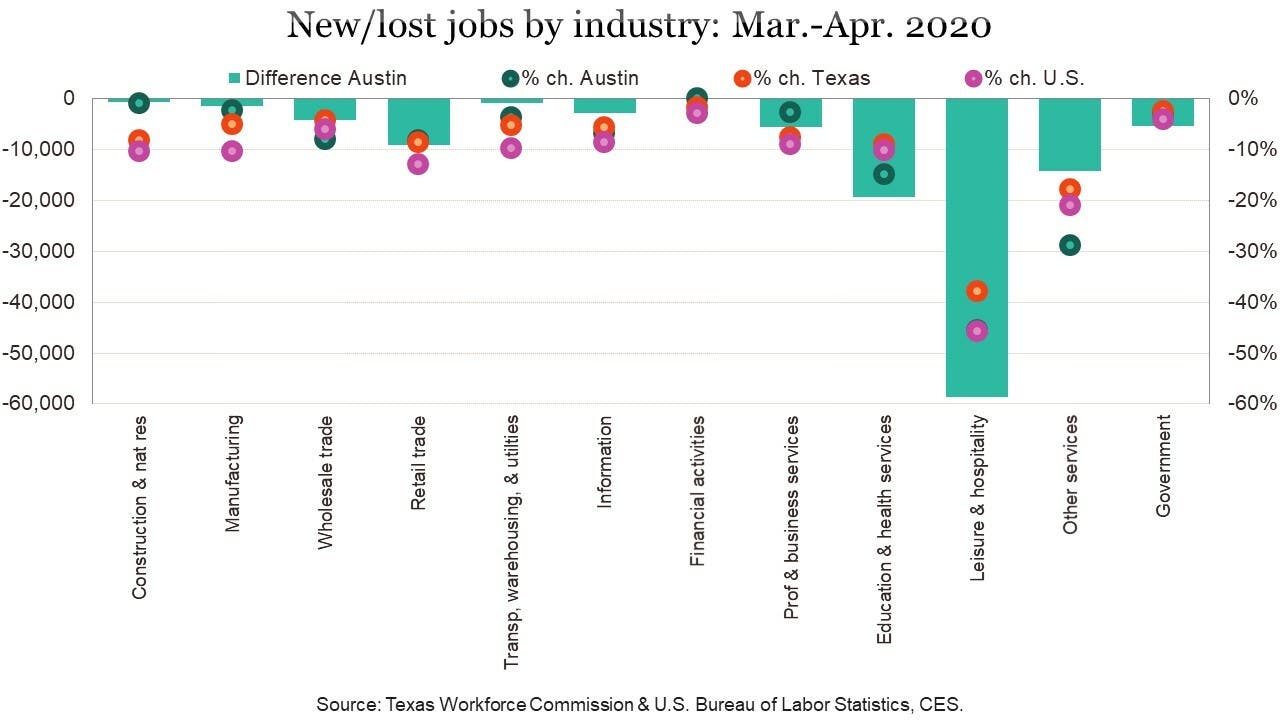
Statewide, over the last 12 months, only financial activities added jobs, 3,800 (0.5 percent). Double-digit losses were seen in leisure and hospitality (39.2 percent or 545,500 jobs) and other services (15.4 percent or 68,200). Retail trade and education and health services each shed over 100,000 jobs (106,300 or 8.1 percent and 123,400 or 7.1 percent respectively).
Nationally, no industries added jobs and five industries lost job at double-digit rates over the 12 months ending in April: leisure and hospitality (47.2 percent or 7.75 million), other services (21.3 percent or 1.25 million), retail trade (13.4 percent or 2.1 million), construction and natural resources (11.3 percent or 0.92 million), and manufacturing (10.5 percent or 1.3 million).
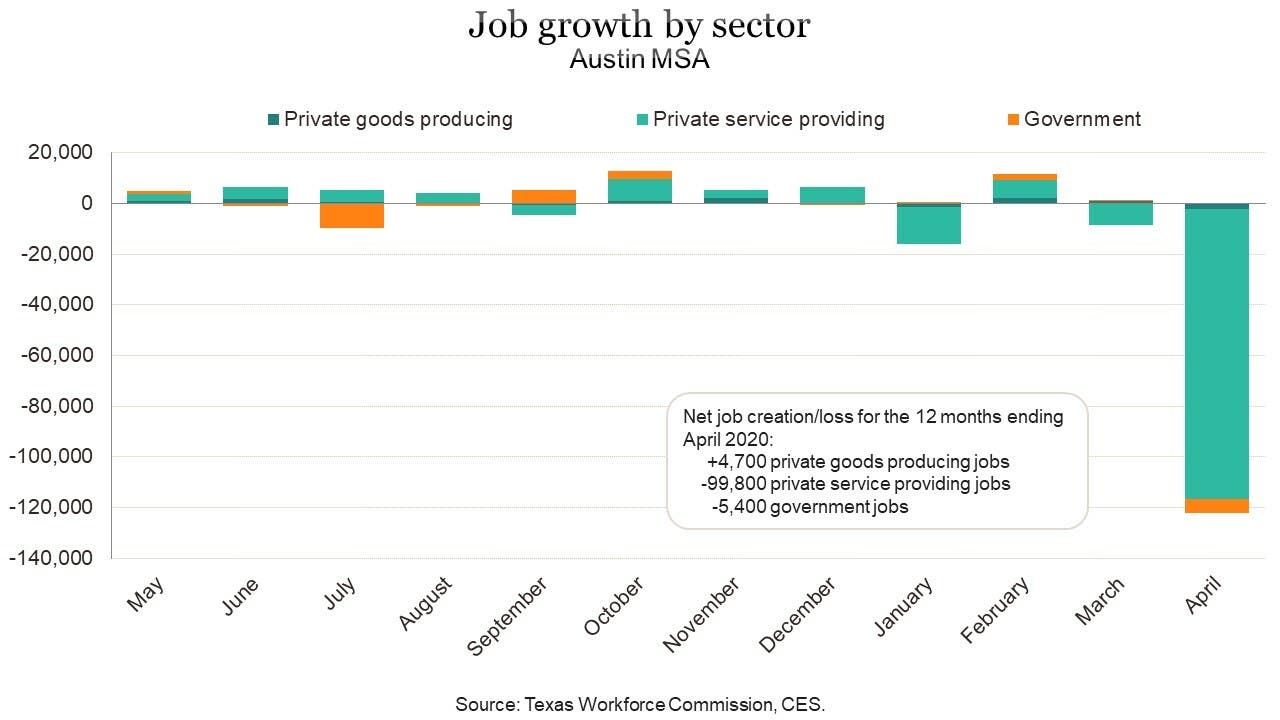
Over the last 12 months, the net losses for private service-providing industries in Austin is 99,800 jobs, or 12.8 percent. Employment in goods producing industries is up by 4,700 jobs or 3.6 percent. Statewide, private service-providing industries are down 959,600, or 10.9 percent, and goods producing industries are down 131,000 jobs, or 6.8 percent.
Between March and April, Austin’s goods producing industries lost 2,100 jobs or 1.5 percent , while private service providing industries lost 114,600 jobs or 14.2 percent. Statewide, jobs fell by 138,100 or 7.1 percent in goods producing industries and by 1,139,500 or 12.7 percent in private service providing industries.
Labor force, employment & unemployment
We also now have April labor force, employment, and unemployment numbers for Texas and local areas in Texas. The same data for all U.S. metros will not be released until June 3. In March, Austin had the 11th lowest rate of unemployment among the 50 largest metros. New unemployment numbers show Austin’s performance relative to the state and other major Texas metros being sustained, however each, of course, saw a dramatic increase in April.
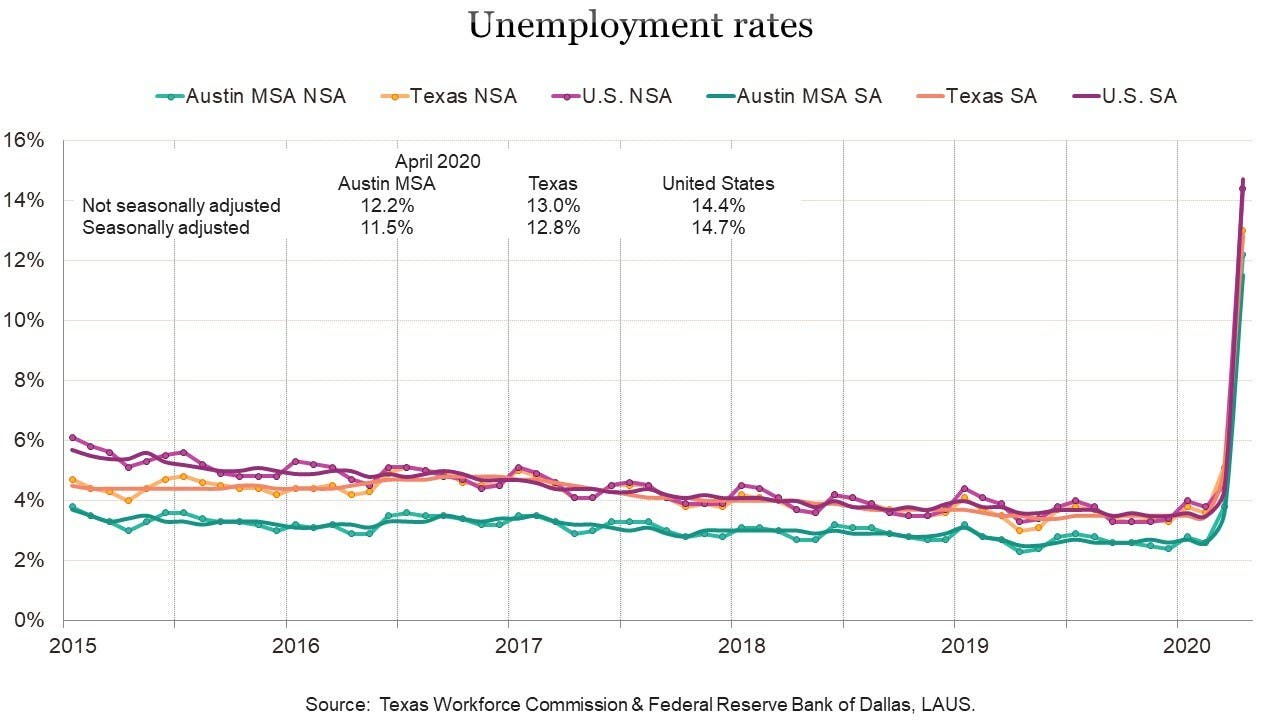
In April, Austin is at 12.2 percent, while the other major metros range from 12.6 percent in Dallas to 14.2 percent in Houston. Fort Worth is at 13.1 percent and San Antonio is at 13.2 percent. Austin’s rate one year ago was 2.3 percent. The rates in the other major Texas metros are elevated from a year ago by from 9.2 to 10.5 percentage points. The statewide not-seasonally-adjusted rate is now 13.0 percent, up from 3.0 percent in April of last year. The national unemployment rate is 14.4 percent, up from 3.3 percent a year ago.
Within the Austin MSA, Caldwell County has the lowest unemployment rate at 10.5 percent in April while Hays County has the highest at 12.8 percent. The rate is 12.4 percent in Travis County, 11.8 percent in Williamson County, and 10.7 percent in Bastrop County. Caldwell County’s relative performance is unprecedented. On the basis of annual average data, Caldwell County has had the highest unemployment rate in the metro every year since the series begins in 1990.
On a seasonally adjusted basis, Austin’s April unemployment rate is 11.5 percent, up from 3.6 percent in March and 2.6 percent in February. The statewide rate is 12.8 percent, up from 5.1 percent in March and 3.5 percent in February; and the national rate is 14.7 percent, up from 4.4 percent and 3.5 percent.
In the aftermath of the Dot.com bust, the highest seasonally adjusted unemployment rate reached in Austin was 6.1 percent. In the Great Recession, the highest rate was 7.5 percent and rates over 7 percent prevailed for 12 months.
Among Texas’ other major metros, Dallas has the next lowest seasonally adjusted unemployment rate, at 11.5 percent, in April, while Fort Worth and San Antonio are at 12.3 percent, and Houston’s rate is 13.3 percent. Seasonally adjusted unemployment rates for Texas metros are produced by the Federal Reserve Bank of Dallas. (The TWC also produces seasonally adjusted rates for Texas metros, but publication lags the Dallas Fed’s data.)
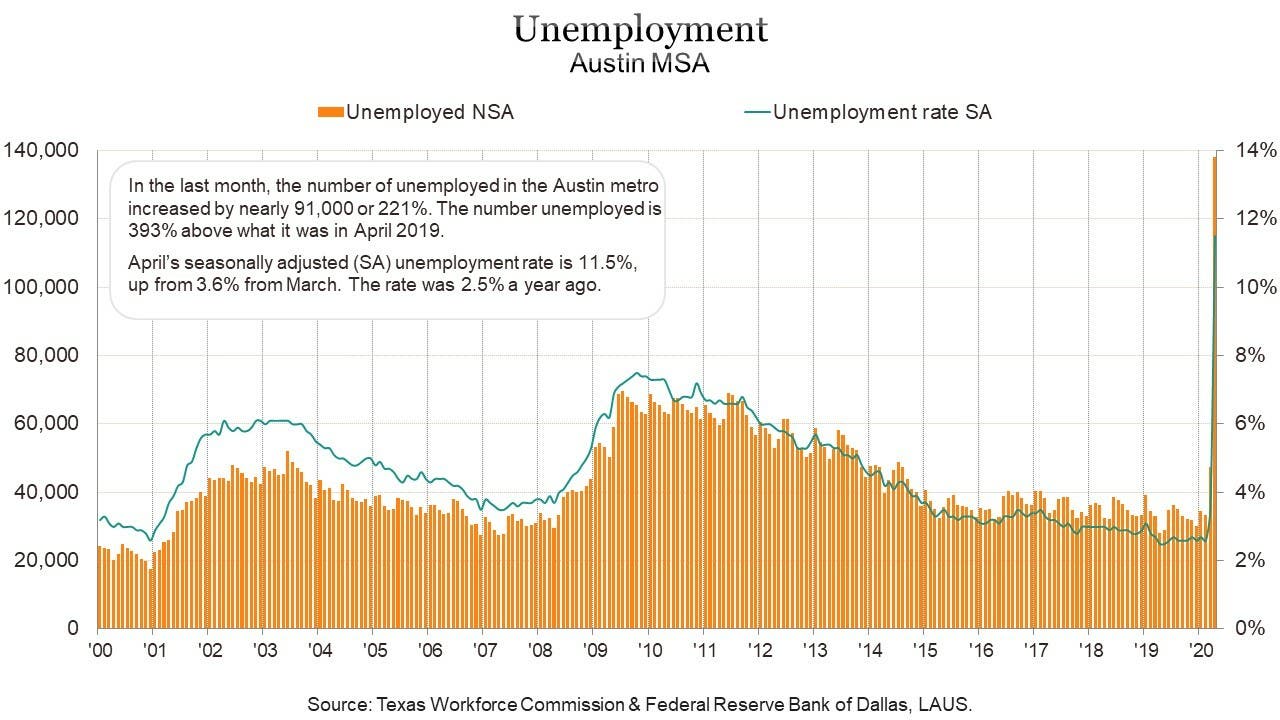
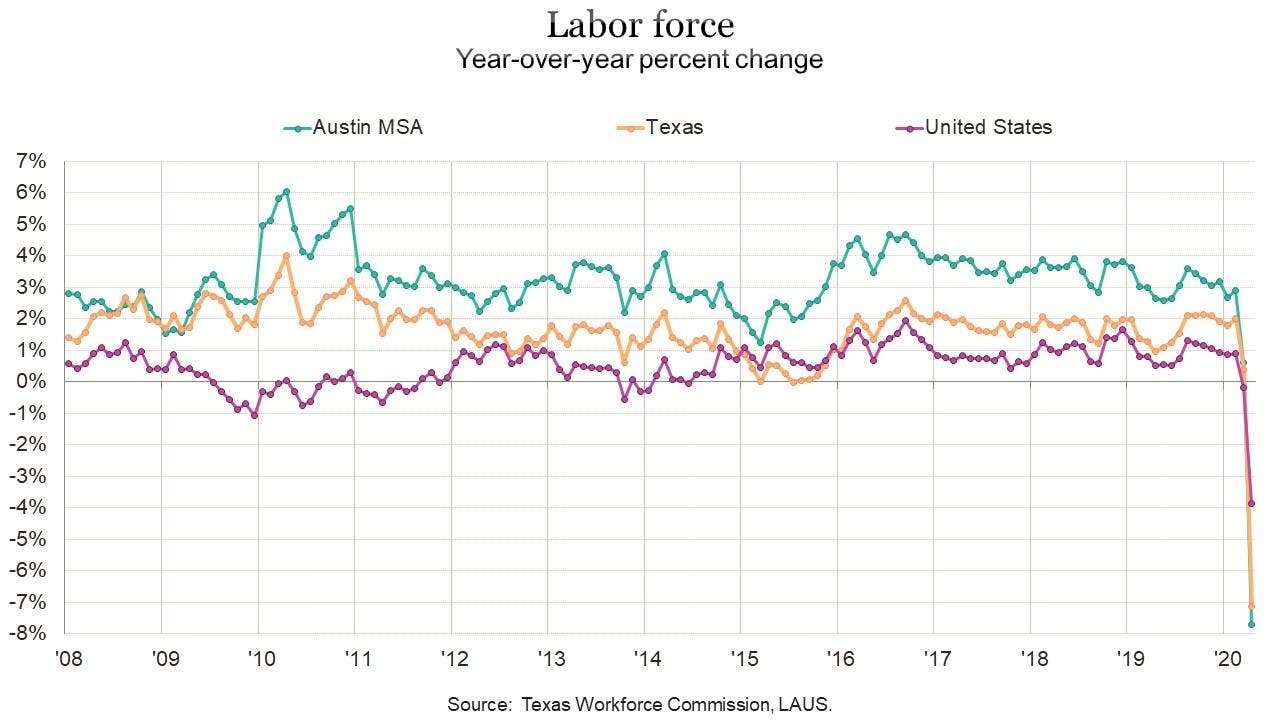
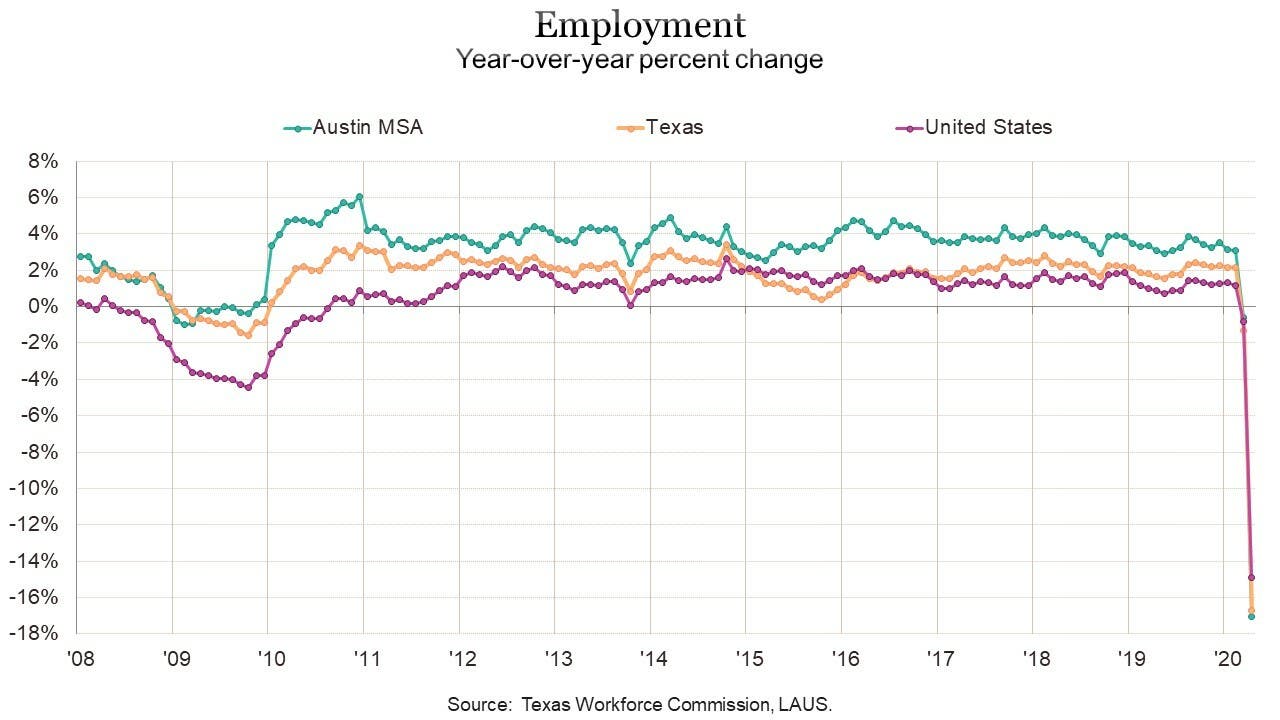
In February, before pandemic impacts, the number unemployed in Austin was 33,432 (very close to 2019’s annual average). The number climbed to 47,372 in March and stands at 138,098 in April—312 percent above February. The Austin metro’s civilian labor force (employed plus unemployed) fell by 132,039 persons or 10.4 percent from February, while persons employed decreased by 236,696 or 19.2 percent. Employed in April fell to 994,789. The last time this number was below one million was February 2014.
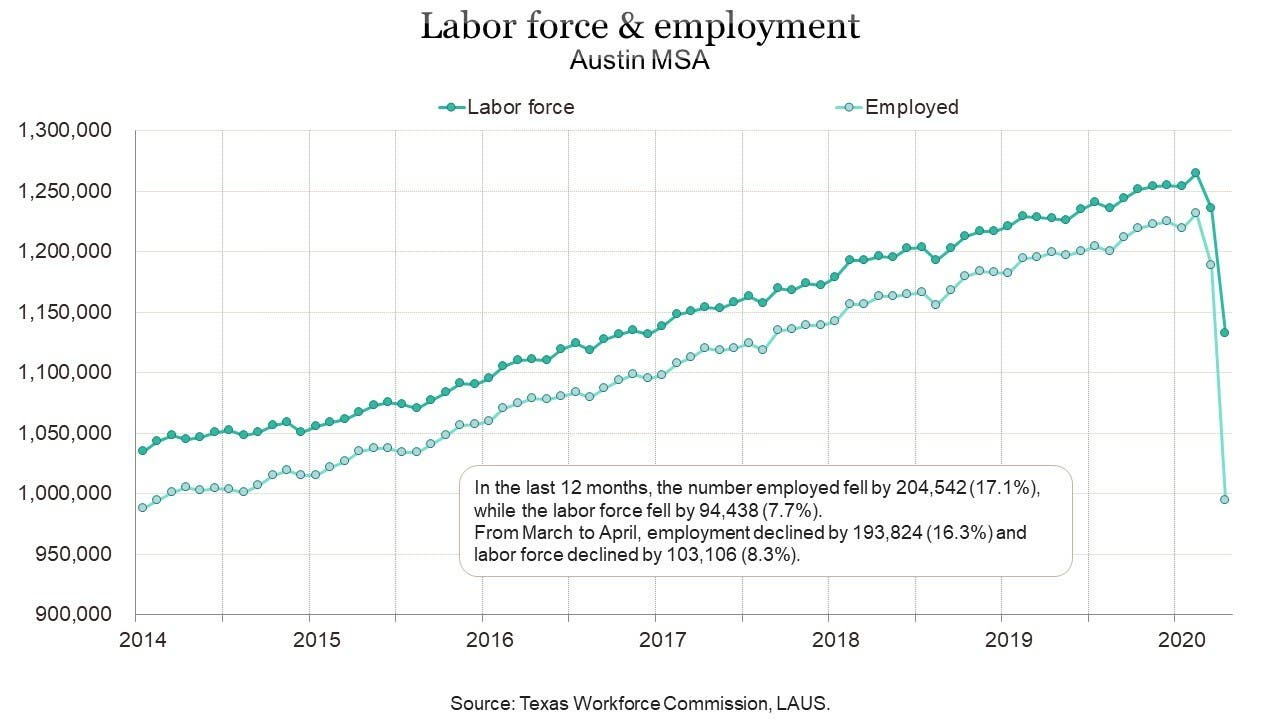
Texas’ employment fell by 2.53 million or 18.4 percent from February to April while labor force fell by 1.35 million or 9.5 percent. Thus, the number of unemployed increased by 1.18 million or 232 percent. Nationally, April civilian labor force shrank by 8.40 million or 5.1 percent, while employed is below the level seen in February by 24.69 million or 15.6 percent, and 16.29 million more people (262 percent) are unemployed.
The Texas Workers Commission and the Bureau of Labor Statistics will release May estimates on June 19.
Get more local news delivered straight to your inbox. Sign up for free Patch newsletters and alerts.