Schools
Frozen Water on Mars Holds as Much Volume as Lake Superior, Texas Scientists Say
It's too early to tell if life exists down there, but a melted layer would yield possibility of life beneath the plains of the red planet.


AUSTIN, TX — Water, as you know, is the essence of life, a necessary ingredient for existence. What you might not know is that frozen beneath a region of cracked and pitted plains on the planet Mars lies about as much water as the volume found in Lake Superior — the largest of the Great Lakes.
That's the assessment from a team of scientists led by the University of Texas at Austin, a conclusion reached after studying data from the NASA Mars Reconnaissance Orbiter.
Scientists said they examined part of Mars' Utopia Planitia region, in the mid-northern latitudes, with the orbiter's ground-penetrating Shallow Radar (SHARAD) instrument. Analyses of data gathered from more than 600 overhead passes revealed a deposit more expansive than the area encompassing New Mexico, according to the scientists' research.
Find out what's happening in Austinfor free with the latest updates from Patch.
The deposit studied ranges in thickness from about 260 feet to about 560 feet, with a composition of between 50 percent to 85 percent water ice, mixed with dust or larger rocky particles, scientists explained.
There's more: At the latitude of this deposit — about halfway from the equator to the pole — water ice cannot persist on the surface of Mars today, researchers noted. Instead, it turns into water vapor in the planet's thin, dry atmosphere. The Utopia deposit is shielded from the atmosphere by a soil covering estimated to be about 3 feet to 33 feet thick, scientists said.
Find out what's happening in Austinfor free with the latest updates from Patch.
"This deposit probably formed as snowfall accumulating into an ice sheet mixed with dust during a period in Mars history when the planet's axis was more tilted than it is today," said Cassie Stuurman of the University of Texas Institute for Geophysics, a unit of the Jackson School of Geosciences. Stuurman is the lead author of a report in the journal Geophysical Research Letters.
They're dubbing it Utopia Planitia, which roughly translates to "plains of paradise." The newly surveyed ice deposit, scientists explain, spans latitudes from 39 to 49 degrees within the plains — representing less than 1 percent of all known water ice on Mars but more than doubling the volume of thick, buried ice sheets known in the northern plains. Ice deposits close to the surface are being considered as a resource for astronauts, the findings indicate.
"This deposit is probably more accessible than most water ice on Mars, because it is at a relatively low latitude and it lies in a flat, smooth area where landing a spacecraft would be easier than at some of the other areas with buried ice," said Jack Holt, a research professor with the University of Texas Institute for Geophysics and a co-author of the Utopia paper. Holt is also a SHARAD co-investigator and has previously used radar to study Martian ice in buried glaciers and the polar caps.
But hold off on telling people that life has been found on Mars just yet. According to scientists, the Utopian water is all frozen now. If there was a melted layer — which would be significant for the possibility of life on Mars — it would have been evident in the radar scans, scientists note.
Then, this bit of intrigue: "However, some melting can't be ruled out during different climate conditions when the planet's axis was more tilted," scientists said.
"Where water ice has been around for a long time, we just don't know whether there could have been enough liquid water at some point for supporting microbial life," Holt said.
So what is Utopia Planitia, you might be asking yourself at this point. It's a basin with a diameter of about 2,050 miles, resulting from a major impact early in Mars' history and subsequently filled, scientists offer helpfully. NASA sent the Viking 2 Lander to a site near the center of Utopia in 1976, and the examined portion studied by Stuurman and colleagues lies southwest of that long-silent lander, they add.
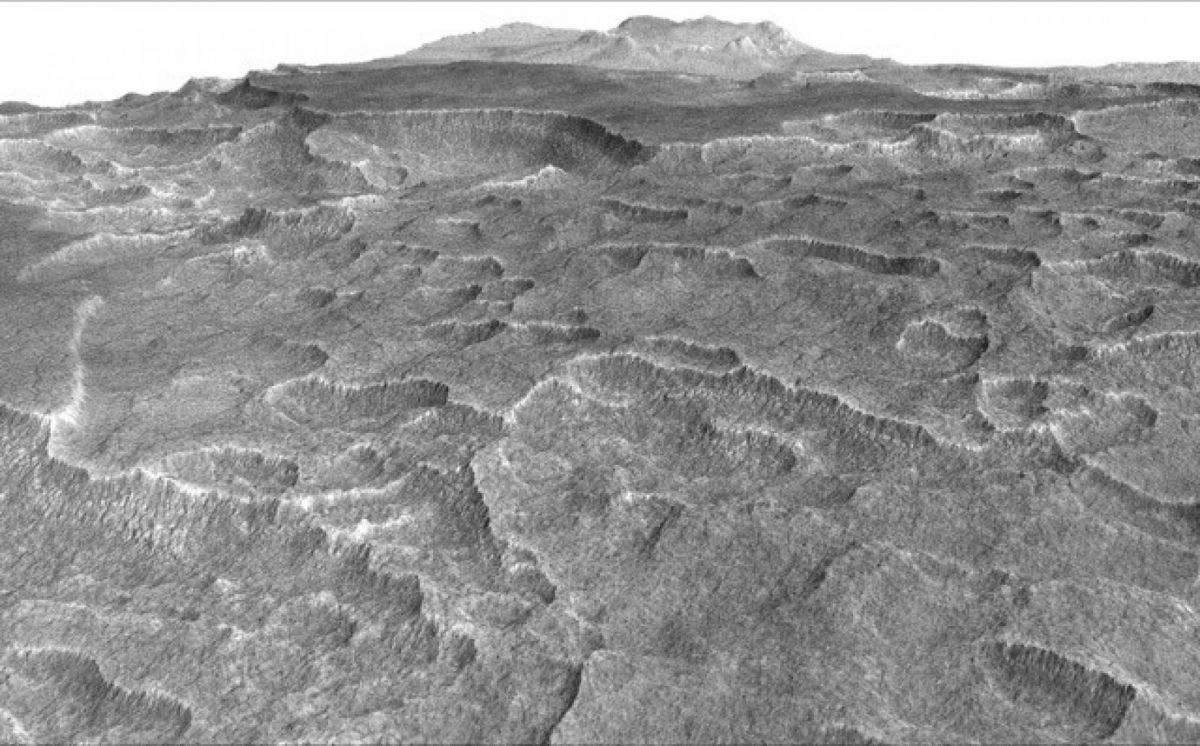
"Use of the Italian-built SHARAD instrument for examining part of Utopia Planitia was prompted by Gordon Osinski at Western University in Ontario, Canada, a co-author of the study," researchers said. Osinski said he and other researchers have long been intrigued by ground-surface patterns on Mars, such as polygonal cracking and rimless pits called scalloped depressions — "like someone took an ice cream scoop to the ground," said Stuurman, who started this project while a student at Western.
Osinki noted that in the Canadian Arctic, similar land forms are indicative of ground ice, "but there was an outstanding question as to whether any ice was still present at the Martian Utopia or whether it had been lost over the millions of years since the formation of these polygons and depressions."
In studying the large ice volume detected with SHARAD, knowledge is advanced into understanding about the red planet's history and yields a possible resource for future use, scientists said.
"It's important to expand what we know about the distribution and quantity of Martian water," said Mars Reconnaissance Orbiter Deputy Project Scientist Leslie Tamppari of NASA's Jet Propulsion Laboratory in Pasadena, California. "We know early Mars had enough liquid water on the surface for rivers and lakes. Where did it go? Much of it left the planet from the top of the atmosphere. Other missions have been examining that process. But there's also a large quantity that is now underground ice, and we want to keep learning more about that."
Joe Levy of the University of Texas Institute for Geophysics, a co-author of the new study, agreed.
"The ice deposits in Utopia Planitia aren’t just an exploration resource. They’re also one of the most accessible climate change records on Mars,” he said. “We don’t understand fully why ice has built up in some areas of the Martian surface and not in others. Sampling and using this ice with a future mission could help keep astronauts alive, while also helping them unlock the secrets of Martian ice ages.”
>>> Image courtesy of NASA/JPL-Caltech/University of Arizona. It depicts a vertically exaggerated view to show scalloped depressions in a part of Mars where such textures prompted researchers checked for buried ice, using ground-penetrating radar aboard NASA's Mars Reconnaissance Orbiter.
Get more local news delivered straight to your inbox. Sign up for free Patch newsletters and alerts.