Weather
Monday's High Temp In Austin Reaches 110 Degrees (Updated)
Triple-digit heat has been a constant for the last 21 days, but Monday topped them all at 110 degrees. Caution is highly urged.


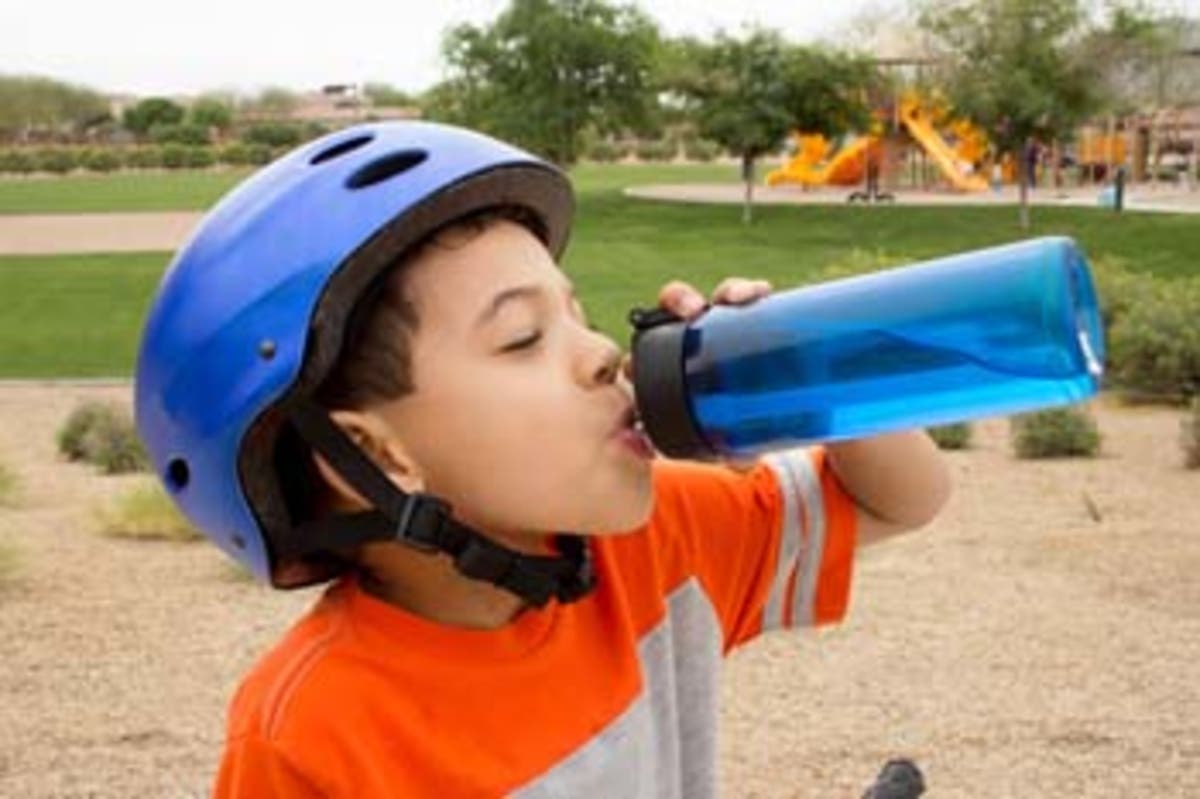
UPDATE: The temperature on Monday reached 106 degrees by around 2:30 p.m. in Austin on Monday, matching the high recorded on Sunday. This is according to Camp Mabry weather station officials.
And by around 4 p.m., it jumped to 109 degrees. Then, it climbed to 110 degrees — the hottest day in July for Austin ever recorded, National Weather Service officials said. Up until now, the hottest day locally on this date in July was 109 degrees on July 26, 1954.
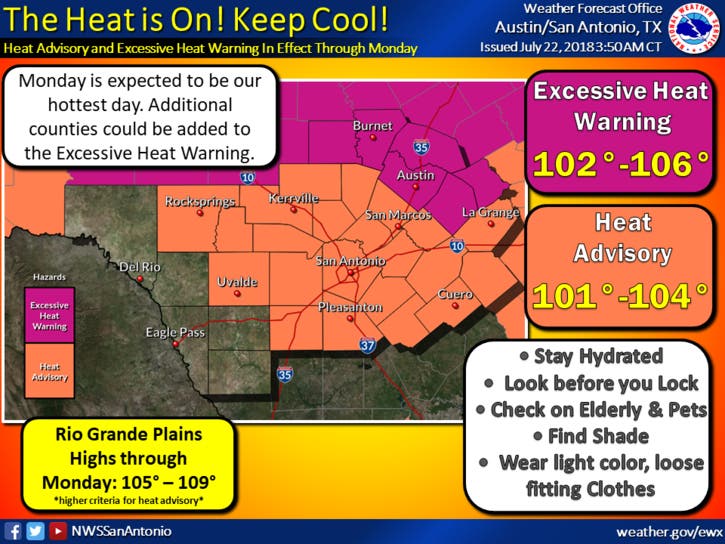
The daily record was broken at around 2 p.m. when temperatures reached 104 degrees, according to Camp Mabry officials. This marks the 21st consecutive day of triple-digit heat in Central Texas, prompting weather officials on Monday to issue an "excessive heat warning" for the region.
Find out what's happening in Austinfor free with the latest updates from Patch.
The temperature could potentially reach 107 degrees today, according to weather officials.
Those in the area are advised to drink plenty of water — particularly when active outdoors — wear loose-fitting clothing and take breaks in air-conditioned comfort. Read below for further tips from the National Weather Service and Centers for Disease Control and Prevention.
Find out what's happening in Austinfor free with the latest updates from Patch.
The threat is real: On Monday alone, Austin medics responded to at least 16 heat-related incidents, by far the most incidents in the last week, Austin-Travis County EMS officials said via Twitter.
#ATXHeat Update: #ATCEMSMedics have responded to 16 heat related incidents so far today, by far the most incidents in the last week, on the hottest day this year. Here are our tips for the heat as it continues this week but not to the level of this past week. Stay Safe, Stay Cool pic.twitter.com/LdBJ3osk9f
— ATCEMS (@ATCEMS) July 23, 2018
All told, medics have responded to 40 heat-related calls since last Monday:
#ATXHeat #ATXWx This is the last day of the @NWSSanAntonio Extreme Heat Warning. However temps will continue to be quite hot the remainder of this week as well. #ATCEMS has responded to 40 heat related incidents since last Monday. Stay Safe, Stay Cool, Stay Hydrated! pic.twitter.com/k7VpO8Biqu
— ATCEMS (@ATCEMS) July 23, 2018
From earlier:
AUSTIN, TX — If you think it's been hot in the last few days, you ain't seen nothing yet. Monday is expected to be the hottest day of the year in the Austin region, with a high temperature near 107 degrees expected.
This is dangerous territory, and many counties will likely be added by the National Weather Service to its "excessive heat warning" as the day progresses. The high on Sunday reached 105 degrees, according to timeanddate.com, already a setting for heat-related illness such as heat stroke.
According to the National Weather Service, it's expected to be sunny and hot on Monday. The winds won't help col things down as they will be negligible at around 5 miles per hour. By nightfall, conditions will be partly cloudy with a low around 80.
But you know that saying that if you don't like the weather in Texas just wait five minutes and it'll change? Something like that is forecast this week, with actual rain (remember what that looked like?) likely by Tuesday.
However — and sorry to burst your bubble — the chances of rain will be slight. According to NWS forecasters, there will be a 20 percent chance of showers and thunderstorms, partly sunny and hot, with a high near 100. But here's the kicker: Heat index values still are expected to be up there — as high as 109 degrees, according to forecasters. And east-northeast wind will be blowing at between five miles per hour to 10 miles per hour.
Related story: Heat Advisory Issued For Austin Region Amid Triple-Digit Temps
By Tuesday night, a 20 percent chance of showers and thunderstorms will linger, according to forecasters. It will be mostly cloudy, with a low around 77 with and east wind around five miles per hour and becoming calm after midnight.
If you're able to call 100 degrees cool by comparison to Monday's expected weather, then Wednesday might be more your bag. It's expected to be mostly sunny and hot, with a high near 100. There will be a calm wind becoming east southeast around five miles per hour in the afternoon, according to forecasters.
Wednesday night will be partly cloudy with a low of around 78 — a veritable cold front! The east wind will be five to 10 miles per hour, becoming south after midnight, NWS forecasters predict.
It'll be much the same through the remainder of the week, with triple-digit heat in the offing. Here's what the NWS says:
- Thursday will be sunny and hot, with a high near 103. South southwest wind around 5 miles per hour becoming southeast in the afternoon. Thursday night will be partly cloudy, with a low around 76. East southeast wind of five miles per hour to 10 miles per hour will become south southwest after midnight.
- Friday will be sunny and hot with a high near 101. Friday night will be partly cloudy, with a low around 76.
- Saturday will be mostly sunny and hot, with a high near 102 and Saturday night will be partly cloudy, with a low around 78.
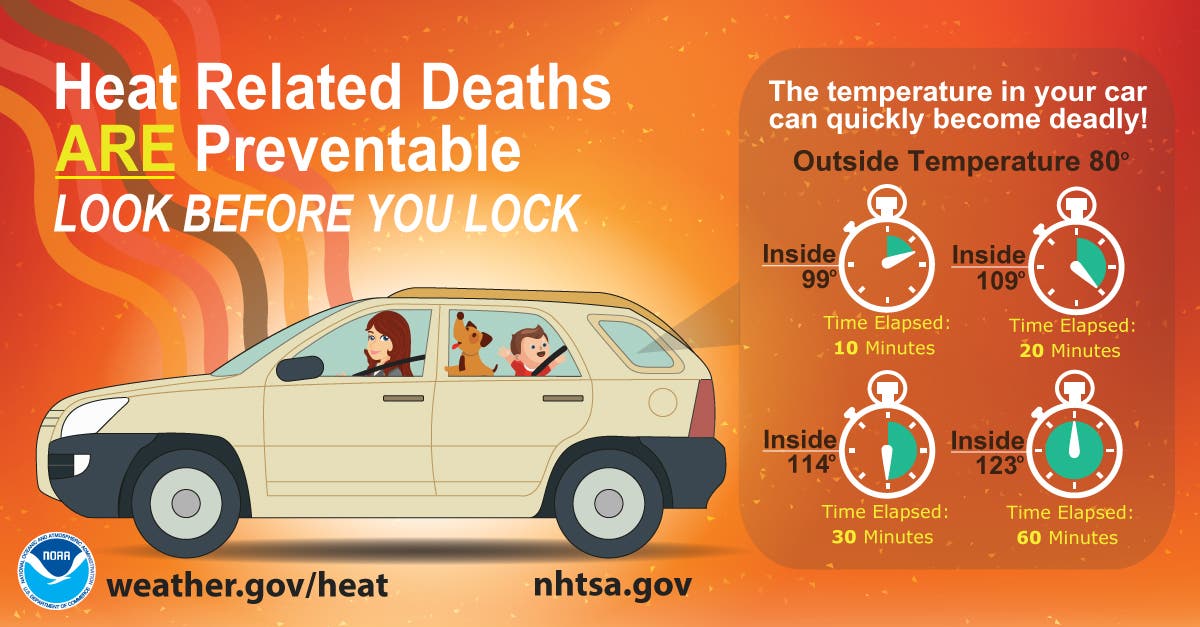
But back to that Monday high of 107 degrees. Residents are highly urged to stay hydrated — advice often repeated of which all should take heed, especially when active outdoors. Weather officials also advise for people to "look before you lock," to make sure that infants and pets aren't still in the car upon exiting the vehicle.
Here are some other tips by the NWS:
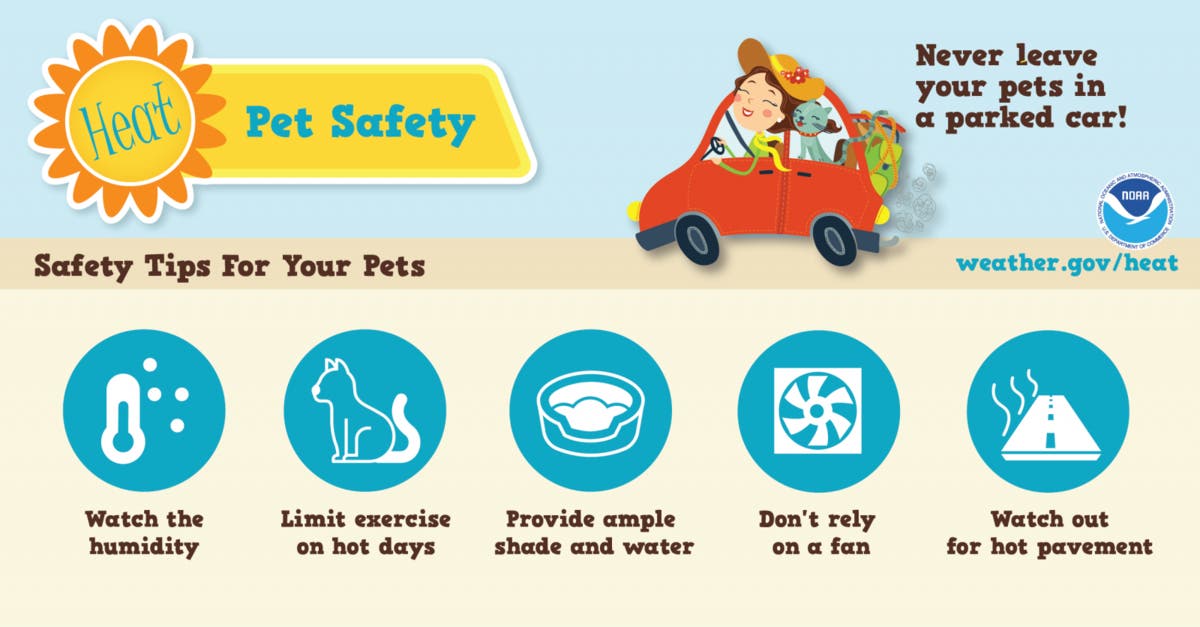
To make it easier to absorb all the safety precautions, forecasters break each area of concern into various colorful graphics. This one advise on pet safety in light of the scorching heat:
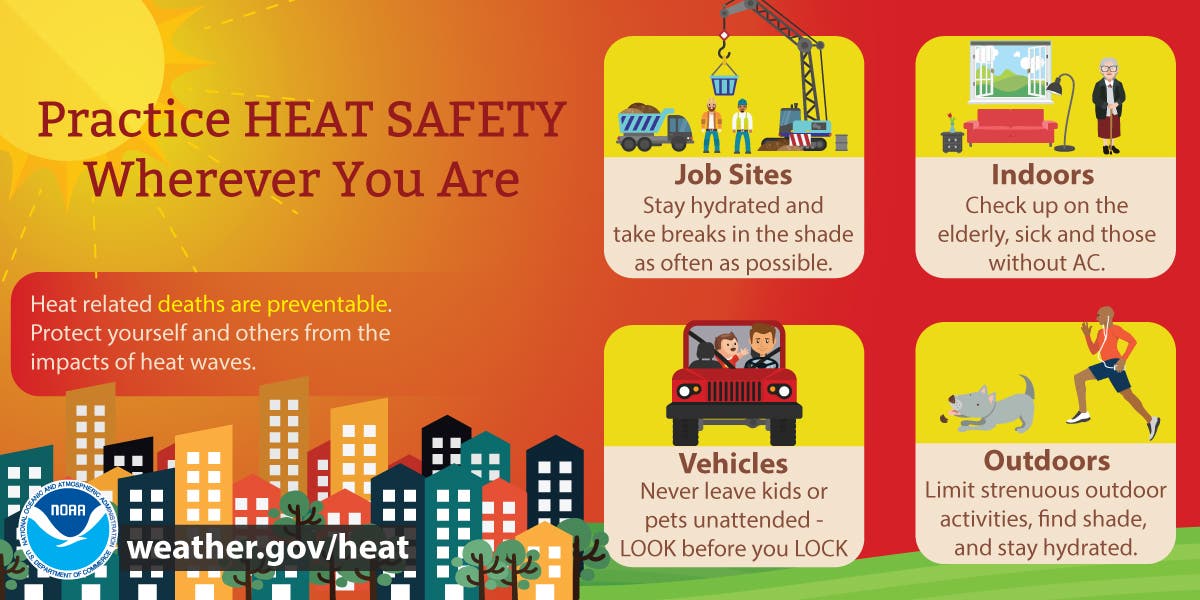
It's important to practice heat safety where you are, according to the National Weather Service. This goes when you're at a job site, indoors, inside a vehicle or outdoors.
Despite the oppressive temperatures, heat-related deaths are eminently preventable by taking common-sense safeguards. It's difficult to comprehend how someone can forget a child inside a hot vehicle, but it tragically happens.
Sometimes, harried parents simply forget their children in the back seat as they rush to work, either forgetting they haven't yet stopped at the daycare or mistakenly assuming a spouse has done so. Sometimes, children have entered unlocked vehicles unbeknownst to their parents who didn't realize the car was unlocked.
As it stands, Texas leads the nation in such hot car deaths. According to noheatstroke.org, 114 children have died of heat stroke between 1998 to 2017 as a result of being left in a hot car. So far this year, three children have died in this manner.
Yet these tragedies are completely preventable. Here's another graphic from the NWS related to this:
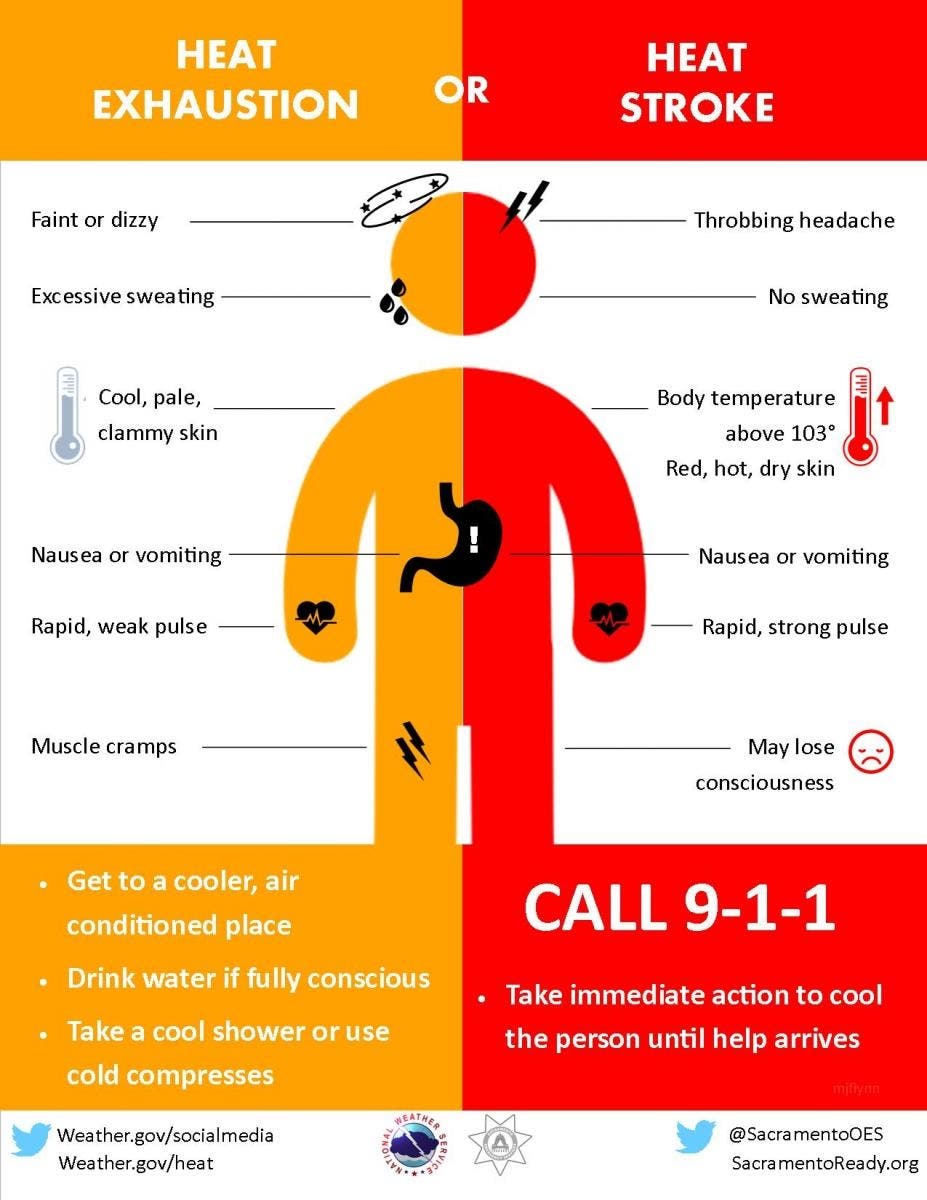
Here are the signs of heat exhaustion and heat stroke:
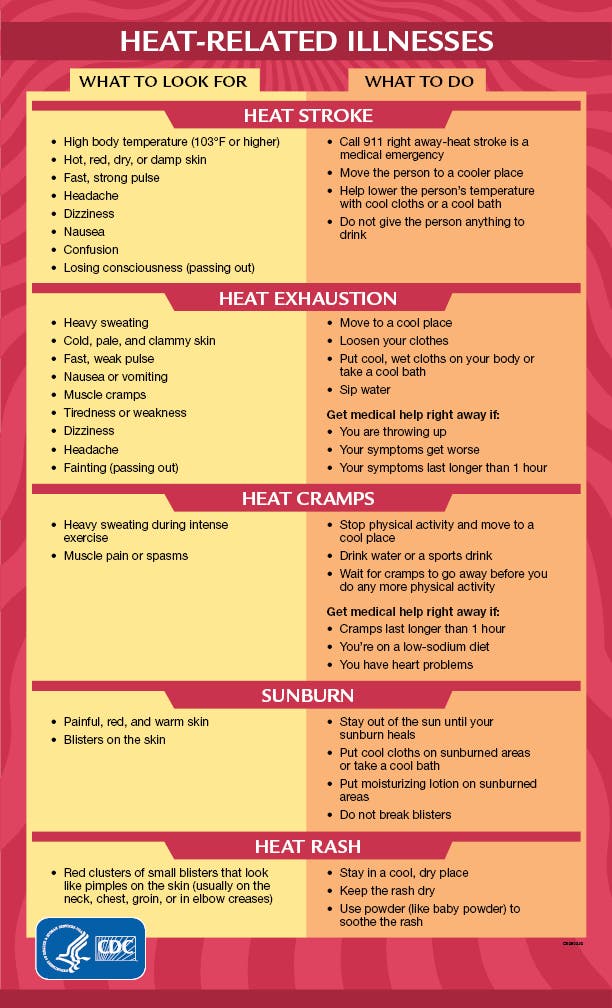
The Centers for Disease Control and Prevention (CDC) offers a more thorough primer on recognizing the signs of heat-related illness in their own graphic:
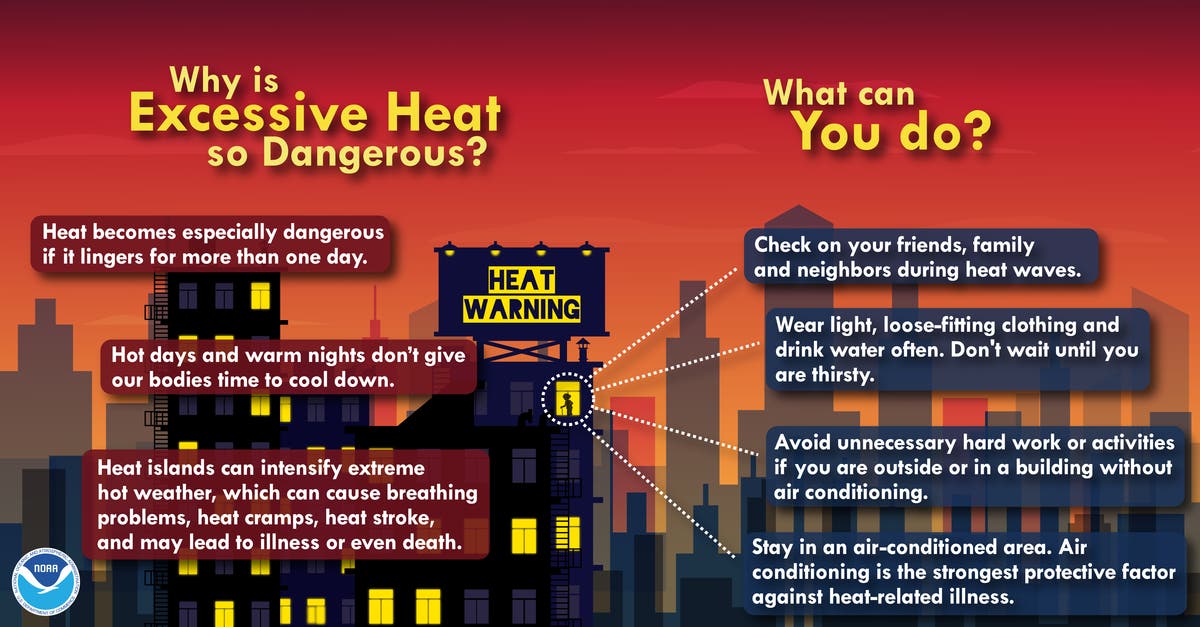
And, finally, here's a primer on why excessive heat poses such a danger, along with tips on avoiding it:
The CDC provides numerous tips on staying cool to avoid succumbing to heat-related illness:
Stay Cool
Wear Appropriate Clothing: Choose lightweight, light-colored, loose-fitting clothing.
Stay Cool Indoors: Stay in an air-conditioned place as much as possible. If your home does not have air conditioning, go to the shopping mall or public library—even a few hours spent in air conditioning can help your body stay cooler when you go back into the heat. Call your local health department to see if there are any heat-relief shelters in your area.
- Keep in mind: Electric fans may provide comfort, but when the temperature is in the high 90s, they will not prevent heat-related illness. Taking a cool shower or bath or moving to an air-conditioned place is a much better way to cool off. Use your stove and oven less to maintain a cooler temperature in your home.
Schedule Outdoor Activities Carefully: Try to limit your outdoor activity to when it's coolest, like morning and evening hours. Rest often in shady areas so that your body has a chance to recover.
Pace Yourself: Cut down on exercise during the heat. If you're not accustomed to working or exercising in a hot environment, start slowly and pick up the pace gradually. If exertion in the heat makes your heart pound and leaves you gasping for breath, STOP all activity. Get into a cool area or into the shade, and rest, especially if you become lightheaded, confused, weak, or faint.
Wear Sunscreen: Sunburn affects your body's ability to cool down and can make you dehydrated. If you must go outdoors, protect yourself from the sun by wearing a wide-brimmed hat, sunglasses, and by putting on sunscreen of SPF 15 or higher 30 minutes prior to going out. Continue to reapply it according to the package directions.
- Tip: Look for sunscreens that say "broad spectrum" or "UVA/UVB protection" on their labels- these products work best.
Do Not Leave Children in Cars: Cars can quickly heat up to dangerous temperatures, even with a window cracked open. While anyone left in a parked car is at risk, children are especially at risk of getting a heat stroke or dying. When traveling with children, remember to do the following:
- Never leave infants, children or pets in a parked car, even if the windows are cracked open.
- To remind yourself that a child is in the car, keep a stuffed animal in the car seat. When the child is buckled in, place the stuffed animal in the front with the driver.
- When leaving your car, check to be sure everyone is out of the car. Do not overlook any children who have fallen asleep in the car.
Avoid Hot and Heavy Meals: They add heat to your body!
Stay Hydrated
Drink Plenty of Fluids: Drink more fluids, regardless of how active you are. Don't wait until you're thirsty to drink.
- Warning: If your doctor limits the amount you drink or has you on water pills, ask how much you should drink while the weather is hot.
- Stay away from very sugary or alcoholic drinks—these actually cause you to lose more body fluid. Also avoid very cold drinks, because they can cause stomach cramps.
Replace Salt and Minerals: Heavy sweating removes salt and minerals from the body that need to be replaced. A sports drink can replace the salt and minerals you lose in sweat.
- If you are on a low-salt diet, have diabetes, high blood pressure, or other chronic conditions, talk with your doctor before drinking a sports beverage or taking salt tablets.
Keep Your Pets Hydrated: Provide plenty of fresh water for your pets, and leave the water in a shady area.
Stay Informed
Check for Updates: Check your local news for extreme heat alerts and safety tips and to learn about any cooling shelters in your area.
Know the Signs: Learn the signs and symptoms of heat-related illnesses and how to treat them.
Use a Buddy System: When working in the heat, monitor the condition of your co-workers and have someone do the same for you. Heat-induced illness can cause a person to become confused or lose consciousness. If you are 65 years of age or older, have a friend or relative call to check on you twice a day during a heat wave. If you know someone in this age group, check on them at least twice a day.
Monitor Those at High Risk: Although anyone at any time can suffer from heat-related illness, some people are at greater risk than others:
- Infants and young children
- People 65 years of age or older
- People who are overweight
- People who overexert during work or exercise
- People who are physically ill, especially with heart disease or high blood pressure, or who take certain medications, such as for depression, insomnia, or poor circulation
Visit adults at risk at least twice a day and closely watch them for signs of heat exhaustion or heat stroke. Infants and young children, of course, need much more frequent watching.
Get Patch's Daily Newsletters and Real Time Alerts
>>> Image via Centers for Disease Control and Prevention
Get more local news delivered straight to your inbox. Sign up for free Patch newsletters and alerts.